

The oil that is extracted from Canadian dirt is being portrayed as saving America from energy dependence on the unstable Middle East, or an environmental catastrophe in the making — depending on the perspective.
As Barack Obama prepares to take office in two weeks, the debate is no longer academic. The president-elect has promised to move forward with an ambitious program aimed at fighting climate change.
Not all oil is alike when it comes to environmental impact, and many environmentalists single out production from the oil sands as the epitome of “dirty oil.” In a recent study, the RAND Corporation estimated that oil from the oil sands generates about 10 to 30 percent more greenhouse gases than conventional crude.
Canada, in large part because of the production capacity of its oil sands, is now the largest oil supplier to the United States. But environmental groups in both countries are pushing for a slowdown or even a halt to further oil sands development, which is concentrated in northern Alberta.
Operators of oil sands projects and Canadian governments are eager to point to its potential to reduce America’s dependence on oil from politically unstable regions. Canadian oil sands produce about 1.2 million barrels a day, or about 9 percent of the imported oil consumed in the United States.
Production was headed toward 3.5 million barrels a day by 2015 before the economic slowdown; with the vast reserves available, Canadian oil sands have the potential to produce the equivalent of 1.7 trillion barrels of oil.
The oil sands companies, however, have been scaling back as falling oil prices and the general market turmoil create a significant economic challenge for the projects. The entire process adds up to the world’s most capital-intensive method for extracting oil. A tiny example: each of the tires on the cartoonishly oversize dump trucks used in oil sands mining costs about $60,000.
While no one is about to park their giant dump trucks, several companies have recently announced delays in future oil sands investments. In November, a consortium led by Petro-Canada said it would temporarily stop 23.8 billion Canadian dollars ($19.5 billion) worth of expansions to its oil sands operations in Alberta.
“We’re not in megaproject mode anymore,” Steve W. Laut, the president and chief executive of Canadian Natural Resources Ltd. , said to analysts after cutting his company’s capital spending plans in half.
And as Washington prepares to deal with climate change, environmentalists, who generally prefer to use the deposits’ traditional name of tar sands, are already pressing for restrictions on the projects.
“It’s one of the most destructive projects on earth,” said Susan Casey-Lefkowitz, a senior attorney with the Natural Resources Defense Council in Washington. “It would be strongly resisted in the United States to exempt the tar sands from any climate agreement.”
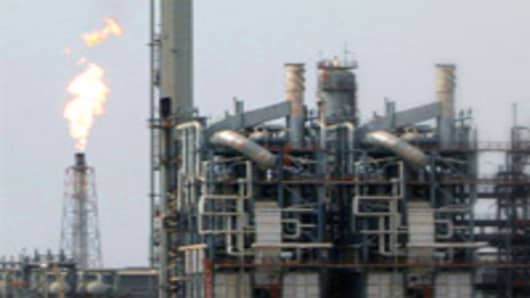
Transforming the tar, more properly known as bitumen, which is mixed with sand, into petroleum is energy intensive and creates significant carbon emissions. Steam created by burning natural gas separates the semisolid bitumen. Then, more natural gas is needed to turn the bitumen into synthetic crude, which can be processed by refineries.
The development of oil sands projects has created North America’s greatest boomtown in recent years, Fort McMurray, Alberta. Its outsize economic importance has prompted Canada’s Conservative government, led by Prime Minister Stephen Harper, to champion the industry.
After the November election in the United States, Mr. Harper said he would seek to devise a continental climate change pact with the Obama administration. Mr. Harper suggested that any such agreement would include an apparent escape hatch for the oil sands because, he argued, of the energy security benefits they offer the United States.
Since then, however, Mr. Harper avoided an early defeat of his government, which does not control a majority of seats in the House of Commons, by shutting Parliament. Even if the Obama administration is willing to hold talks with Canada, Mr. Harper’s grip on power is now uncertain.
Recent environmental assessments, including the RAND study, also do not further the cause of the oil sands industry. While climate change is the current focus, it is not the only environmental issue surrounding the projects.
A warning from the Ambassador
Spent water used in oil sands projects is placed in lake-size tailings ponds, one of which killed about 500 migrating birds in April. Seepage from the ponds is polluting rivers in northern Canada, some scientists argue. In December, Environmental Defence, an environmental lobby group based in Toronto, estimated that about four billion liters of contaminated water leaked from the ponds each year. (The Alberta government and the oil industry dispute that finding.)
Strip mining of the oil sands, the most common method of extraction, has destroyed large swaths of boreal forest, an important habitat for migratory birds and other wildlife. In December, a study published by the Natural Resources Defense Council and two other groups found that six million to 166 million birds could be lost over the next 30 to 50 years because of that disruption.
Producers say they are making efforts to address environmental concerns. Mr. Laut’s company, which recently completed a 110,000-barrel-a-day oil sands project, is developing systems to capture and store much of the carbon dioxide it emits. It has applied for government grants to test a system that will trap some of its carbon dioxide output by bubbling the exhaust gases from an upgrading plant through the spent water from a strip mine’s steam.
Large-scale programs to capture and store carbon dioxide are not yet in place. The demonstration project of Canadian Natural Resources, for example, is not scheduled to begin until 2010.
With oil prices around $49 a barrel, profitability is fast eroding at oil sands projects and may already be vanishing at some operations. Producers have widely differing cost structures and varying definitions of profitability. But Andrew J. Leach, a professor of environmental economics at the University of Alberta in Edmonton, estimates that long-established plants can operate with prices as low as $30 a barrel. But he said newer operations need $60 to $70 a barrel for acceptable returns, and no one will proceed with proposed projects until prices return to the $80 to $90 range.
Exactly how Canada could participate in the shaping of an American strategy for climate change is unclear.
Mr. Harper, who is from Alberta, initially dismissed concerns about climate change. After taking power in 2006, he abandoned commitments to reduce greenhouse gas emissions made by the previous Liberal government when it signed the Kyoto Protocol of the United Nations Framework Convention on Climate Change.
Instead, Mr. Harper’s government has promised a 20 percent reduction in Canada’s greenhouse gas emissions by 2020. What is more significant, however, is that the proposal wants to use as a baseline 2006 — a year with more pollution — rather than the Kyoto standard of 1990.
In addition, the new plan requires companies, including oil sands operators, only to reduce the rate at which they emit greenhouse gases. If they achieve those efficiencies, they will still be allowed to raise their total emissions through increased production.
Even if Canadian producers dislike American climate change policies, they will be hard-pressed to sell their oil elsewhere. Canada’s pipeline network takes oil sands production south and offers no routes to ports for export to other countries.
But some people are optimistic about the prospect of a two-nation climate pact.
“It would be a big mistake for Congress to impose restrictions on the oil sands,” said Paul Cellucci, a former governor of Massachusetts and former United States ambassador to Canada who now works on energy issues for the law firm McCarter & English, in Boston. “That would not be good for the United States.”