- Bear, Lehman Execs Weren't Wiped Out by Crisis: Study
- Existing-Home Sales Jump to 2-1/2 Year High
- Even Buffett's Huge Fame Can't Help the Name 'Warren'
- Wave of Debt Payments Facing US Government
- US Job Losses to Bottom out Next Quarter: NABE
- Obama Jobs Forum May Be More Political Than Practical
- Maria Blog: Are Crazy Retail Deals Good for Business?
- Suze Orman’s 'A Healthier, Wealthier You'
- Latest Holiday Drinks: The Madoff...and the TARPatini
- Buffett's Wealth and Fame Hasn't Helped 'Warren' As a Name
- Are Crazy Retail Deals Good for Business?
- Expect a 'Square Root-Shaped' Recovery: Chief Investor
- Madoff—The Holiday Drink
- HP to Feed on Enterprise Spending Next Year: Tech Analyst
- Busch: Markets Smell a Country Rat
- Schork Oil Outlook: Mission Impossible For The Bears?
- S&P Stocks Trading at New 52-Week Highs
- Losey: Asset Allocation At Retirement
MOST SHARED
- The 'Real' Jobless Rate: 17.5% Of Workers Are Unemployed
- Existing-Home Sales Jump To Highest Level in 2-1/2 Years
- Wave of Debt Payments Facing US Government
- Start-Up Proves Everything Really Is Better With Bacon
- TV Retailer QVC Joins `Black Friday' Frenzy
- S&P Stocks Trading at New 52-Week Highs
- China Asks Its Banks to Slow Down
- Paul: Audit the Fed
The Federal Reserve, which has encouraged excessive borrowing, is to blame for the credit crunch that has gripped world markets for more than a year, Marc Faber, the author of the Gloom Boom & Doom Report, told CNBC on Tuesday.
"About 15 percent of U.S. households have negative equity. Who supplied the leverage into the system? It's called the Federal Reserve Board," Faber said.
"If I'm the drug dealer I'm not responsible that everybody takes drugs, but I facilitate it, especially if I give it out free of charge, I can enlarge the market share, and that's what the Fed has done."
Liquidity will dry up even more, volatility will stay high and financial assets are going to suffer as the crisis continues to unfold. The bailout plan is unlikely to work and the global economy will take the hit, he predicted.
"People rely on the people in Congress, at the Fed, at the Treasury, people that brought us into this trouble, to take us out of trouble. I don't think they will succeed," Faber said. "We can have recovery rallies but a new high on the S&P is practically out of the question for a very long time. In real terms, equities are still very high and economically, I think the world will go into a slump."
The main provider of global liquidity was the U.S. current account deficit, which increased at a fast pace over the past 10 years, but this will no longer be the case.
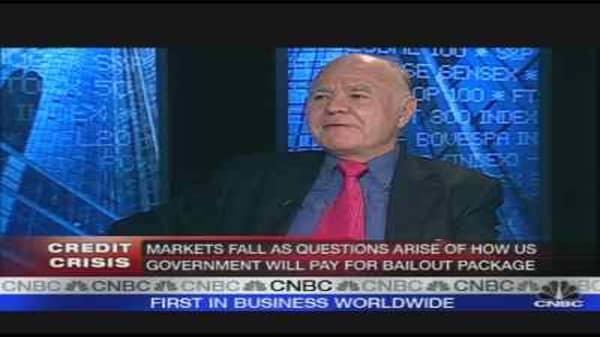
"Next year, if the economy in the U.S. is as weak as I think it would be, the trade and the current account deficit will continue to contract," Faber said. "When global liquidity contracts, it's not a good time for financial assets."
Other sources of funding, such as foreign reserves of resources-rich countries, are also likely to dry up, Faber said. "I think sovereign wealth funds are going to be very busy supporting their own markets, they won't have much money to buy assets around the world."
(Watch Marc Faber's full interview on CNBC above.)
Short-Selling Ban "Stupid"
Volatility comes from the fact that, as the private sector tightens lending conditions to adjust its risk management, central banks are injecting liquidity in the money markets to grease the system, he said, adding that banning short-selling will not contribute to reducing volatility and was a "stupid measure."
"Short sellers are not responsible for current problems. The current problems are caused by the US Fed (Federal Reserve), that was sitting there and letting credit growth go out of bounds," Faber said.
"We have to see very clearly that the cause of the problem was excess leverage. The biggest hedge funds were Fannie Mae [FNM
Loading...
()
] and Freddie Mac [FRE
Loading...
()
], they had the leverage of one over 150 and under the eyes of Congress, under the eyes of the SEC and everybody… and nobody did anything about it. Then, people go and bitch about the short sellers," he added.
The fact that the rules on short-selling are changing nearly daily, with new names added to the list of securities in which short-selling is banned or with specific rules regarding hedging and confidentiality contributes to adding uncertainty, he said.
The problem is also exacerbated by the fact that nobody knows how long the emergency measure will last or what is next.
"The next emergency measure will be that Americans are not allowed to buy foreign currency and transfer money overseas, and the next measure will be not permitting Americans to buy gold and so on and so forth…. It creates even more uncertainty in the market place when you continually change the rules," Faber said.
- The show attracts a big TV audience every year, but this year it may take on even more importance.
- …you'll want to be prepared. Tips for getting the most out of the post-Thanksgiving shopping frenzy.
- Congressman Ron Paul explains to Squawk Box why he’s pushing legislation to audit the Federal Reserve.
- CNBC’s Phil LeBeau took a test drive of GM’s flagship electric car. Here’s what he thought of the Volt.
- A Macau casino will open Asia's first Michael Jackson shrine after its owners made a key purchase at a US auction.
- CNBC’s technology reporter Jim Goldman guides you through the best gadgets to buy this holiday season.


