Skip navigation
Stocks Video Gallery
Bob Doll, of BlackRock, discusses the likelihood that the Dow will hit 15,000 in 2012.
US stock index futures signaled a higher open for Wall Street on Monday, after Greek lawmakers voted a bill bringing mor...
U.S. futures point to a higher open after the Greek parliament secured a majority to pass the proposed austerity bill; t...
US futures point to a higher open for Wall Street. Banking shares led European stocks higher early on Monday after the G...
Jürg Kiener, MD & CIO at Swiss Asia Capital (Singapore), discusses why Greece should be a minor concern for investors.


Current DateTime: 05:15:01 13 Feb 2012
LinksList Documentid: 33482595

Current DateTime: 05:14:58 13 Feb 2012
LinksList Documentid: 23279666
Expiration DateTime: 2/13/2012 5:15:26 AM

Current DateTime: 05:15:01 13 Feb 2012
LinksList Documentid: 31255208
Expiration DateTime: 2/13/2012 5:18:08 AM

Current DateTime: 05:15:01 13 Feb 2012
LinksList Documentid: 23452764
Expiration DateTime: 2/13/2012 5:18:24 AM

Current DateTime: 05:15:02 13 Feb 2012
LinksList Documentid: 24355697
  • The World's Best Beers

      Craft brewers account for only about five percent of the US market, but that may be changing.

  • Fashion Stocks Traders Love

      Over the past couple of months, the “Fast Money” traders weighed in on companies that stood out.

  • Best in Show

      Who is the top dog at the Westminster Kennel Club Dog Show

MOST SHARED


Current DateTime: 05:15:01 13 Feb 2012
LinksList Documentid: 31330905
Expiration DateTime: 2/13/2012 5:18:45 AM

MOST POPULAR


Current DateTime: 05:15:02 13 Feb 2012
LinksList Documentid: 35819650
    • Road Warriors

        All the gadgets and gear a savvy frequent traveler needs to navigate the global economy.

HOT ON FACEBOOK

Three Reasons Why Stocks Have Become So Volatile

By: Jeff Cox, CNBC.com | 30 Oct 2008 | 04:16 PM ET
Text Size

Bear markets are noted for their volatility—but more than 300 points in six minutes?

It's not as crazy as it sounds. Some analysts see several important factors contributing to the type of moves that the market witnessed at the close of trading on Wednesday, when the Dow Jones Industrials plummeted from a 250-point gain to a 72-point loss before most people had even realized what happened.

Kathy Willens / AP
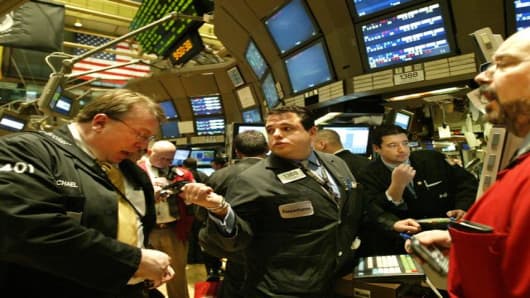
Traders at SIG Specialists trading post on the floor of the New York Stock Exchange talk among themselves shortly after the opening bell Monday, April 18, 2005, in New York. Stocks regained some stability Monday following a three-day selloff as strong first-quarter earnings and a pair of merger announcements lent some support to a market battered by worries about economic growth. (AP Photo/Kathy Willens)

"It's actually not extraordinary," says Jordan Kimmel, a hedge fund and mutual fund manager at Magnet Investment Group in Randolph, N.J. "This is exactly how bear markets end, so it's not that uncommon at the very end of a bear market that has been this severe to see this kind of emotional trading."

Stocks had another volatile day on Thursday, when the Dow shot up roughly 150 points in the final 15 minutes to close up nearly 200.

The late-day market swing on Wednesday was attributed largely to an out-of-context statement from General Electric [GE  Loading...      ()   ] chairman Jeff Immelt that some took as an earnings warning from the company, a Dow component and parent of CNBC.

But to market veterans, such a wicked swing in sentiment is merely the symptom of the type of volatility that plagues bear markets. That's because when volume is light—as it typically is in bear markets—the actions of a relatively small number of investors can have a profound impact on stock prices.

So what should investors do in this kind of market? Investment pros have identified three broad factors behind this kind of whipsaw trading—and how you can profit from it.

Speed of Information

Though there are common elements in this bear market with previous downturns, market analysts do see differences.

For one thing, no other bear market has ever had such swift dissemination of information through electronic media, nor the ease of trading that sometimes bedevils this one. That has compounded the volatility.

"It has been exacerbated compared with other bear markets," says Quincy Krosby, chief investment strategist at The Hartford. "With programmed trading everything is very quick, instantaneous. It's been exacerbated by technology, the movement of global information and rumors."

For Investors

That came into play sharply following the Immelt rumor.

"What that rumor did—whether it was true or false—the fact that this is a trader's market you're going to extrapolate from that rumor," Krosby says. "That's what happens. They act very quickly, and what happens is you've got to take all this information, all these various headlines, all these disparate headlines, disparate rumors, and you have to distill them in a second and extrapolate from them, and that's what I think happened yesterday."

That rapid pace of information only serves to feed the anxiety that has been prevalent through the market since the credit crisis hit.

"I don't think it's normal, but nothing that has happened over the last several months has really been normal," says Richard Sparks, senior analyst at Schaeffer's Investment Research in Cincinnati. "We're in a market that we've never experienced before. It seems to me to point to how much fear there is in this market."

Traders Play the Swings

The types of market movements that have led to the Dow swinging as much as 1,000 points in a single day essentially involve taking the old strategy of "buy the dips, sell the rallies" and putting it on steroids.

Asked whether bear market rallies can be even this violent, Krosby says, "not even, especially this violent."

"That has been the hallmark of these rallies—sell into strength," she says. "I have to say the volatility we're seeing, the swings are emblematic of a bear market."

As the trend gains steam and the market gets closer to finding a bottom, such swings tend to be larger in terms of points and percentages, and can happen later in the day, especially if the market is at an extremely high or extremely low level.

That's been evidenced throughout the month, as the chart below illustrates.

  Biggest Half-Hour Dow Point Swings for October
FromUntilAverage Spread
9:3010277.04
1010:30151.21
10:3011139.34
11:3012112.25
1212:30101.12
12:301111.19
11:30100.98
1:302109.43
22:30125.26
2:303139.62
33:30139.99
3:304258.36

"You have to be very aggressive in going long at the bottom of ranges and selling when you get to the top of a range," Sparks says.

And the trend gets even more heated with the plethora of funds in the market that are being forced into selling their positions because of the need to raise cash in the volatile market.

Tools:
Add This share icon


Current DateTime: 02:20:35 13 Feb 2012
LinksList Documentid: 29778428

Current DateTime: 02:15:13 12 Feb 2012
LinksList Documentid: 29779196

Current DateTime: 03:55:35 13 Feb 2012
LinksList Documentid: 29779197

Current DateTime: 11:00:49 12 Feb 2012
LinksList Documentid: 29779199
CNBCCNBC
About CNBC  |  Site Map  |  Video Reprints   |  Advertise  |  Help  |  Contact
Privacy Policy  |     |  Terms of Service  |  Independent Programming Report
  Data is a real-time snapshot  *Data is delayed at least 15 minutes
Global Business and Financial News, Stock Quotes, and Market Data and Analysis

© 2012 CNBC LLC.  All Rights Reserved.
A Division of NBCUniversal
Thomson ReutersThomson Reuters