

The unexpectedly deep plunge in home sales this summer is likely to force the Obama administration to choose between future homeowners and current ones, a predicament officials had been eager to avoid.

Fuse | Getty Images
Foreclosure
Over the last 18 months, the administration has rolled out just about every program it could think of to prop up the ailing housing market, using tax credits, mortgage modification programs, low interest rates, government-backed loans and other assistance intended to keep values up and delinquent borrowers out of foreclosure. The goal was to stabilize the market until a resurgent economy created new households that demanded places to live.
As the economy again sputters and potential buyers flee — July housing sales sank 26 percent from July 2009 — there is a growing sense of exhaustion with government intervention. Some economists and analysts are now urging a dose of shock therapy that would greatly shift the benefits to future homeowners: Let the housing market crash.
When prices are lower, these experts argue, buyers will pour in, creating the elusive stability the government has spent billions upon billions trying to achieve.
“Housing needs to go back to reasonable levels,” said Anthony B. Sanders, a professor of real estate finance at George Mason University. “If we keep trying to stimulate the market, that’s the definition of insanity.”
The further the market descends, however, the more miserable one group — important both politically and economically — will be: the tens of millions of homeowners who have already seen their home values drop an average of 30 percent.
The poorer these owners feel, the less likely they will indulge in the sort of consumer spending the economy needs to recover. If they see an identical house down the street going for half what they owe, the temptation to default might be irresistible. That could make the market’s current malaise seem minor.
Caught in the middle is an administration that gambled on a recovery that is not happening.
“The administration made a bet that a rising economy would solve the housing problem and now they are out of chips,” said Howard Glaser, a former Clinton administration housing official with close ties to policy makers in the administration. “They are deeply worried and don’t really know what to do.”
That was clear last week, when the secretary of housing and urban development, Shaun Donovan, appeared to side with current homeowners, telling CNN the administration would “go everywhere we can” to make sure the slumping market recovers.
Mr. Donovan even opened the door to another housing tax credit like the one that expired last spring, which paid first-time buyers as much as $8,000 and buyers who were moving up $6,500. The cost to taxpayers was in the neighborhood of $30 billion, much of which went to people who would have bought anyway.
Administration press officers quickly backpedaled from Mr. Donovan’s comment, saying a revived credit was either highly unlikely or flat-out impossible. Mr. Donovan declined to be interviewed for this article. In a statement, a White House spokeswoman responded to questions about possible new stimulus measures by pointing to those already in the works.
“In the weeks ahead, we will focus on successfully getting off the ground programs we have recently announced,” the spokeswoman, Amy Brundage, said.
Among those initiatives are $3 billion to keep the unemployed from losing their homes and a refinancing program that will try to cut the mortgage balances of owners who owe more than their property is worth. A previous program with similar goals had limited success.
A Glimpse of the Abyss
If last year’s tax credit was supposed to be a bridge over a rough patch, it ended with a glimpse of the abyss. The average home now takes more than a year to sell. Add in the homes that are foreclosed but not yet for sale and the total is greater still.
Builders are in even worse shape. Sales of new homes are lower than in the depths of the recession of the early 1980s, when mortgage rates were double what they are now, unemployment was pervasive and the gloom was at least as thick.
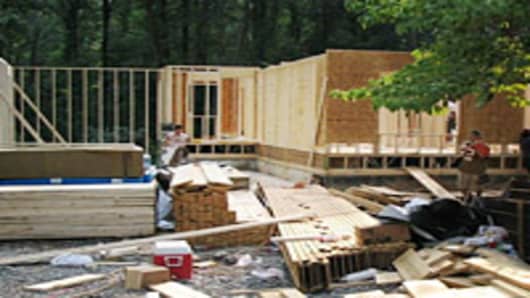
Lee Coursey
Home Construction
The deteriorating circumstances have given a new voice to the “do nothing” chorus, whose members think the era of trying to buy stability while hoping the market will catch fire — called “extend and pretend” or “delay and pray” — has run its course.
“We have had enough artificial support and need to let the free market do its thing,” said the housing analyst Ivy Zelman.
Michael L. Moskowitz, president of Equity Now, a direct mortgage lender that operates in New York and seven other states, also advocates letting the market fall. “Prices are still artificially high,” he said. “The government is discriminating against the renters who are able to buy at $200,000 but can’t at $250,000.”
A small decline in home prices might not make too much of a difference to a slack economy. But an unchecked drop of 10 percent or more might prove entirely discouraging to the millions of owners just hanging on, especially those who bought in the last few years under the impression that a turnaround had already begun.
The government is on the hook for many of these mortgages, another reason policy makers have been aggressively seeking stability. What helped support the market last year could now cause it to crumble.
Since 2006, the Federal Housing Administration has insured millions of low down payment loans. During the first two years, officials concede, the credit quality of the borrowers was too low.
With little at stake and a queasy economy, buyers bailed: nearly 12 percent were delinquent after a year. Last fall, F.H.A. cash reserves fell below the Congressionally mandated minimum, and the agency had to shore up its finances.
Government-backed loans in 2009 went to buyers with higher credit scores. Yet the percentage of first-year defaults was still 5 percent, according to data from the research firm CoreLogic.
“These are at-risk buyers,” said Sam Khater, a CoreLogic economist. “They have very little equity, and that’s the largest predictor of default.”
This is the risk policy makers face. “If home prices begin to fall again with any serious velocity, borrowers may stay away in such numbers that the market never recovers,” said Mr. Glaser, a consultant whose clients include the National Association of Realtors.
Those sorts of worries have a few people from the world of finance suggesting that the administration should do much more, not less.
William H. Gross, managing director at Pimco, a giant manager of bond funds, has proposed the government refinance at lower rates millions of mortgages it owns or insures. Such a bold action, Mr. Gross said in a recent speech, would “provide a crucial stimulus of $50 to $60 billion in consumption,” as well as increase housing prices.
The idea has gained little traction. Instead, there is a sense that, even with much more modest notions, government intervention is not the answer. The National Association of Realtors, the driving force behind the credit last year, is not calling for a new round of stimulus.
Some members of the National Association of Home Builders say a new credit of $25,000 would raise demand but their chances of getting this through Congress are nonexistent.
“Our members are saying that if we can’t get a very large tax credit — one that really brings people off the bench — why use our political capital at all?” said David Crowe, the chief economist for the home builders.
That might give the Obama administration permission to take the risk of doing nothing.