Go Symbol Lookup
Loading...

Younger Generations Lag Parents in Wealth-Building

 Text Size  
Published: Friday, 15 Mar 2013 | 12:34 PM ET
Steve Cole Images | Vetta | Getty Images

Pearl Brady has a stable job with good benefits and holds two degrees, a bachelor's and a master's. But despite her best efforts, she has no savings, and worries that it will be years before she manages to start putting away money for a house, children and eventually retirement.

"I'm in that extremely nervous category," said Ms. Brady, 28, a Brooklynite who works for a union. "I know how much money I'm going to be making for the near term. I hope in my 30s and 40s to be able to save, but I have no idea how. It's scary."

Ms. Brady has plenty of company. A new study from the Urban Institute finds that Ms. Brady and her peers up to roughly age 40 have accrued less wealth than their parents did at the same age, even as the average wealth of Americans has doubled over the last quarter-century.
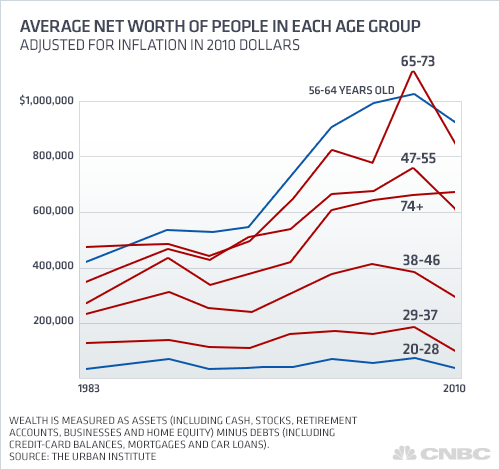
Because wealth compounds over long periods of time—a dollar saved 10 years ago is worth much more than a dollar saved today—young adults probably face less secure futures for decades down the road, and even shakier retirements.

"In this country, the expectation is that every generation does better than the previous generation," said Signe-Mary McKernan, an author of the study. "This is no longer the case. This generation might have less." The authors said the situation facing young Americans might be unprecedented.

A broad range of economic factors has conspired to suppress wealth-building for younger American workers; the trend predates the Great Recession. Younger Americans are facing stagnant pay—the median income, when adjusted for inflation, has declined since its 1999 peak—as well as a housing collapse and soaring student loan debt.

In interviews, a half-dozen young adults—men and women, with families and single, in a broad range of industries—described economic conditions that left them just barely keeping their heads above water.

Ms. Brady, for instance, earns about $1,800 a month in take-home pay. But she paid for her undergraduate and graduate education in part with loans, which cost her about $400 a month. She also is trying to pay down her credit card debt, which requires about $500 a month. After food, rent and living expenses, there is little left over.

Looking forward, she said, it seemed hard to imagine building a nest egg. "Realistically, my income will go up, but not at a rate that's going to match my expenses," Ms. Brady said. "I feel like every step forward I take, it's three steps back."

(Read More From NYT: New Jobless Claims at a 5-Year Low)

Chuck Ross, 31, has a master's in economics and at one point built up a $12,000 nest egg from investing. But he lives in Wichita, Kan., where jobs in his field are few. He works at a large chain restaurant and is struggling with $40,000 in student loans. "My dad works for himself," he said. "He's always joking about how he'll work until he dies. We laugh, but for me, that's becoming more and more of a thought."

Others said they had put their money into a home only to fall into foreclosure, or were struggling to pay for child care.

Strong and sustained job and wage growth would cure many of the ills facing younger workers, experts said. But their delayed or diminished wealth accumulation might still have a lasting impact on their finances.

"It's a little bit of a tipping-point moment," said Ms. McKernan of the Urban Institute, a nonprofit Washington research institution. "If we don't address it today, they might never catch up." For instance, the researchers said, if a person delayed the purchase of a home to age 40 instead of buying at age 30, that might result in a $42,000 loss in home equity by the time she reaches 60, given trends in wealth accumulation over the past few decades.

(Read More From NYT: Hidden Costs of the Minimum Wage)

The Urban Institute study is one of many to show something of a perfect storm of economic trends battering younger workers. One is the collapse of the housing bubble. Young people who bought homes as prices started to decline in 2006 are often underwater on their mortgages today. But now that prices have fallen sharply and interest rates are remarkably low, many other young adults are locked out of the market because credit standards are tougher.

A second major trend is the rise of student loan debt, which has continued to grow through the recession, sometimes saddling students with burdens that extend into six figures and might take decades to pay down. A study of Federal Reserve data by the Pew Research Center found that 40 percent of relatively young households had outstanding student debt as of 2010, up from 34 percent in 2007. The median balance among all households with student loan debt was more than $13,000.

"I just don't think about it," said Mr. Ross, of his student loans. "I push the thoughts out of my mind, and when I do think about it now and then I kind of just think that maybe I'll have to work indefinitely. And I hope I can find a career that will allow my body to do that."

(Read More From NYT: Wealth, Spending and the Economy)

 Print
Young adults face stagnant pay—the median income, when adjusted for inflation, has declined since its 1999 peak—as well as a housing collapse and soaring student loan debt.

   
Comments


More Comments


Add Comments


Your Comments (Up to 1100 characters):

Remaining characters

Your comments have not been posted yet.

Please review your submission to make sure you are comfortable with your entry.

Your Comments:


Featured

Fast Adviser

The Suze Orman Show