

Foreign trade inequality emerged early on as a hot-button issue among the nine Republican presidential hopefuls squaring off on Tuesday.
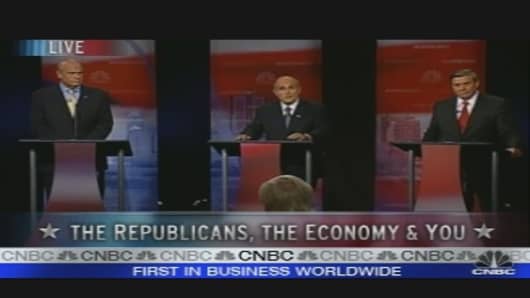
U.S. Congressman Duncan Hunter addressed the trade imbalance issue and said he would pass a bill that would bring overseas manufacturing jobs back to the United States.
"What is missing from this economy is 1.4 million jobs that have moved to China," said Hunter.
Congressman Ron Paul of Texas said America must start living within its means if it wants a healthier trade position.
"Right now we owe foreigners $2.7 trillion," said Paul. "No wonder they have money to come back here and buy stuff up and then we object."
"We can't maintain a reserve currency where our greatest export today are paper dollars," he added.
The debate -- sponsored by CNBC, MSNBC and The Wall Street Journal -- was marked by hearty but generally cordial disagreement on such issues as recession, taxes and the health of the middle class.

Meanwhile, former Sen. Fred Thompson said there's no reason to think the economy is headed for a recession but warned about profligate spending threatening future growth.
"I think there are pockets of the economy that are having difficulty," said Thompson, responding to word that polls show Americans are worried about the economy. "But you always find them in a dynamic, vibrant economy."
Tuesday's debate -- occurring at a time when there's growing concern that the six-year old U.S. economic expansion is on its last legs -- is the first Republican presidential debate of the 2008 campaign to focus solely on economic issues.
Rudolph Giuliani, former mayor of of New York, said the president needs to work off of economic fundamentals -- keep taxes low, moderate regulatory policy and reign in spending.
"The market is a wonderful thing, a free market is one of our greatest assets," he said.
"Wealth creates wealth, " said Sen. John McCain, adding that the problem is the U.S. is losing industrial jobs and government spending is out of control. McCain singled out pork-barrel spending and S-CHIP, the federal-state program to provide health care to low-income children.
With nine candidates and a wealth of subjects, the debate moved faster than most. Here are some highlights of where candidates stand on the issues.
Tax Reform
Senator McCain said the U.S. should reform the tax code, calling it "completely broken" and indecipherable by most Americans.
"Should we reform our tax code, which is completely broken, which no one understands, no living American understands?" asked McCain. "Absolutely, we should fix our tax code and we should fix it immediately. And we should have Congress either vote up or down on a freer, fairer, simpler tax code, I believe that Americans deserve that."
Sen. Thompson pointed out that America has the second highest corporate tax rate in the world.
Sen. Sam Brownback of Kansas said "clearly the last thing we need to do in this country is to raise taxes. We're taxed to the max."
Rep. Tom Tancredo and Brownback both pledged not to raise taxes. "The thing that pushes spending at the federal level is mandatory spending," he said, singling our Social Security and Medicare. "If you want to control federal spending you must look at Social Security and Medicare. And it’s a dicey game."
Giuliani and Mitt Romney, former governor of Massachusetts, engaged in a heated debate on taxes and spending.
Giuliani, who leads Republicans in national polls, said he cut taxes 17 percent when he was mayor of New York, while Romney let them rise by 11 percent in Massachusetts.
Romney responded by saying "It's baloney. Mayor, you've got to check your facts. I did not increase taxes in Massachusetts. I lowered taxes."
Energy Independence
In response to how America will become less dependent on foreign oil and consumption, Giuliani said we need to utilize alternative forms of energy.
"(The United States) must use options including nuclear, hydroelectric power, solar power, wind power, and we must support it in positive way and treat this as putting man on the moon, it's a question of national security."
Giuliani added that rising geopolitical tension with Iran and other countries would be less of an issue if America was more energy efficient.
Gov. Huckabee said it was in the nation's best interest to not only become energy independent, but to get it done within a decade.
"If we don't say we will do this within a decade we will never get there. We need to approach it the same way that a car does at the NASCAR pit stop," Huckabee said. "But instead of running it like NASCAR, we have been running at like a station wagon and letting goober take care of it under a shade tree."
"We have to come to a place where everything is on the table: nuclear, biofuels, wind, solar; anything they think this country can produce," said Huckabee.
Social Security
A number of candidates said mandates on Social Security and Medicare were to blame for spiraling government spending.
"We're going to have to fix Social Security," said Sen. McCain. "The problem is that the American people no longer have faith that we're going to fix the issues they face. We have to fix these programs, but first we have to go to the American people with clean hands."
"We're spending the money of future generations, and those yet to be born," said Thompson. "Everyone knows that we have to address that, and it's the fundamental and foremost challenge, I think, facing our country economically."