

Asian stocks took another massive leg downwards Tuesday as growing fears of a U.S. recession renewed pressures on share prices. Hong Kong’s Hang Seng finished the session 8.7 percent lower, while Australia’s major index lost 7.1 percent.
AP
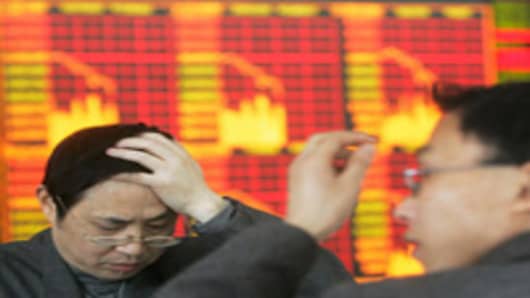
Stock investors watch stock movement at a stock exchange in Chengdu, China.
Analysts are nervously awaiting Wall Street's reaction later Tuesday. U.S. markets were closed for a holiday on Monday, but index futures down around 4.5 percent, signaling a sharp selloff on Wall Street is likely. This may usher in a bear market when trading resumes later in the session.
A common definition of a bear market is a fall of around 20 percent over a recent period or from a recent peak, characterised by a pessimistic outlook.
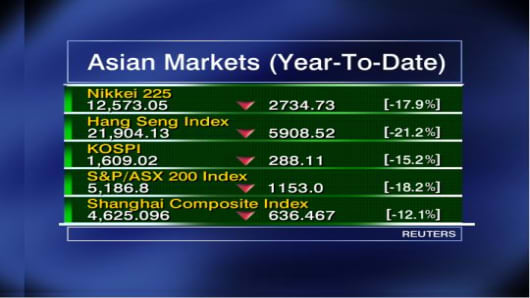
As of 2:00 pm, Hong Kong/Singapore time, regional markets were posting double-digit losses year-to-date, with Hong Kong's Hang Seng Index down over 21 percent followed by Australia and Japan.
In Tokyo, the Nikkei 225 Average plunged 5.65 percent to a 28-month closing low, its
biggest one-day loss since the session after the Sept. 11 attacks on the United States in 2001, as growing fears about the U.S. economy sent global stocks reeling. The Nikkei has lost more than 1,000 points and 9 percent this week. Investors dumped stocks across the board, battering financials and exporters especially hard. Mizuho Financial Group tumbled more than 8 percent. The yen hit a 2-½ year high against the U.S. dollar, sending big exporters Toyota Motor and Honda Motor down more than 6 percent. Sony and Canon were also beaten down.
South Korea's KOSPI ended down 4.4 percent , the biggest daily fall in six months, to hit an eight-month low as concerns over a slowdown in the global economy hit exporters such as Samsung Electronics.

Australia's S&P/ASX 200 Index lost 7 percent in its biggest-ever one-day percentage drop, to record its 12th straight session of declines. Mining stocks, sensitive to any economic slowdown, led the decline. BHP Billiton fell 4.9 percent and Rio Tinto tumbled 11 percent.
Hong Kong stocks dived as recession fears gripped investors, with China plays fell nearly 12 percent to mark their worst percentage loss in ten years. The Hang Seng Index plummeted, ending the session down 8.7 percent to break below the key 22,000 point level for the first time since August when the subprime debacle roiled financial markets. Global bank HSBC Holdings fell to its lowest since Oct. 2003. China Eastern Airlines also tumbled in resumed trade a day after it snubbed an approach by bigger rival Air China's parent to buy a $2 billion stake.
Singapore's FTSE Straits Times shed 4.8%, touching its level since November 2006, as risk aversion triggered a second day of losses across Asia. Firms with exposure to China were among the worst hit. At noon, Singapore's biggest decliner was real-estate developer Yanlord Land, with shares down 12.2%. The decline came on concerns the firm's residential development business in China may be hurt by a slowdown in the country's real estate sector.
China's Shanghai Composite Index was 7.2 percent lower because of sliding overseas markets and the prospect of big supplies of new shares. Trading in Bank of China's Shanghai-listed local-currency A shares was suspended as the company failed to make comments on an "important event", the Shanghai Stock Exchange said.
The Bombay Stock Exchange fell more than 11 percent in the first few minutes of trade as panic-stricken investors dumped stocks, setting off circuit breakers that automatically halted trade for an hour. Trading was also briefly halted on Monday afternoon when the market had fallen almost 11 percent. The Bombay Sensex Index closed 5 percent down.

