

The economy is continuing to give off mixed signals as the Federal Reserve prepares to meet today and tomorrow on whether to cut interest rates further.
Stronger-than-expected orders for U.S.-made durable goods in December suggested the economy retained some life and might not need a heavy dose of interest-rate cuts, even though house prices fell a record amount in November.
Gary C. Knapp
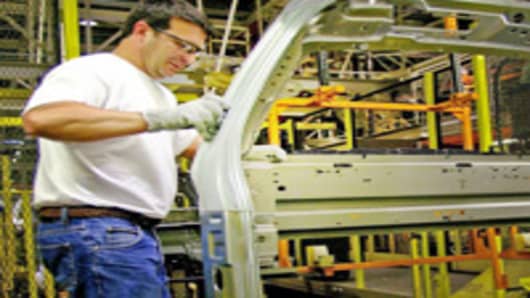
Manufacturing Cars
The Fed, which begins a two-day monetary policy meeting on Tuesday, is expected to lower interest rates on Wednesday in an effort to bolster the economy suffering from a
credit crunch, falling home values and rising prices that threaten to send the economy into recession.
Short-term interest rate futures have put the chances of a half-point cut in rates by the Fed at 70 percent with the chances for a quarter-point rate cut at 30 percent.
The Fed already has cut its benchmark rate 1.75 points points since mid-September to 3.5%.
New orders for long-lasting goods rose 5.2 percent last month, a Commerce Department report showed, well above the 1.5 percent increase forecast by economists in a Reuters poll.
The surprise surge in durable goods orders helped offset a report that showed home prices in 10 major metropolitan areas fell a record 8.4 percent in the year through November.
U.S. Treasuries fell after the durables report, which contradicted weakness in other areas of the economy and undermined the argument for more aggressive interest rate cuts by the Fed. Stocks rose.
A consumer sentiment survey, meanwhile, showed confidence fell in January but by slightly less than economists had expected. The Conference Board's index of consumer sentiment fell to 87.9 from an upwardly revised 90.6 in December.
"Consumers are on the edge but haven't packed it in yet. They are worried about the up-and-down stock market, falling house value and high gasoline prices. But they still have jobs," said Mark Zandi, chief economist at Moody's Economy.com in West Chester, Pennsylvania.
On Friday, the U.S. Labor Department reports January jobs data. Economists forecast 63,000 new jobs will be created and the unemployment rate will remain unchanged at 5.0 percent.
The increase in durable goods orders, products meant to last three or more years, was driven by the largest rise in machinery orders since December 2006. But the report is notoriously volatile.
"We are witnessing the positive impact of the cheap U.S. dollar on the economy, and the reason we only believe the economy will flirt with recession rather than falling into a full-fledged one," said T.J. Marta, fixed income strategist at the RBC Capital Markets in New York.
On the negative side was the sharp drop in home prices reported by Standard & Poor's/Case-Shiller Home Price Index.
Home prices in 10 major metropolitan areas have now declined for 11 consecutive months and show little sign of bottoming, Robert Shiller, a founder of the index and chief economist at MacroMarkets LLC, said in a statement.
"We reached another grim milestone in the housing market in November," Shiller said.
Falling U.S. home prices in the past year have fueled rising delinquencies and foreclosures as homeowners are unable to get out of costly loans.
The housing market's troubles have prompted lawmakers in Washington to rally with bipartisan support for an economic stimulus plan of $150 billion.
With the specter of recession supplanting the Iraq war as the top U.S. concern, President George W. Bush acknowledged in his final State of the Union address on Monday that growth was slowing but insisted the country's long-term economic fundamentals were sound.
"In the long run, Americans can be confident about our economic growth. But in the short run, we can all see that growth is slowing," Bush said in a globally televised speech to the U.S. Congress.
The impetus for compromise is that no one, least of all an unpopular president nearing the end of his watch, wants to be blamed for an economic meltdown before the Nov. 4 elections.