

President Bush forecast the U.S. budget deficit would more than double in 2008 and blamed a weakening economy as he unveiled a $3.1 trillion spending plan for fiscal 2009 Monday that would nearly freeze domestic programs.
Ron Edmonds
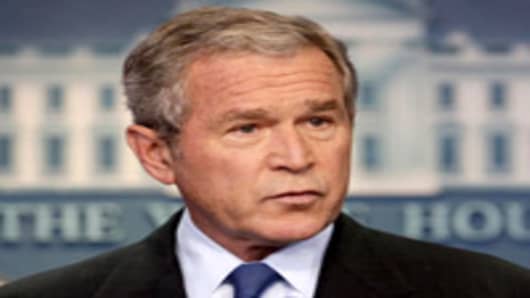
President Bush speaks during a news conference, Thursday, Sept. 20, 2007, in the press briefing room at the White House in Washington. (AP Photo/Ron Edmonds)
The White House projections were immediately criticized by both Democratic and Republican lawmakers who said the numbers may gloss over the full extent of the fiscal deterioration.
With the economy teetering on the brink of a recession, Bush said the deficit would reach $410 billion for the budget year 2008 that ends on Sept. 30 and $407 billion for fiscal 2009 that begins on Oct. 1.
The budget makes military spending and the Iraq war its centerpiece, proposing a 7.5 percent increase for the Pentagon to $515 billion. On top of that Bush also sought $70 billion more for the conflicts in Iraq and Afghanistan.
Bush, after meeting with his Cabinet, said, "The budget protects America and encourages economic growth. Congress needs to pass it."
The grimmer budget situation will be inherited by the next president, who succeeds Bush in January 2009.
While the near-term deficits are a concern, many budget experts are bracing for much more serious fiscal problems in coming years as the baby boom generation's retirement causes spending on health care and other entitlements to explode.
"Far from proposing a plan to fix the budget, the Bush administration proposes policies that worsen it, and with little compunction, leaves the consequences for the next administration and future generations," said House Budget
Committee Chairman John Spratt, a South Carolina Democrat.
Budget as 'Academic Exercise'
While some Republican legislators welcomed the budget, New Hampshire Sen. Judd Gregg, the senior Republican on the Senate Budget Committee, was scathing, saying it lacked credibility.
"This budget must have been viewed by them more as an academic exercise than a serious exercise because it's not a serious budget," Gregg told Reuters in an interview. "There are even more games than usual."
Bush forecast deficits of over $400 billion in the next two years. That would be more than twice the size of the $162 billion gap of 2007 and approach the $413 billion all-time high for the deficit hit in 2004.
The bigger deficits, caused in part by weakening revenues amid a slower economy, would reverse a trend of the past three years in which annual deficits declined.
A promised $150 billion stimulus package of tax rebates meant to jolt the economy away from recession will also add to the deficit, at least in the short term, and funding for the Iraq war is another source of red ink.
"The budget takes into account that we're going to see a slowdown in the economy, a temporary one," White House spokeswoman Dana Perino said. "It takes into account the economic stimulus package we're going to put in place in order to shield against that."
Bush said despite the worsening near-term deficit, it would still be possible to balance the budget by 2012 while making tax cuts he made in 2001 and 2003 permanent.
Fiscal Woes
Lawmakers gave numerous reasons why they thought his budget masked the true fiscal woes.
They noted it only includes a portion of the expected funding for the Iraq and Afghanistan wars in 2009 and the economic forecasts underlying the figures are above those of private-sector economists.
The blueprint also assumes deep cuts in many popular domestic programs such as highway funds and heating assistance for the poor, in addition to wringing out billions in savings from the Medicare program for the elderly and disabled.
While many -- if not most -- of the priorities of the Bush budget will be jettisoned by the Democratic-led U.S. Congress, the unveiling of the document is sure to trigger a new round of sparring over Bush's fiscal policies and his economic legacy.
Democrats have hammered Bush for presiding over a shift to deficits after taking office amid budget surpluses, pointing to a jump in the national debt to $9 trillion from about $5.6 trillion when Bush took office in January 2001.
In addition to freezing scores of programs, Bush proposed cutting others totaling $7.1 billion and reducing still others by some $11 billion.
One area in which Bush did ask for more spending was combating illegal immigration, a popular Republican cause. He sought 17 percent more for customs and immigration enforcement, including for a border fence and more border patrol agents.