

Prodded in part by some of the nation’s biggest banks, the Bush administration and Congress are considering costly new proposals for the government to rescue hundreds of thousands of homeowners whose mortgages are higher than the value of their houses.
AP
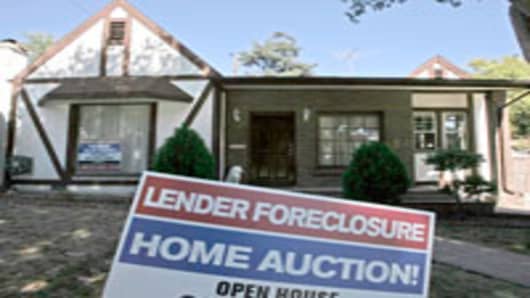
Not since the Depression has a larger share of Americans owed more on their homes than they are worth. With the collapse of the housing boom, nearly 8.8 million homeowners, or 10.3 percent of the total, are underwater. That is more than double the percentage just a year ago, according to a new estimate of the damage by Moody’s Economy.com.
Administration officials say they still oppose any taxpayer bailout for either people who borrowed more than they could afford or banks that made foolish loans during the height of the speculative bubble in housing.
But with the current efforts to arrest the housing collapse so far bearing little fruit, Washington is being forced to explore new ideas, among them the idea of a federal mortgage guarantee for troubled borrowers.
And policy makers are listening to proposals from industry and community groups to use government funds to purchase and refinance billions of dollars in mortgages now in danger of default.
Many owners are only gradually becoming aware that their homes would sell for less than the debt against them — a phenomenon, said Richard T. Curtin, director of the Reuters/University of Michigan Surveys of Consumers, that is “beginning to weigh on people, making them uncertain and nervous about the future.”
That nervousness is evident across the country, particularly in places like Memphis, a city of nearly 1.3 million people where falling home prices and negative equity are new experiences.
The housing slumps of the mid-1970s and late 1980s were confined to the coasts. The current bust, while leaving some cities relatively unscathed, has cut a far wider path and it comes just when home debt is at its highest level since World War II.
For Stuart B. Breakstone, the problem hit home when he was forced to come to the closing on the sale of his eight-year-old custom-built house with a check for $65,000. The money, out of his own pocket, was to pay the difference between what he still owed on the mortgage for his home and the lower selling price.
Mr. Breakstone, a 42-year-old lawyer, and his wife, Lori, chief of customs agents at Memphis International Airport — who together earn more than $250,000 a year — managed to extricate themselves by paying off the mortgage. But millions of others are trapped in their homes. They have jobs, make their mortgage payments on time, but cannot raise enough cash to cover the shortfall.
Some eventually default, surrendering to foreclosure. But the vast majority — embedded in their communities, their children in public schools, their reputations at stake — wait nervously in hope that prices will bottom and rise once again, eliminating their negative equity and restoring their freedom to sell or refinance.
“People can’t believe this is happening to them,” said Robert Moulton, president of the Americana Mortgage Group in Manhasset, N.Y.
Fear and Confusion in D.C.
In Washington, it will be difficult to engineer a bailout similar to the one for savings and loan companies in the early 1990s, because Democrats and Republicans alike cringe at the very word bailout and fear a backlash by people who never became overextended.
But with millions of homeowners already underwater and the prospect that millions more may face the same situation, Democrats and Republicans alike are scrambling for ideas to keep people from simply walking away from their homes and to help those struggling to pay their bills.
Bank of America, which is in the process of acquiring Countrywide Financial and has potentially huge exposure, has circulated a proposal to create a new federal agency that would buy vast quantities of delinquent mortgages at a deep discount and replace them with fixed-rate federally guaranteed loans.
The bank warned that tightening credit conditions were leading to “escalating levels of delinquency and default among borrowers” and “an unprecedented number” of homes that would enter foreclosure.
Administration officials have given the Bank of America plan a cold reception. But the idea is similar to one proposed by Senator Christopher J. Dodd, Democrat of Connecticut and chairman of the Senate Banking Committee.
The Federal Housing Administration, meanwhile, is examining ways to expand its new insurance program, known as FHA Secure, to help people replace their costly subprime mortgages with federally guaranteed fixed-rate mortgages.
Mortgage industry executives have complained that the F.H.A.’s eligibility requirements are so restrictive that the new program has helped only a trickle.
Credit Suisse executives said they have held lengthy meetings with F.H.A. officials and have urged the agency to relax rules that currently disqualify many borrowers.
One idea, company officials said, was to allow borrowers who had simply made six payments during the course of their mortgage to qualify.
Representative Barney Frank, Democrat of Massachusetts and chairman of the House Financial Services Committee, has ordered his staff to come up with options for a broader rescue bill. An aide to Mr. Frank said his bill would, among other things, allow the government to buy up at least some troubled mortgages.
A more modest plan is being developed by John M. Reich, director of the Office of Thrift Supervision, the agency that regulates savings and loan companies. His plan, still in rough form, would create a voluntary system under which mortgage lenders would reduce debt and monthly payments to reflect the diminished sales value of a home.
It would take the remainder of the mortgage as a “negative amortization certificate,” a lien that the investor could recoup if the house were later sold for its original mortgage value or higher.
In an interview, Mr. Reich said he hoped that most of the old mortgages would be replaced by cheaper mortgages insured through the F.H.A.
“It isn’t a bailout,” Mr. Reich said. “It is a market-driven solution.”
Can't Sell, Can't Move Away
For Americans caught in a mortgage trap and owing more on a home than it would sell for, consumer spending and confidence are the most immediate casualties, Mr. Curtin reports. But the damage goes deeper.
People cannot move easily to jobs in other cities if they have to sell their homes at a loss. The $168 billion federal stimulus package is likely to be less effective than intended because many homeowners may simply use their government checks to pay down their debts.
Housing prices in Memphis fell by 2.5 percent last year, only the second decline since records began to be kept in 1968, and by far the largest dip, according to Chandler Reports, which gathers this data for Greater Memphis.
The Memphis metropolitan area highlights the larger national trend, with the average first-mortgage debt, at $153,764, edging above the average home price, $152,815, for the first time. And that does not count refinancing and home equity loans, as well as closing costs.
(For a close-up look at problems in Miami, watch the video below).
Collie Tuttle, in her early 60s, is caught in this bind. Four years ago, she purchased a newly built four-bedroom three-bathroom house in the Memphis outer suburb of Olive Branch, Miss., for $270,000. She put nothing down, relying on her six-figure income from selling furniture to pay down the mortgage, reducing it to $248,000.
But then she lost her job, and in her next one — also selling furniture, but at lower pay — she is being forced to choose between her home and the rest of her life.
“It was a big mistake on my part to buy this house,” she said. Divorced, with two grown sons, she rattles around in it alone. She had thought the house would add to her wealth.
But now, to sell it for the $269,000 a potential buyer was recently willing to pay, “I would have to come up with $6,000 from my pocket,” Ms. Tuttle said, explaining that she cannot afford to invade her meager retirement account. “All I’m asking is for enough so that I come out even.”
Her house payments and utilities come to nearly $2,400 a month. That is affordable, she said, on her present income. But very little is left over to replace her 11-year-old car, to travel, to pay down her credit card debt, or even to buy new clothes.
“I’m stuck,” she said. “I’ve tried everything and I can’t get rid of this house.”
The reluctance to sell at a loss helps to explain why the number of homes listed for sale in the Memphis area has climbed to more than 13,000 from 9,000 a year ago.
Jane and Kevin Naus, in their mid-40s, have had their home on the market since last May; their attempts to sell for a price that covers their debts are skewing their lives.
Mr. Naus took a job in Greenville, N.C., last March, at a local bank. His wife stayed behind, putting their house up for sale, just a month before prices began to unravel.
But there were no offers at the $239,000 the couple asked for their four-bedroom brick house on a one-acre corner lot, so they gradually cut the price to $220,000, barely enough to cover the $192,000 in mortgage debt and an additional $22,000 in closing costs and broker’s fees. It still did not sell.
Mr. Naus says prices are under downward pressure because of competition from the auctioning of foreclosed homes at bargain prices. There were 5,714 foreclosures in Memphis in 2007. “In our neighborhood alone,” Mr. Naus said, “five houses were sold last September and October, and four of the five were foreclosures.”
Mrs. Naus joined her husband in Greenville in December but he lost his job in January, when his division was shut down. The couple decided to stay in Greenville, to be near the family of Mrs. Naus, who has multiple sclerosis and no longer works.
Her $1,800-a-month in disability pay, however, falls short of the $1,400 in monthly payments on the Memphis house and the $700 in rent for an apartment in Greenville. The Nauses make up the difference with his severance pay, and occasional dips into their savings, which have fallen below $100,000.
“We don’t want to lose the house or cut the price,” Mrs. Naus said, “and end up owing money.”
“Basically,” she added, “we are praying that the house sells before my husband’s severance runs out.”
The Breakstones are similarly in danger of sinking, despite their high income. After forking over $65,000 on the house they just sold, they are struggling with $670,000 in debt on their present, larger home — perhaps more than the house itself is worth.
The Breakstones, each previously divorced, married in 2006, bringing three children to their union. They needed a bigger house than the one Mr. Breakstone had built.
Mr. Breakstone thought that he could sell his other home quickly, but it sat on the market for 17 months and finally brought only $170,000. He covered the shortfall by borrowing against his present home — bringing it closer to being underwater, too.
Now the Breakstones are saddled with $4,000 a month in house payments, and $14,000 more in fixed outlays, including child support, car leases, taxes, consumer debt and utilities, using up the bulk of their income.
“I used to think,” Mr. Breakstone said, “that I would pay the piper later and enjoy life now. I’ve totally reversed that view.”
Edmund L. Andrews reported from Washington and Louis Uchitelle from Memphis and New York.