

Federal Reserve Chairman Ben Bernanke said that some small U.S. banks might go under during the current stress prompted by housing market problems, but the U.S. bank system overall remained solid.
"I expect there will be some failures,'' Bernanke told the Senate Banking Committee, referring to smaller regional banks who became heavily invested in real estate.
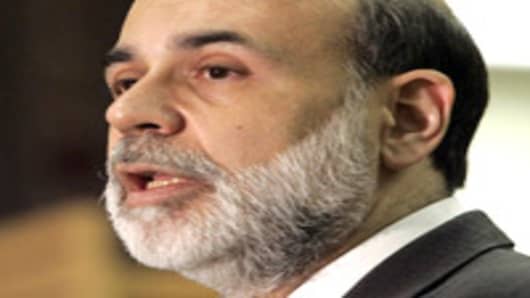
Pablo Martinez Monsivais
Federal Reserve Bank Chairman Ben Bernanke
His comments caused a selloff in the stock marketand arally in the bond market.
"Among the largest banks, the capital ratios remain good and I don't anticipate any serious problems of that sort among the large, internationally active banks that make up a very
substantial part of our banking system,'' he said in response to a question during semi-annual congressional testimony.
Big U.S. banks have already raised billions of dollars of
fresh capital to make good on losses on subprime mortgages,
often by tapping foreign investors. Bernanke said that he hoped this trend would continue in order to bolster lending.
"They have already sought something of the order of $75 billion of capital in the last quarter. I would like to see them get more," Bernanke said.
"They have enough now certainly to remain solvent and remain ... well above their minimum capital levels. But I am concerned that banks will be pulling back and not making new
loans and providing the credit which is the lifeblood of the economy. In order to be able to do that ... in some cases at least, they need to get more capital," Bernanke added.
Bernanke also said the nation is "not anywhere near" the dangerous stagflation situation that prevailed in the 1970s.
With the economy slowing and inflation rising, fears have grown that the country could be headed for the dreaded twin evils of stagnant growth and rising prices known as "stagflation."
"I don't anticipate stagflation," Bernanke told the Senate Banking Committee.
Still, high energy prices and rising inflation does complicate the Fed's job of trying to keep the economy growing and inflation contained, Bernanke acknowledged.
High energy prices are creating "inflationary stress," Bernanke said. And, that is "complicating" the Fed's work in terms of shoring up the economy, the Fed chief said.
President Bush, at a news conference Thursday, noted the slow economic growth but said the nation isn't headed into a recession.
He rejected calls for additional stimulus efforts, instead advising patience. "Why don't we let stimulus package one, which seemed like a good idea at the time, have a chance to kick in?" Bush said at the White House.
Bernanke's testimony in the Senate caps back-to-back appearances on Capitol Hill that started in the House on Wednesday. The Fed chief's overarching economic message was the same on both days: The Fed stands ready to lower a key interest rate yet again to bolster the struggling economy.
Many fear the country is hurtling toward a recession or is in one already.
The central bank started lowering a key interest rate in September. Over just eight days in January, the Fed shaved 1.25 percentage points, the biggest one-month reduction in a quarter century. Economists and Wall Street investors predict the Fed will cut rates again at its next meeting, March 18.
Just before Bernanke testified, the government reported that the economy nearly stalled in the final quarter of last year.It grew at a pace of just 0.6 percent, a big loss of momentum compared with the prior quarter's brisk 4.9 percent growth rate.
Bernanke indicated he is prepared to lower rates even as high oil prices heighten inflation risks.