

If you're thinking of buying a house or refinancing your mortgage, you might want to wait a bit longer.
The rate on a 30-year fixed mortgage rose to an average 6.24 percent this week from 6.04 percent a week earlier, according to Freddie Mac, a major provider of mortgage money. The 15-year fixed mortgage rose to 5.72 percent from 5.64 percent.
AP
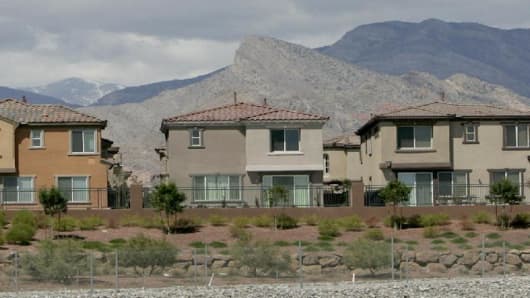
Homes in Las Vegas
One-year adjustable rate mortgages (ARM) also rose this week, averaging 5.11 percent compared to 4.98 percent last week.
The "5/1" ARM, set at a fixed rate for five years and adjustable each following year, averaged 5.43 percent, up from 5.37 percent last week, Freddie Mac said.
Why is this happening? Though the Federal Reserve has been aggressively cutting interest rates, mortgage rates have actually been going up, not down. The reason: Banks are still reluctant to make home loans even though money is cheaper.
"What people are realizing is that the interest-rate cuts haven't helped anybody but the banks," said Michael Cohn, chief investment strategist at Atlantis Asset Management. "They're taking these rate cuts and pocketing the money ... to shore up their own balance sheets."
With 30- and 15-year mortgage rates rising back to their levels of last November, refinancing activities will likely begin to decline, said Frank Nothaft, Freddie Mac vice president and chief economist, in a statement.
The news couldn't happen at a worse time for the already battered housing market.
On Wednesday, the Commerce Department said new U.S. single-family home sales fell to an annual rate of 588,000 in January, the lowest rate in nearly 13 years. The median sales price for a new home dropped 15.1 percent to $216,000 from $254,400 a year ago.
There was one bright spot: mortgage fees eased slightly. Lenders charged an average of 0.5 percent in fees and points on 30-year mortgages, down from 0.6 percent last week. They charged 0.4 percent on the 5/1 ARM, down from 0.5 percent the prior week.
Fees and points on the one-year ARM rose to an average of 0.7 percent from 0.6 percent a week earlier.
Fifteen-year mortgages averaged 0.5 percent in fees and points, unchanged from last week.
Freddie Mac is a mortgage finance company chartered by Congress that buys mortgages from lenders and packages them into securities to sell to investors or to hold in its own portfolio.
Meanwhile, plans in Congress for federal aid to troubled mortgage borrowers was criticized by Treasury Secretary Henry Paulson, who said it would bring unfair relief to speculators and reward investors who made bad bets.
"So while some in Washington are proposing big interventions, most of the proposals I've seen would do more harm than good," he said in a prepared statement.
Several leading Democratic lawmakers in Washington have proposed multi-billion dollar programs that would help troubled borrowers stay in their homes.
Republicans in the U.S. Senate are likely to block this week a Democratic bill aimed at curbing new home foreclosures by changing bankruptcy law, Senate Majority Leader Harry Reid said on Thursday.
"I would be surprised if they didn't" block the legislation, Reid said. "I'm sure they will oppose" a move by Democrats to limit the debate, the Nevada Democrat added.
The test vote could come late Thursday or sometime Friday. If Republicans do refuse to allow limited debate leading to an up-or-down vote on the bill, Reid could try to bring the measure back to the Senate floor as early as next week.