

There is more than a 50 percent chance the United States could go into recession, former Federal Reserve chairman Alan Greenspan told Spain's El Pais newspaper in an interview published on Sunday.
J. Scott Applewhite
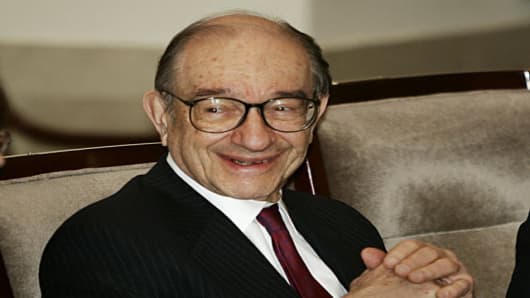
On his last day as chairman of the Board of Governors of the Federal Reserve System, Alan Greenspan smiles as he presides over his final Federal Open Market Committee meeting at the the Fed's headquarters in Washington, Tuesday, Jan. 31, 2006. He is speaking to Deborah J. Danker, at left, special assistant to the board, with Vice Chairman Roger W. Ferguson Jr., at right. Greenspan has held the post for more than 18 years and is widely viewed as the most successful chairman in the Fed's 92-year h
However, the U.S. has not yet entered recessionary state marked by sharp falls in orders, strong rises in unemployment and intensive weakening of the economy, he said.
"We would have to see signs of this intensification: there are some, but not many yet,'' he said. "Therefore ... I would not describe the situation we are in as a recession, although the chances that we'll have one are more than 50 percent.''
A sharp downturn in the U.S. housing market has led to a full-blown credit crisis that has reverberated throughout the U.S. financial system.
The economy has become increasingly important in the U.S. presidential campaign, topping the list of voters' concerns heading into the November election.
Greenspan, the U.S. Fed chairman from 1987 to 2006, endorsed the Republican presidential candidate John McCain in the interview.
"I'm Republican and I support John McCain, who I know very well and who I respect a lot,'' he said.
The economies of the United States and the European Union were at a crossroads after a long period of economic growth without inflation, he said.
"This period is going to be much more difficult, from the point of view of monetary policy, than the period during which I was chairman of the Federal Reserve,'' he said.
Turning to Europe, he pinpointed Spain as having a bigger real-estate bubble than the United States, exposing it to the global credit squeeze.
"The real-estate bubble in Spain has been bigger than most other European countries, even bigger than the one in the United States,'' he said. ``In that sense, one would have to presume that there is more vulnerability."
Spain has been the fastest-growing major European economy for more than a decade due to a housing boom during which house prices tripled, but the global credit crisis coupled with higher interest rates have put a sharp brake on growth.
He gave a broadly positive overview of other European economies.