Skip navigation
Watchlist Sponsored By :

Current DateTime: 07:04:50 01 Dec 2009
LinksList Documentid: 24355697
  • The Cost of True Love

      In the popular holiday song "The 12 Days of Christmas," the cost of gifts - from the 12 drummers drumming to a partridge in a pear tree - is quite pricey.

  • Runway Angels

      The superbowl of fashion shows, models walk down the runway at the 2009 Victoria's Secret Show.

  • Smartphone Guide

      Here's a need-to-know guide to nine devices, based on features, price, network and platform.

FEATURED QUIZZES


Current DateTime: 07:04:50 01 Dec 2009
LinksList Documentid: 33793611
  • Test Your Google IQ

      How much do you know about the most popular search engine in the world? Take the following quiz and find out.

  • A Healthier & Wealthier You

      Take the following quiz and find out how much you know about the impact of obesity on the health of the U.S. economy.

  • How Well Do You Know Your Bird?

      Let's talk turkey. Test your turkey knowledge and perhaps pick up a bit of trivia to trot out at your holiday meal.


Current DateTime: 07:04:51 01 Dec 2009
LinksList Documentid: 24890560
  • Predictions '10

      After a brutal 2009, we're all looking forward to 2010. Here's what our bloggers expect.

  • Holiday Central

      There are plenty of reasons to believe that this Christmas holiday season will not be as bad for retailers as last year.

  • Winterizing Your Portfolio

      If 2009 was the winter of our discontent, will 2010 be a winter wonderland for investors? A lot depends on the recovery—or lack thereof.

powered by digg
By: Lisa Auret,, Special to CNBC.com | 10 Apr 2008 | 03:55 AM ET
Text Size

Wall Street banks are the first to be blamed for the credit crunch. Central banks come a close second, but as the Federal Reserve's image is suffering, the European Central Bank looks as solid as a rock.

Many analysts and traders in the U.S. have cheered the Fed's rapid rate cuts and widening of collateral it accepts in exchange for liquidity for cash-strapped banks, saying that without them the crisis would be worse. The bailout of Bear Stearns [BSC  Loading...      ()   ] also had its fans.

But the voices of those who accuse the Fed of debasing the currency and creating moral hazard are stronger and stronger.

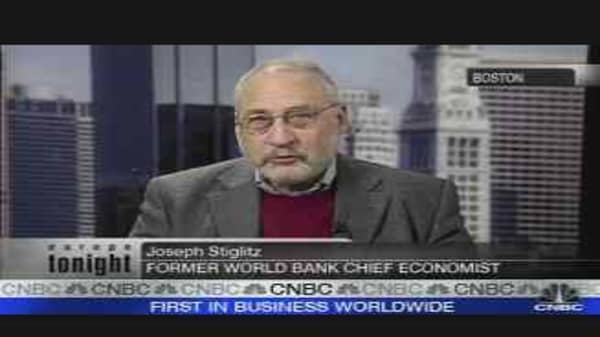
Former World Bank chief economist Joseph Stiglitz, eternal bear Marc Faber and renowned investor Jim Rogers accused the Fed of being the source for the global credit turmoil that is crippling financial markets.

Asked what he would do if he were in Federal Reserve Chairman Ben Bernanke’s shoes, Rogers said: “I would abolish the Federal Reserve and I would resign.”
A recession may be a good way to clean up the economy, while trying to prevent one may cost more and actually worsen it, he said. Also, the market should take care of investment banks.

“If you bail out an investment bank that gets in trouble, that’s not capitalism, that’s socialism for the rich," Rogers told CNBC Europe. "That’s not the way this system is supposed to work. And why should 300 million Americans suffer so that we can bail out two or three investment banks on Wall Street?”

Problem Made Worse?

Stiglitz said some of the statements made by Fed officials over time had contributed to exacerbating the problem.

“(Former Fed Chairman Alan) Greenspan, at the very moment interest rates were at the low, advised Americans to go out (and) take these veritable rate mortgages, which have been the source of the problem, when there was a clear bubble,” Stiglitz said.

Greenspan defended his legacy, telling CNBC that it wasn't the Fed's easing that encouraged the bubble.

"What is fairly clearly the case from the data is that if adjustable rate mortgages weren't available, the purchases (of homes) still would've occurred," he said.

Not being able to identify the ‘gigantic bubble’ in the housing market and the measures taken to ease the liquidity crisis were also slammed by Faber.

“They do not solve the problems, they postpone the problems,” Faber told CNBC Europe. “I think the credit problems took 20 years to build and will take a very long time until they’re solved, and the market, at best, will move sideways.”

Arguably, action attracts criticism as well as praise, and maybe the ECB's stubbornness in not acting has kept its critics at bay, with few exceptions, among whom vocal French President Nicolas Sarkozy.

Admiration for the ECB

The ECB’s sole mandate to curb rising inflation, unlike its U.S. counterpart which also targets growth, has sometimes been questioned by economists as being too rigid. But it has also earned it admiration.

“I like the way the European central banks have been handling things. I think that they have got their eye on the inflation that, in my opinion, does exist, and they’re trying to hold back (and) keep as many arrows in their quiver as long as they can for as long as they can,” said Bob Iaccino from RWH Financial.

Credibility is key in financial markets, and a tough stance is a sure way to achieve it.

Ironically, the Fed’s recent aggressive rate-cutting has actually made the ECB more reluctant to cut because “the Fed has, to some extent, lost some of its credibility in terms of commitment to price stability”, said Barclays Capital’s David Woo.

But the ECB's glow will fade if economic conditions take a turn for the worse. Marco Annunziata from Unicredit said that the ECB is “underestimating the growth risks and risks to the financial sector.”

“We’ve already seen consumer confidence being hit, and consumption slowing, a growth slowdown is coming. High interest rates and a strong euro are making it worse,” Annunziata said.

Growth will eventually slow down and the central bank will have to react by cutting rates, but will find itself “behind the curve,” Annunziata predicted.

© 2009 CNBC.com
Tools:
Print EmailAdd This share icon
  • digg share

CNBC HIGHLIGHTS

  • Will the Fed raise rates? Will the dollar continue its slide? CNBC experts weigh in on the year ahead.
  • Lloyd Blankfein
  • Goldman Sachs has forbidden employees from gathering in private holiday parties of 12 or more.
  • Lemonade stand
  • Do you have what it takes to run your own business? Ask yourself these questions.
  • Heavily armed pirates in Somalia have set up a sort of stock exhange to fund their hijackings.
  • Since its launch in 1998, Google has become a primary force on the Internet. How much do you know about the company?
  • typewriter
  • A famed author has written all his work on an old typewriter that is now up for auction. The NYT reports.
ADD COMMENTS
Remaining characters


Current DateTime: 05:16:08 01 Dec 2009
LinksList Documentid: 29778428

Current DateTime: 01:04:13 01 Dec 2009
LinksList Documentid: 29779196

Current DateTime: 05:04:23 01 Dec 2009
LinksList Documentid: 29779199

Current DateTime: 07:24:04 01 Dec 2009
LinksList Documentid: 29779198
  Data is a real-time snapshot  *Data is delayed at least 15 minutes
Global Business and Financial News, Stock Quotes, and Market Data and Analysis

© 2009 CNBC, Inc.  All Rights Reserved.
A Division of NBC Universal
Thomson ReutersThomson Reuters