

Worries about a deep recession--not a shallow one--drove Federal Reserve policymakers to slash interest rates again last month, according to minutes of their closed-door meeting.
CNBC.com
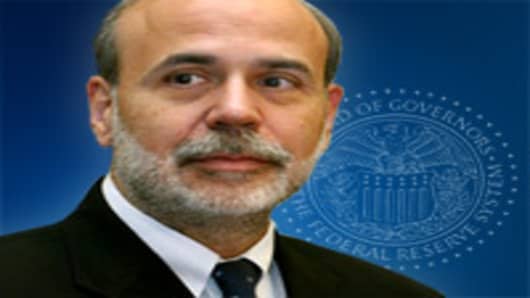
Ben Bernanke
Even as the Fed battled in almost unprecedented fashion to stem a widening credit and housing slump, some Fed members fretted over the possibility of a "prolonged and severe" business downturn.
It was in that environment that they voted--with two dissents--to cut this important interest rate by three-quarters of a percentage point, to 2.25 percent.
That action capped the most aggressive Fed intervention in a quarter-century.
Some Fed policymakers thought that such a widening recession could not be ruled out given the further restriction of credit availability and "ongoing weakness in the housing market," according to the meeting minutes that were made public Tuesday.
Two Fed's members--Charles Plosser, president of the Federal Reserve Bank of Philadelphia, and Richard Fisher, president of the Federal Reserve Bank of Dallas--opposed such a big rate reduction, however.
They favored a smaller cut because of concerns about a potential inflation flare-up.
It was a crack in the mostly unified front that the fed often has projected to the public.
The minutes of the closed-door March meeting underscored the economic cross-currents pulling at Fed policymakers.
"With the uncertainties in the outlook for both economic activity and inflation elevated, members noted that appropriately calibrating the stance of (interest-rate) policy was difficult," the minutes stated.
On the one hand, the Fed has been urgently moving to prevent the trio of economic woes -- housing, credit and financial -- from plunging the country into a deep recession.
On the other hand, with soaring energy prices and high food costs, policymakers realize that they can't afford to let inflation get out of control, either.
Even with the big interest rate reduction in March, most Fed members saw overall inflation moderating in coming quarters, the minutes said.
However, inflation pressures had picked up even as economic growth had weakened, the minutes added, suggesting that uncertainty clouded the inflation outlook.
Plosser and Fisher _ the two who opposed the hefty three-quarter-point reduction in March _ were "concerned that inflation expectations could potentially become unhinged," according to the minutes.
If people, investors and businesses expect prices to rise sharply, they'll act in ways that will make inflation worse.
Once inflation takes hold, it is hard to break." Since last September, the Fed has been cutting rates to shore up the economy.
One of the risks of lowering rates is that it can sow the seeds of inflation down the road.
To battle inflation, the Fed usually boosts rates.
Against this backdrop, Bernanke, in a congressional appearance last week, didn't tip his hand about the Fed's next move on interest rates.
Many economists, however, believe the Fed will lower rates again at its next regularly scheduled meeting on April 29-30, especially in light of the faltering employment market.
The government reported last week that the economy lost jobs for the third month in a row in March.
All told, the nation has lost 232,000 jobs in just three months _ stark evidence of just how much the employment market has buckled under the weight of the economy's woes.
Besides cutting rates, the Fed has taken a number of unconventional steps recently to ease a dangerous credit crisis.
Under one new program, the Fed has been letting big investment firms borrow super-safe Treasury securities and put up more risky investments, including certain shunned mortgage-backed securities as collateral.
The Fed said it would make as much as $200 billion worth of Treasuries available through weekly auctions.
The program is intended to help financial institutions and the troubled mortgage market.
The goal is to make investment houses more inclined to lend to each other.
It also is aimed at providing relief to the distressed market for mortgage-linked securities.
Questions about their value and dumping of these securities have driven up mortgage rates, aggravating the housing crisis.
In the broadest use of its lending authority since the 1930s, the Fed last month agreed to temporarily let investment firms obtain emergency financing from the Fed, a privilege that previously had been granted only to commercial banks.