|
CNBC'S MOST SHARED
- 'We're in the Middle of a Crash': Black Swan
- The Rising Mountain of Debt May Be the Next Crisis
- Latvian Banker Taking Souls as Collateral
- Your First Move For Monday July 6th
- Malaysia PM Speaks to CNBC
- NY City Apartment Sales Down More Than 50%
- Alaska Governor Sarah Palin Will Resign
- The Worst Expected 2010 State Budget Gaps
- Cuddle Parties Heat Up
- SEC May Reinstate Rules for Short-Selling Stocks
- The Rising Mountain of Debt May Be the Next Crisis
- Alaska Governor Sarah Palin Will Resign
- For Banks, Wads of Cash and Loads of Trouble
- SEC May Reinstate Rules for Short-Selling Stocks
- For Australian Winemakers, More Turns Out to Be Less
- Earnings Season: A Likely Game-Changer
- Slideshow: Best-Selling Fourth of July Fireworks
- Divisions Dominate as Third Quarter Begins
- Stanford Clients Sue Insurance Broker Willis Group
- Fireworks At Pharma's Market
- Value of Warren Buffett's Annual Gift to Gates Foundation Falls Along With Berkshire's Stock
- Michael Jackson: The Music And The Money
- Five Stock Picks for This Market
- Realities of the New Obama Refis
- Weak Dollar Means Gold at $1,040: Strategist
- Court Ruling Could Mean Trouble for TiVo
- Lance, Please Back Out Of Tour
- TeleMedicine Gets An Apple App Store Facelift
Many a high tech CEO may have excellent green credentials, but the technology does not lend itself to easy adoption of sustainable, environmentally friendly practices.
Imagine a world without portable computers, such as laptops and notebooks, which are now powered by lithium ion batteries that are difficult to recycle.
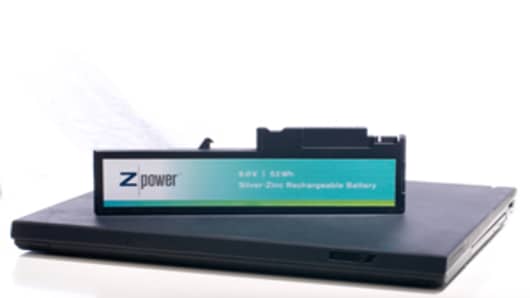
Enter ZPower, a California-based company, which has spent the last 10 years working on silver-zinc rechargeable battery technology and will unveil its first product through a major technology partner in August.
![]() |
Sue Bell |
ZPower's efforts are based on existing silver zinc technology, offering greater power density (essentially, how much electricity a battery can hold) than lithium ion, thus requiring fewer recharges before becoming useless. The battery will hold a charge about 40 percent longer than the normal four-hour period.
The privately held company has spent $40 million developing the product, with backing from, Intel [INTC
Loading...
()
] , OnPoint Technologies — a venture capital fund of the US Army — and PowerVentures, a large private equity group.
Key components of the battery are recyclable and reusable. The company says its recycling infrastructure allows it to reduce the cost of silver for by as much as 85 percent, making its batteries cost-competitive with the conventional lithum ion batteries.
ZPower's business model includes recycling partners and a customer service component that will allow consumers to return and recycle their batteries once the charge is exhausted. The company will also offer a refund or credit toward a new unit.
CNBC.com spoke with ZPower's CEO Dr. Ross Dueber about the technological, financial and environmental issues for his company, the industry and consumers.
![]() |
Ross Dueber, CEO of ZPower |
This has been a long time coming, hasn't it?
"What you do with the product at the end of its life hadn't been given much thought until recently. It is truly a maturation of our thinking in that the responsibility doesn't end after you make the product.
"The company is really geared to bringing responsible technology to the marketplace that is mindful of the environmental impact. ZPower's approach is the best way to bring new energy-storage technology to the market given that we have finite resources on Earth, how do you responsibly use them and reuse them? The model we adopted for our technology is to use it again, again and again.
"We factored that into our business model. We actually incentivize the customer to return the battery at the end of its life and we provide them a financial incentive to do it. It helps keep our costs down. It only takes 20 percent of the energy to recycle and reuse a metal it takes when you take it from the ground."
What's your research told you?
"It has resonated very well in terms of the feedback. That's given us a feel at a high level that this can be successful. These people tend to be more of the IT department, road warrior premium users of notebook computers."
A big part of making green work is having to make a difference in the every day lives of people. Will this do that?
"There is certainly that level of the population that considers itself to be green, but I think everybody wants to feel responsible for that in some way. We can bring in a larger portion of the population to participate by them. What better what way to practice greenness than to make it part of the financial layout for you as the end user."
How about your investors. What's their take on this?
"We have a fairly wide investor base, of which a significant component of that are environmentally responsible individuals and advocates. So this resonates very, very well with them and certainly makes them feel better about their investment above their expectations for a financial return."