

High gasoline prices got you down? Come to the land of seasonal adjustment, where the sun is always shining and gas prices fell 2 percent last month.
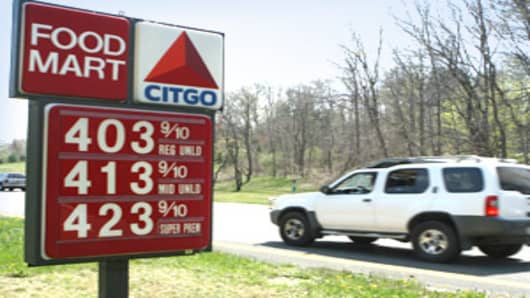
New York Gas Prices at $4 per gallon
What? You paid more? Well, in the real world, gasoline prices did rise by a sharp 5.6 percent in April from a month earlier, but the way that the Bureau of Labor Statistics adjusts the figures to smooth out seasonal oddities, it appeared to be down in the consumer price index released Wednesday.
"The drop makes absolutely no sense. Where does the BLS buy their gas?" asked Mark Vitner, senior economist at Wachovia.
No, there is not a magical government gas station where pump prices remain below $3 per gallon while the national average stands at $3.72.
Another branch of the very same U.S. government, the Department of Energy's Energy Information Administration, said average retail gas prices actually shot up 9.5 percent in April from March.
So who's right? It has to do with how the Bureau of Labor Statistics compares current price trends with the norm.
Typically, gasoline prices rise sharply in April as the arrival of warmer weather encourages people to drive more.
The government data is adjusted to reflect that pattern so that it can highlight variations from the trend.
Because gas prices did not rise as much last month as they typically do in April, the seasonal adjustment showed that prices fell.
This is no consolation for consumers grappling with record-high gasoline prices that have curbed spending on other goods and services, adding another drag to an already sluggish U.S. economy.
"We don't feel great about paying less for seasonally adjusted gas. We feel bummed that we actually had to pay more for gas," said Kenneth Beauchemin, U.S. economist with Global Insight.
But the seasonal adjustments are a useful tool for economists because they eliminate factors that probably say more about the calendar than the health of the economy, he noted.
The data may also offer some peace of mind to Federal Reserve officials who have been increasingly wary of rising inflation.
Investors have begun to speculate that the central bank may be forced to raise interest rates as early as this year if price pressures continue to build.
Overall, the consumer price index rose by a smaller-than-expected 0.2 percent in April.
So-called core prices, which strip out food and energy costs, were up just 0.1 percent, half the increase that analysts had forecast.
Back in the unadjusted world, not only did gas prices rise sharply in April, but with oil hitting record highs on a regular basis, they are likely to keep climbing in the coming weeks.
That means May's CPI data may look less tame.
"We do not think that the market or the Fed should take false comfort from the data. We expect to see much worse numbers in both the headline and the core a bit down the road," said Joseph Brusuelas, chief economist with Merk Investments.