The Earth’ s mantle heats reservoirs of molten rock, which in turn heats water and produces steam. This occurs at depths of 10,000 feet or more. Geothermal is able to provide either the steam to spin electricity-generating turbines or hot air for space heating. Water can be reinjected into the ground to produce more steam. Although some sites have been depleted because of overuse, fields can generally be replenished if left alone for some time.
Where are the resources and what is their potential?
Estimates vary considerably, but all say the potential is vast compared to what exists today. They rise significantly with technological improvements, the most important of which is the Enhanced Geothermal System (in which water is injected among hot dry rocks some 10 km below the surface). Most experts say this is probably several years from being commercially viable.
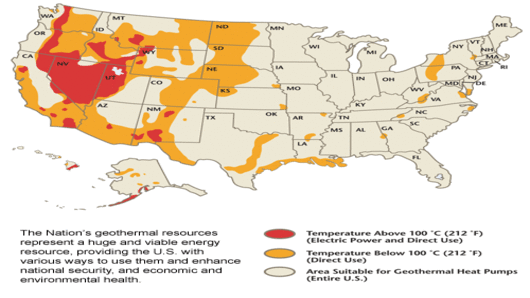
A widely cited MIT studyconcluded that the EGS could affordably provide at least 100 Gigawatts by 2050 in the US. Most of these resources are located in Western states (see map). EGS, for instance, could provide 60 percent of Nevada’s electricity needs.
Other countries with significant geothermal potential are around the Asian-Pacific "ring of fire", including China, the Philippines, Mexico, New Zealand, Australia and Indonesia.
Where are actual deployments?
Italy's Larderello plant was the world's only industrial producer of geothermal electricity until New Zealand built one in 1958. The first US plant — the Geysers Resort Hotel — started up in 1922. Pacific Gas and Electric, a subsidiary of PG&E, began a commercial operation there in 1960, which was later taken over by Northern California Power Agency, a local non-profit, and Calpine Corporation.
What are the most active companies and their biggest customers?
The biggest US players are firms in which geothermal is only a portion of their business. This includes Chevron but also Calpine and Raser Technologies . More pure play operators in this space are Ormat Technologies and US Geothermal (formerly US Cobalt). There are also several foreign firms active in the US — Italy’s Enel North American unit and Iceland’s Geysir Green Energy — as well as a number of small companies (some with listings on the Toronto Stock Exchange),including Sierra Geothermal, Nevada Geothermal, ThermaSource and Geodynamics. Customers vary but are generally located near fields; much of the current geothermal output gets fed into local grids.
Chevron is the largest private producer of geothermal, accepting for more than half of all privately generated power. Virtually all of this is in four sites — two each in Indonesia and the Philippines — which collectively generate 1,273 MW.
The efforts of Calpine, the biggest US geothermal producer, are concentrated at The Geysers in northern California. Calpine operates 19 of the 23 plants there, currently producing 725 MW — enough to supply San Francisco. PSE&G has a power purchase agreement with Calpine (to meet the state's renewable portfolio standard). The power gets fed into California's grid.
The Geysers used to produce 2,000 MW, until a dramatic decline in the 1980s due to overuse. Calpine has recently stabilized production by reinjecting waste water from nearby communities and is in the midst of a five-year, $200-million program to drill new steam fields and make older ones more efficient.
Raser has eight projects under construction. The output from the first two projects in Utah are slated to be sold to the city-owned utility of Anaheim, Ca., which will take 22 megawatts.