

JPMorgan Chase’stop investment banking executives conceded yesterday that their acquisition of Bear Stearns was worth far more than the rock-bottom $10 a share price they paid, but that the market turmoil is still taking a toll on investment-banking profits and may result in further layoffs, CNBC has learned.
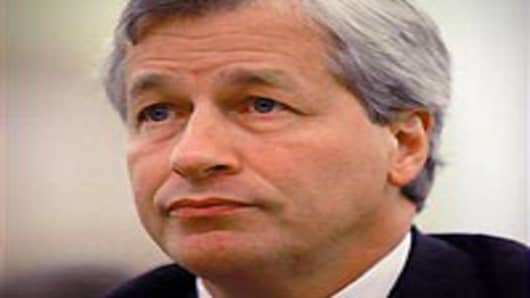
Getty Images
Jamie Dimon
The executives—CEO Jamie Dimon, as well as investment banking co-heads Steve Black and Bill Winters—made the comments late yesterday afternoon during their first company address to the newly combined investment bank. JPMorgan acquired Bear Stearns in mid-March, first offering a paltry $2-a-share price before later upping their bid to a still-low $10 a share.
The meeting was held in JPMorgan’s large cafeteria, attended by about 1,000 employees. Executives with the firm estimate that another 2,000 employees called in to hear the widely anticipated talk.
Bear was forced to sell itself to JPMorgan amid a run on the bank that nearly toppled the US financial markets as investors bet that bad loans on Bear’s books would leave the firm insolvent. Under the terms of the deal, the Federal Reserve guaranteed $30 billion of those bad loans, while JPMorgan agreed to assume the first $1 billion.
That said, Black, the investment banking co-chief, said the integration of the firm is proceeding "smoothly" and that JP Morgan "got something that has far more value then the price we paid," according to people who attended.
Black said JPMorgan expects to earn an additional $1.1 billion in 2009 from the Bear Stearns businesses. Dimon later stated that the firm still hasn’t come up with just how much of the first $1 billion in liabilities JPMorgan will have to shell out.
Despite some positive talk on the Bear merger, the executives were quick to point out that business conditions on Wall Street remain glum. JPMorgan has withstood the impact of sub-prime collapse better than most firms, but like its Wall Street counterparts, profits have been hammered so far this year in the investment banking business. (See Charles Gasparino's exclusive CNBC report in the accompanying video.)
JPMorgan has cut its investment banking staff so far this year by about 15 percent, and Winters suggested that additional layoffs at JPMorgan could be in cards given the market environment.
"A lot of you had some of friends go, and that's hard for everybody, but it's the right thing to do for the company," he said, adding: "The revenue base available in this economy must be matched with appropriate cost structure."
He also said both the revenue potential from the current economic environment and revenue being generated by JPMorgan's investment banking business continue to decline.
Dimon is notorious for cost-cutting; last year when the subprime meltdown began, analysts in one of JPMorgan's buildings say, they received a memo stating that milk would no longer be available at coffee pantries. After an uproar, the firm began serving milk again. During the call, Dimon said "wasting money is a sin," and then quipped that "It is not true that I ordered smaller hamburgers for the café, but if I [had] thought about it, I would have done it."
Later, Dimon was asked by an employee if he could have "access to the Bear cafeteria, because they serve bigger hamburgers there." Dimon did not answer the question.
None of the executives mentioned the fate of Alan Schwartz, the former CEO of Bear Stearns, who is weighing whether to join JPMorgan as a senior investment banker. If Schwartz remains at JPMorgan, he is sure to stir controversy, since he was in charge when the firm was sold at the depressed price (Bear once traded at around $170 a share) and he would get a deal in which he earns tens of millions of dollars since he’s considered one of the best investment bankers on Wall Street.
A JPMorgan spokeswoman had no comment.