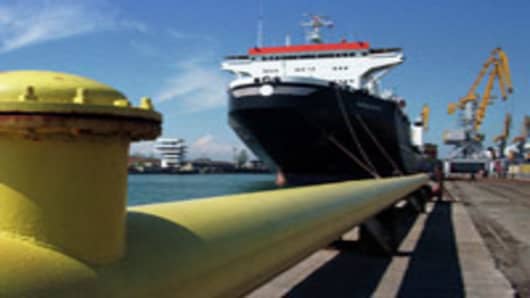
As a result, explorers are scouring ever-more remote corners of the globe in their hunt for hydrocarbons. That quest has found petroleum reserves off the shores of Africa and Brazil, and opened up promising exploration regions in the South China Sea, off the shore of India, and around the coast of Australia. But those sites will remain largely off limits until the new drill-ships arrive.
Most new orders for drill-ships have gone to Asian shipyards. Companies in Singapore and China have benefited, but South Korea’s big three shipbuilders — Samsung Heavy Industries, Daewoo Shipbuilding and Marine Engineering and Hyundai Heavy Industries — have gotten the bulk of orders for the most complex and expensive types of vessels.
“The market for offshore exploration is now the hottest sector in the global shipbuilding industry,” said Lee Jae-kyu, shipbuilding analyst at Mirae Asset Securities in Seoul.
At Samsung’s sprawling shipyard on the southern Korean island of Geoje, next to the gigantic hulls of half-finished supertankers, cranes and dry docks work overtime to construct odd-looking drill-ships like the West Polaris.
At 62,400 tons, the West Polaris, due for delivery this month, is larger than a World War II aircraft carrier. The pipes and steel scaffolding of its drill loom over the other ships lining the construction yard, like cars in an oversize parking lot.
The shipyard and its 25,000 workers bustle with activity, emitting a cacophony of clanging construction sounds, the roar of motors and short musical ditties that warn of moving cranes. These sounds echo in the emerald hills behind the yard, which stretches across one side of a deep blue bay.
“The oil reserves that were easy to reach are all drying up,” said Harris S. Lee, vice president in charge of Samsung’s offshore drilling rig business. “The future is in exploring the deep seas and harsh environments.”
A big challenge in deep-sea drilling is to stay over the same spot on the sea floor even as the vessel is buffeted by strong winds, currents and waves. Because water depths can reach up to 10,000 feet, far too deep for traditional rigs that are moored to the seafloor, ships like the West Polaris rely on high-speed computers that use global-positioning satellites to control an array of six swiveling propellers on the hull’s bottom.
The ship was ordered by Seadrill, a Bermuda-based offshore exploration company, for $453 million.
Last month, Samsung announced it had received a $942 million contract to build an even hardier type of drill-ship made specifically for Arctic conditions. The vessel, ordered by Stena Offshore, a Swedish company, will have a hull strong enough to break through ice, withstand 50-foot waves and insulate the men and machinery inside from outside temperatures as low as 40 degrees below zero. Samsung’s sales of all types of offshore drilling vessels jumped to $7.8 billion last year, up from $1.5 billion in 2005.
Despite the construction frenzy, constraints in the rig market could last several more years.
The last such boom in orders came in the late 1970s and early 1980s, when exploration rose after the 1970s oil shocks. In the 1990s, low oil prices and overflowing oil supplies led oil companies to cut back on exploration drastically.
“It will certainly mean more drilling activity and more discoveries in the deepwater side,” said Tom Kellock, the head of consulting and research at ODS-Petrodata.