Skip navigation

Current DateTime: 12:15:51 06 Jul 2009
LinksList Documentid: 24355697
  • Collection of Michael Jackson

      Earlier this year, Jackson sought to auction his personal items. Although it never came through, here's a look at what was almost sold.

  • Recession-Resistant US Cities

      Some cities have been hit much harder than others during the recession. Here are the metro areas faring the best.

  • How Much For A T-Bone Steak?

      From the cost of a T-bone steak to a monthly phone bill, the price for everyday items can vary dramatically across the country.


Current DateTime: 12:15:51 06 Jul 2009
LinksList Documentid: 24890560
  • Boom, Bust and Blame

      The inside story of the economic crisis that has gripped the entire world.

  • E3: Gaming's Cutting Edge

      North America's premier computer and video game trade show draws tens of thousands of professionals to experience the future of interactive entertainment.

  • The Fall of GM

      A look into the fall of General Motors as the automaker heads toward bankruptcy and an effective nationalization.

By: CNBC.com | 01 Jul 2008 | 06:55 AM ET
Text Size

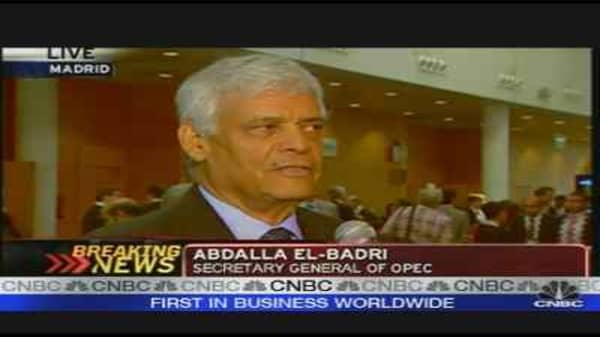
There is "no shortage" in the oil market and OPEC member countries would prefer a lower price than the current highs, OPEC Secretary General Abdalla El-Badri told CNBC on Tuesday.

"I think the problem is with the U.S. dollar, I think the problem is with the speculators, but there is no shortage in the markets," El-Badri said on "Squawk Box."

The dispute between those who say the oil price is driven by speculators and those who maintain that supply is tight has heightened over the past weeks, when crude broke record after record on the international markets.

On Tuesday, New York light crude futures were trading about $2 higher on the dollar's weakness and concerns over the main Gulf oil shipping route amid lingering tensions surrounding Iran. But the price was still off the record high of $143.67 hit on Monday.

World oil inventories were within their five-year average and OPEC is "producing more than we should," El-Badri said. "If you need oil, we can sell it to you, but we don't see any queue."

He admitted there were bottlenecks in the refining process as everybody prefers light crude, which is easier to refine, rather than the heavy crude which OPEC also churns out.

But $162 billion was invested in OPEC countries to boost capacity and in fact the cartel would like to see the prices at lower levels than the current ones, he added.

"We do not prefer a high price, we'd like to see a comfortable price," El-Badri said.

More than 85 percent of the OPEC revenue from selling crude are going back to the U.S. and European Union anyway, he added, because member countries were buying materials and goods from there.

"We are not really keeping that money in our member markets, we are channeling it back into the market," El-Badri said.

Earlier on Tuesday, Saudi Arabia's King Abdullah was quoted as saying that oil prices were unlikely to come down even if OPEC would pump more.

"People who think that oil prices will go down once production is raised are wrong because there are indications the prices will remain high," the Arab Times quoted the ruler of the world's largest oil exporter as saying.

On Monday, Saudi Oil Minister Ali al-Naimi said Saudi Arabia stands ready to pump as much oil as its customers require, but supply for now was adequate.

© 2008 CNBC.com
Tools:
Print EmailAdd This share icon


Current DateTime: 11:41:25 06 Jul 2009
LinksList Documentid: 29778428

Current DateTime: 11:26:00 06 Jul 2009
LinksList Documentid: 29779196

Current DateTime: 12:11:29 06 Jul 2009
LinksList Documentid: 29779199

Current DateTime: 01:05:27 06 Jul 2009
LinksList Documentid: 29779198
CNBCCNBC
About CNBC  |  Site Map  |  Privacy Policy  |  Terms of Service  |  Video Reprints  |  Advertise  |  Help  |  Contact
Partners: AOL Money  |  BloggingStocks.com
CNBC is a Division of NBC Universal
  Data is a real-time snapshot *Data is delayed at least 15 minutes
Global Business and Financial News, Stock Quotes, and Market Data and Analysis

© 2009 CNBC, Inc.  All Rights Reserved.
Thomson ReutersThomson Reuters