

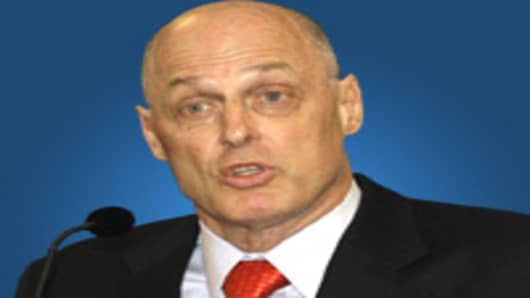
The U.S. economy needs months to recover from its slowdown, but the banking system remains sound despite a home mortgage crisis that could cause more problems, Treasury Secretary Henry Paulson said.
Paulson also said on Sunday morning news programs he was optimistic Congress would approve the Bush administration's request for authority to shore up the troubled mortgage giants Fannie Mae and Freddie Mac.
The treasury secretary has been trying to reassure nervous financial markets and is scheduled to deliver an important speech on markets and the economy in New York on Tuesday.
"We're going to be in a period of slow growth for a while," Paulson told "Face the Nation" on CBS.
"I think it's going to be months that we're working our way through this period." High energy prices would prolong the slowdown, but the key to recovery was stabilizing the housing market, Paulson said.
He added that U.S. banking problems were manageable despite this month's highly publicized failure of mortgage lender IndyMac bank.
The July 11 takeover of the bank by Federal regulators marked the third-largest bank failure in U.S. history.
The lines of frustrated depositors outside its doors provided a stark illustration of the U.S. home financing crisis.
"Our banking system is a safe and a sound one," Paulson insisted on CNN's "Late Edition." He had earlier told CBS, the list of troubled banks would grow.
But "this is a very manageable situation ... our regulators are focused on it." Five U.S. banks have failed this year, compared with an annual average of about 250 during the U.S. savings-and-loan industry crisis in the 1980s, Paulson said..
99 Percent Healthy
He said about 99 percent of the 8,500 U.S. banks, holding about 99 percent of bank assets, fell into the highest category of capitalization, a measure of financial health.
However at the end of the last quarter, the number of problem banks on the Federal Deposit Insurance Corp.'s watch list rose to 90 with combined assets of $26 billion, up from 76 with $22 billion at the end of 2007.
Ensuring confidence in U.S. financial markets was crucial to reviving the housing industry and the broader economy, Paulson said.
To that end it was essential that Congress approve the stability plan for Fannie Mae and Freddie Mac, which are responsible for 70 percent of U.S. home loans.
Treasury asked Congress for unlimited authority to lend money to the troubled mortgage companies and to buy their stock if necessary to inject fresh capital.
Some Republican lawmakers have balked at the prospect of a blank check that could cost U.S. taxpayers billions of dollars.
But Paulson told CBS he was "very optimistic we're going get what we need from Congress here, because Congress understands how important these institutions are." The stability package would be accompanied by stronger regulation and oversight of the two banks, he said.
In an interview with the Financial Times published on Saturday, Sen. Richard Shelby, the top Republican on the Senate Banking Committee, said he believed legislation shaped around the administration's rescue plan could reach the president before Congress takes a summer break at the end of the month.