

U.S. Secretary of State Condoleezza Rice accused Iran on Monday of using stalling tactics and warned Tehran it faced more sanctions if it flouted a two-week deadline to curb its nuclear program.
Haraz N. Ghanbari
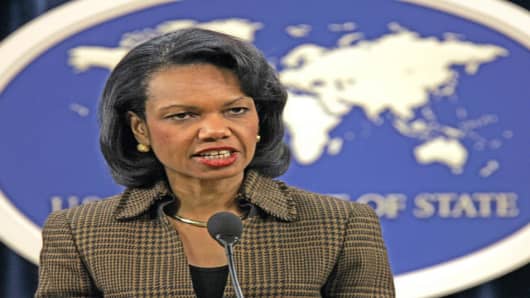
Secretary of State Condoleezza Rice.
Rice said Iran must give a "serious answer" within the deadline laid down by the six world powers to an offer of trade and technical incentives to halt uranium enrichment.
"We are in the strongest possible position to demonstrate that if Iran does not act then it is time to go back to that (sanctions) track," Rice said in her first comments after Washington broke from usual policy and joined nuclear talks with Iran in Geneva on Saturday.
Rice, speaking to reporters on her way to Abu Dhabi en route to Asia, said the United States would impose more bilateral sanctions on Iran and the Europeans would look at what they could do if Iran failed to meet the world powers' demand.
"The main thing is we will have to start considering what we do in New York," she said, referring to the Security Council which has already imposed three rounds of sanctions on Iran.
Envoys from the United States, Russia, China, France, Germany and Britain -- the so-called sextet of world powers -- attended the Geneva meeting.
Prospects of ending the row looked dim as Iran's top nuclear negotiator Saeed Jalili said Iran would not discuss a demand to freeze sensitive atomic work the West fears is aimed at making bombs at the next meeting. Iran says its aims are peaceful.
But Iranian President Mahmoud Ahmadinejad gave an upbeat assessment on Sunday. "Any negotiation that takes place is a step forward," he told reporters, according to IRNA. Yesterday's negotiation is regarded as one of these forward-moving negotiations," Ahmadinejad said.
No More "Small Talk"
Rice said Iran's envoy to Saturday's talks, attended by senior U.S. diplomat William Burns, engaged in small talk rather than tackling the demand that Tehran give up sensitive nuclear work in exchange for diplomatic and financial benefits.
"I understand that it was at times meandering," Rice said.
She said EU foreign policy chief Javier Solana "clarified" Iran's choices at the talks.
"It was also a very strong message to the Iranians that they can't go and stall and make small talk and talk about culture and that they have to make a decision," said Rice.
Burns is set to give a full briefing to Rice on her one-night stopover in Abu Dhabi, where she is also meeting Gulf Arab officials to discuss Iran and other issues.
The U.S. attendance at the Geneva talks was an about-turn in U.S. tactics and comes as Washington is considering whether to open an interest section in Tehran. The United States cut off ties with Iran nearly 30 years ago and the interest section would allow for diplomatic contact while falling short of diplomatic ties.
"We are always looking for ways to relate to the Iranian people and to make it easier for them to relate to us," said Rice. She said such a move should not be seen as a thawing of relations.
Rice said there were no plans to join further nuclear talks unless Iran met conditions to give up the enrichment work. She said the decision to join the Geneva talks was to show U.S. commitment to the incentives offer to Iran.
"I think we have done enough to demonstrate that the United States is serious and to assure our partners that we are serious and to show the Iranians that we are serious. I think we have done enough," Rice said.

