

It has been one of the most predictable trades on Wall Street all year. When oil prices go down, stock markets go up, and vice versa.
If the stock market is a reflection of the broader economy, then only half of that equation makes sense.
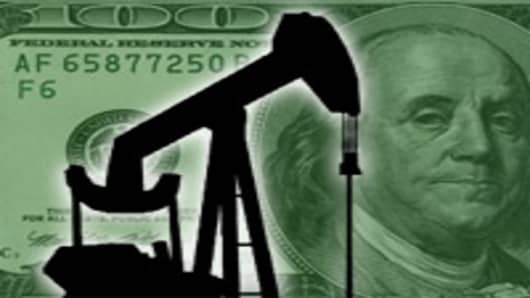
Oil inflicts heavy and immediate economic pain on the way up, but provides slower and smaller benefit on the way down.
U.S. airlines that ratcheted up fares when fuel prices spiked earlier this year are in no hurry to lower them now that oil has fallen more than $30 per barrel in the past month.
The auto industry cannot simply reopen darkened factories overnight now that gasoline costs less than $4 per gallon again.
Indeed, products ranging from toys to breakfast cereal that got pricier as raw materials rose are not likely to track commodities prices on the way back down.
"Price increases are sometimes associated with economic recessions, but oil price declines have never been followed by an economic boom," said James Hamilton, an economist at the University of California, San Diego, who studies oil price shocks.
Cheaper oil is certainly a welcome change for the economy. It has already helped to perk up U.S. consumer confidence and ease the strain on corporate profits.
If oil prices keep falling, that could boost spending and encourage companies to resume hiring after seven months of job cuts.
However, consumers and companies must first be confident that the oil price drop will prove lasting, and that could take quite a while.
While there may be debate over the role speculation played in oil's surge from January until early July, sliding global demand appears to be a primary cause for oil's recent retreat.
That bodes ill for the overall economy and should not be much cause for celebration.
Yet since July 15, when oil began declining from its $147 per barrel peak, the Standard & Poor's 500 index of major stocks has tacked on about 8 percent.
The gains are even more dramatic for the S&P retailing index, which has jumped 22 percent in that time.
That suggests investors think consumer spending will bounce back now that energy costs are gobbling up a smaller portion of household budgets.
But Hamilton said the hangover from high oil prices—particularly gasoline—may linger.
The Fast-Money Crew Talks About How the Conflict in Georgia Could Affect the Dollar, Oil and Markets. Watch Video at Left.
In 2005, when hurricanes Katrina and Rita drove oil sharply higher and gasoline topped $3 per gallon, consumers concluded that it was only temporary and they made few lifestyles changes, he said.
"I expect an opposite perception could have set in today—even if gasoline prices go lower for a few months, consumers know they could go back up and nobody wants to be saddled with the big gas bills they remember from this summer," said Hamilton.
After Katrina, consumer confidence dropped sharply for two months but quickly rebounded, according to data from the Reuters/University of Michigan Surveys of Consumers.
Perhaps more telling is what that report shows about consumers' expectations of how long prices would stay high.
In the two months after Katrina, one-year inflation expectations spiked to 5.5 percent, but quickly dropped back to 4.1 percent by November 2005.
This year, one-year inflation expectations began rising sharply in March, a couple of months after oil topped the psychologically significant $100 per barrel mark. They remained at a lofty 5.1 percent in July even while gasoline prices fell, boosting consumers' overall mood.
If Friday's Reuters/University of Michigan report shows another month of improving sentiment with no change in inflation expectations, that may suggest consumers think higher prices are here to stay.
For Corporate America, the benefit of lower oil prices will largely flow to the bottom line.
Package delivery companies, plastics makers, food manufacturers and a host of other businesses have raised prices this year, and they are not in any hurry to reverse course.
While stronger profits would be good news for the U.S. economy, until companies are convinced that demand is improving, they are not likely to step up production or hiring, which would provide a much bigger economic boost.
Lower oil prices alone cannot fix the underlying problems of slowing global demand and tightening credit conditions.
Airlines were among the hardest hit by the oil price spike, and they responded by cutting jobs, taking airplanes out of service, raising fares and tacking on charges for everything from checking bags to pillows and blankets.
Rick Seaney, chief executive of airline ticket research site FareCompare.com, said the companies have already taken the public relations hit for those unpopular moves, so there is little incentive to do away with them now.
He said U.S. airlines attempted 21 fare hikes so far this year, and 15 of them were successful. In all of last year, they tried 23 times and were successful on 17 occasions. They have not tried to raise prices in the past 5-1/2 weeks, he said, probably because of cooling oil prices.
However, they have not cut back on fares or fuel surcharges, which now average $160 per domestic round trip flight.
"If it was just oil, it would be not that big of a deal," Seaney said. "You've also got the weak dollar, and a relatively sluggish economy where you can't tell where it's going. Any one of those three things could cause airlines heartburn. All three together is like a perfect storm."

