

Minneapolis Federal Reserve Bank President Gary Stern told CNBC that the decline in energy prices has slowed the inflation outlook, allowing the Fed "to be patient" on whether to boost interest rates.
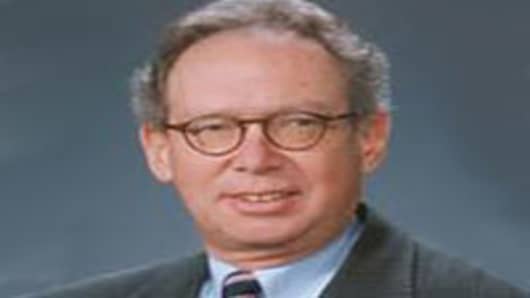
Gary Stern
Meanwhile, Dallas Federal Reserve Bank President Richard Fisher said he sees the U.S. economy hitting "zero growth" in the year's second half. (See more below.)
"From my perspective...I had been expecting oil to level off, because that's the way the futures markets were pricing it, so it seemed that if that happened, headline inflation would abate a bit, at least," Stern said in a live interview.
"Now, with the decline in energy prices, and assuming that sticks, that clearly improves the inflation outlook relative to what I was earlier expecting."
Stern, a longtime Fed bank president and inflation hawk, is currently a voting member of the Federal Open Market Committee, which sets interest-rate policy. Though he has favored having the Fed raise interest rates sooner than later, he said that "it pays to be patient" on rates right now.
On the economy itself, the Fed president doesn't see any improvement until next year, though he declined to say whether the US was in a recession. "I think it will be a close call," he said.
(Watch the entire interview at left.)
"We shouldn't lose sight of the fact that energy prices have risen a lot over the last several years all told, so I don't think, at least from my perspective, that it's going to provide a huge amount of stimulus to economic activity at these levels."
Separately, the Philadelphia Federal Reserve trimmed its forecast for third quarter economic growth to a 1.2 percent annual rate from 1.7 percent earlier. The bank also cut its estimate of fourth quarter gross domestic product growth to 0.7 percent from 1.8 percent.
In the CNBC interview, Stern reiterated that he thinks the Fed will need to hike interest rates before the economy and credit markets heal.
"If you wait till you have conclusive evidence, you run the risk of waiting too long, and so, the real message is, you've got to be willing, at some point along the way, to say, 'You know, I have enough confidence in my outlook; it's time to go."
When asked if the Fed was near that point, Stern said: "My guess is, it's going to pay to be patient at this point, especially with the developments we've seen on the energy side, where, at least from my perception, some of the concerns about inflation and some inflation expectations seem to have diminished."
Fisher Sees Growth Standstill
Separately, the Fed's Fisher said on Tuesday the U.S. economy was in for prolonged slow growth and could shrink later this year.
"I expect that in the second half of this year we will broach zero growth," Fisher said in an interview with the Dallas Morning News. The outlook was for "a sustained period of anemic growth," he told the newspaper.
Fisher, a voting member of the U.S. central bank's policy-setting Federal Open Market Committee, is seen as an inflation hawk and voted against the majority decision on Aug. 5 to hold the benchmark federal funds rate at a low 2 percent.
Fisher said other U.S. central bank members shared his worry about the risk of inflation and said that, if necessary, the Fed would act quickly to ward off any possibility that an expectation of rising prices sets in.
"One of the things I have been concerned about ... is that we don't wish for these expectations to take grip and become part of the psyche of the way decisions are made in our economy," he said.
Fisher said a key source of weakness for the economy was that lenders have grown wary about making credit available in the wake of the subprime mortgage crisis.
He said the current credit crunch was more acute than one that followed the savings and loan crisis in the early 1990s.
"It's broader. It's deeper," Fisher said. "We go through these periods of correction. It's not unhealthy. It's the way capitalism works."