TRANSCRIPT/VIDEO PART ONE: Three Hours With Warren Buffett - Live From Omaha
By: Alex Crippen | Executive Producer
BUFFETT: Well, it's really an incredible case study in regulation because something called OFHEO was set up in 1992 by Congress, and the sole job of OFHEO was to watch over Fannie and Freddie, someone to watch over them. And they were there to evaluate the soundness and the accounting and all of that. Two companies were all they had to regulate. OFHEO has over 200 employees now. They have a budget now that's $65 million a year, and all they have to do is look at two companies. I mean, you know, I look at more than two companies.
QUICK: Mm-hmm.
BUFFETT: And they sat there, made reports to the Congress, you can get them on the Internet, every year. And, in fact, they reported to Sarbanes and Oxley every year. And they went--wrote 100 page reports, and they said, `We've looked at these people and their standards are fine and their directors are fine and everything was fine.' And then all of a sudden you had two of the greatest accounting misstatements in history. You had all kinds of management malfeasance, and it all came out. And, of course, the classic thing was that after it all came out, OFHEO wrote a 350--340 page report examining what went wrong, and they blamed the management, they blamed the directors, they blamed the audit committee. They didn't have a word in there about themselves, and they're the ones that 200 people were going to work every day with just two companies to think about. It just shows the problems of regulation.
QUICK: That sounds like an argument against regulation, though. Is that what you're saying?
BUFFETT: It's an argument explaining--it's an argument that managing complex financial institutions where the management wants to deceive you can be very, very difficult. Or even when the management doesn't know what's going on, and--just take Bear Stearns. Bear Stearns had--I read it, anyway--750,000 derivative contracts. Now, you know, I could clone Albert Einstein, you know, and--many, many times and have him work 12-hour days for me and he would not be able to keep track of what's going on in an institution like that. It's--the ones that are too big to fail may be too big to manage, in some cases. And they're particularly difficult to manage if they're promising Wall Street and their investors that they're going to do things that can't be done.
QUICK: You've come out and said derivatives are the weapons of financial mass destruction before. But you use derivatives, too.
BUFFETT: That's right. I don't say they're evil, per se.
QUICK: Yeah.
BUFFETT: I just say that once the genie opened the bottle on those many years ago, that their proliferation, their variation, their inability to be valued and their ability to allow institutions to pile up leverage like the world has never seen can cause great systemic problems. And that doesn't mean, you know--it's like gun powder or water. You can do damage with a lot of things, but these have systemic--they pose systemic risks. And incidentally, the government recognizes this. I mean, you've had a task force working on, you know, what do we do to prevent these things from causing a real problems? But they have caused problems so far. I don't think they're going to cause problems at Berkshire Hathaway. I know every single derivative contract we have. Now, when we bought Gen Re, they had 23,000 plus contracts.
QUICK: Mm-hmm.
BUFFETT: There was no way in the world I can get my mind around that. I mean, if I--if I had spent full time and had all kinds of assistants and everything, I never would've known what was in those contracts. We had one contract that was due in 100 years, so that meant that for 100 years some guy at our place put a mark on it every day and some guy at another place put a mark and they got their bonuses based on it. I mean, that is a system that is guaranteed to cause trouble. And so I got out of the business. It took me four years under benign market conditions, and we lost $400 some million in the process. So they are dangerous things. The ones we put on may be dangerous things, too, but I do know every contract, and I know what my gain-loss arrangement is and nobody else marks them. I mean, I keep track of it.
QUICK: You do it yourself on every one. OK. Warren, we have a lot more to talk about with you this morning. We'd like to get to some of your holdings, more on the economy, but we also are going to take a very quick pause right now for a quick break. When we come back, Carl's going to be joining us again from China and Carl, what's on your mind?
QUINTANILLA: Becky, if that's the A-block, I cannot wait to see the rest of the show. Wow. What--that's great insight from Mr. Buffett from OFHEO to derivatives, you name it. We'll get more from the world's most successful investor and an Olympic update as we head into closing ceremony on Sunday night. Becky's in Omaha, I'm in Beijing. This very special edition of SQUAWK BOX continues in just a moment.
(Announcements)
WAS THAT BUFFETT IN BEIJING?
QUICK: All right, welcome back, everybody. You know, Warren, we know that you are a huge sports fan. You're somebody who watches all sorts of things, and, of course, one of your major holdings, Coca-Cola, so what better way to tie all this up than Coca-Cola, sports, you've got one of the major sponsors of the Olympics here. Let's bring Carl back into this conversation from Beijing. And appropriately, yeah, Warren is holding up his Coca-Cola just right now, Carl. So, as always, he's got a cherry Coke by his side.
CARL QUINTANILLA, co-host: Cherry Coke, yes.
QUICK: Yeah, cherry Coke by his side. And, Warren, we've been talking all things Olympics the whole way through. What do you think about Coca-Cola and the major sponsorship that it has with the Olympics?
BUFFETT: Well, it has a long, long history with the Olympics, and it--it's very important. I mean, Coca-Cola wants to be associated with happiness around the world. Every major event they want to be here. And it's important--with a brand, there's something in the mind about a brand. I mean, you have something in your mind about Coca-Cola or--but you don't have anything in your mind about RC Cola because they've never been, you know. So we want that--we want that brand to be associated with something like the Olympics where there's happiness, where there's competition, where the nations are getting together. It's a venue we could not skip.
QUICK: There have been people in the past who have said, `Hey, these sponsorships get more and more expensive.' There are guerilla ways that other companies can kind of make their way in...
BUFFETT: Yeah.
QUICK: ...without paying. Is that an option for Coca-Cola down the road?
BUFFETT: No, I--Coca-Cola would never be going on a country road when the interstate's available. And it's--we're not--we're not there to be around the edges, we're there to be front and center.
QUICK: You know, Carl, we've been talking earlier in the week about what some of the Chinese media had been reporting about Buffett, about Bill Gates. What have people been saying?
QUINTANILLA: Well, I think--I think the Coke comments are interesting, Warren. We interviewed the chief marketing officer from Coke here last week, and of all the Olympic sponsors, right, the global sponsors, the GEs of the world, the Lenovos, in China the poll numbers show that they associate the Olympics the most of all the sponsors with Coke. So the marketing machine is obviously working. We did--we did talk earlier in the week back--maybe it was last week--about Pangu Plaza, the big hotel and office park...
QUICK: Right.
QUINTANILLA: ...and shopping mall that's over my shoulder here. And The Times did that story earlier in the week about whether or not Bill Gates had rented out a penthouse for a year, and whether or not Warren was staying there. Any truth to that at all, Warren?
BUFFETT: No, I'd actually talked about going to the Olympics a little bit with Bill, but I'm the kind of guy that has to have it explained to me on television what happened, you know, that I just saw. So I enjoy it enormously watching it on television, and Bill was over there for a week. Although the day or two before he went over he was playing at a bridge tournament in Omaha and then he came back to Omaha almost directly from the Olympics after about a week over there.
QUICK: So that wasn't you? You weren't--you weren't the one they spotted walking around in Beijing?
BUFFETT: No, that must be my double, George Clooney, actually that was spotted.
QUINTANILLA: Has--Warren, has the--have the games, in all seriousness, have the games made you think any differently about this part of the world--the world, western China, growth opportunities, the ability for American companies to operate effectively within a different government structure?
BUFFETT: Yeah, well, I was over there almost a year ago--Becky was with me--and I was blown away by what I saw. I'd been there--the time before that was 1995, and I really had never seen a country change so much in a--in a 12 or so year period, and clearly, when you think of the size of the country, to effect that sort of change. So I--no I've been a big believer in China before the Olympics and certainly they've put on a marvelous show during the Olympics. And--but I would have expected that. You get--you get a bunch of very, very bright people who care enormously about putting on a wonderful event, they're going to get the job done.
QUICK: What about Chinese stocks? Does--do those--does the stock market there interest you? You've been looking around the globe?
BUFFETT: Yeah, you know, you still can't buy stocks within China except under special circumstances.
QUICK: Right.
BUFFETT: But, yeah, I--we owned that PetroChina stock at one time. There's one other stock over there that we actually made a bid on here not so long ago, and it wasn't accepted. But it's a terrific--it's going to be a terrific area for business. So, under the right circumstances, you could see us with a lot of money there.
QUICK: What was the stock that you made the bid on?
BUFFETT: Oh, surprise, surprise. I never thought you'd ask.
QUINTANILLA: Nice, Beck.
BUFFETT: No, that--I have sort of a mind blankout after I learned...
QUICK: But it's not--it's not impossible to say that, yeah, you are continuing to look at stocks and you would make a bid from time to time if you found something that interested you.
BUFFETT: We made--we made a half a billion dollar bid on something, right.
QUICK: You made a half a billion dollar bid?
BUFFETT: Dollar bid, right.
QUICK: OK, if you don't remember the--if you don't remember the stock, what was the industry?
QUINTANILLA: Oh sure, now you tell us.
BUFFETT: Yeah, it's bigger than, yeah--you're good, but...
QUICK: But not that good. No dice on this one? All right, well, Carl...
BUFFETT: She thought she'd get me at 5 in the morning, folks, and I'd be punchy.
QUICK: Yes, and maybe you wouldn't quite be on the defensive just yet. But, Carl, we do have about two and a half more hours where we can try and work on him and squeeze more details out, so...
QUINTANILLA: Yeah, I've heard--I've heard that if you get enough cherry Cokes in him, he will spill everything.
QUICK: We've got them lined up.
BUFFETT: It acts like truth serum, yeah. There's no question about that.
QUICK: Yeah, well we've got those cherry Cokes lined up, and we'll keep them coming. All right, folks, coming up, we're going to go from Wall Street to Washington, as a new movie is out there creating some shock waves this morning. This movie is all about debt and why it could be putting the future of our country at risk. We'll get to the men behind the film who'll be joining us when SQUAWK BOX returns live from America's heartland.
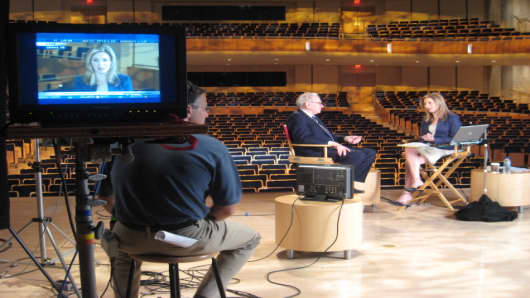
QUICK: Welcome back, everybody, to this very special edition of SQUAWK BOX. Yeah, you hear the "Love Boat" music playing today. We are in Omaha where last night we got to watch a new movie premier that came out. We're going to be talking about that more. But we figured while we had Warren Buffett here and we're in this movie theater of sorts, Warren, we'd ask you about the first time you ever took a date to a movie theater.
BUFFETT: It was in eighth grade right here in Omaha, and a friend of mine wanted particularly to ask out one girl and he was afraid to go by himself, so he talked two others of us to each asking a girl. And we picked these girls up sequentially to go to the streetcar, and they lived miles apart. By the time we got to the streetcar they were all exhausted, and we came downtown to the movie. We picked a movie called "The Cat Woman" with Simone Simon and "The Mummy's Hand" with Lon Chaney. And we felt that the girls would get terrified and jump onto our laps or something of the sort. And what happened is, instead, we got terrified, and the boys jumped on each other's laps. The girls were very cool. We finally got them home, and I don't think anybody ever when on another date for about two years after that.
QUICK: All right, so it cured you the first time out. We'll take it as that. You know, Warren, we have a lot more to talk about with you today. That was a quick little fun one, but we also want to start asking you about some of the holdings of Berkshire Hathaway and where you see the economy going. We're going to get to all of that in just a few minutes.
CLICK HERE FOR PART TWO OF THE TRANSCRIPT
Current Berkshire stock prices:
Class A:
Class B:
Questions? Comments? Email me at buffettwatch@cnbc.com