THIS IS PART THREE OF "THREE HOURS WITH WARREN BUFFETT - LIVE FROM OMAHA" ON CNBC'S SQUAWK BOX WITH BECKY QUICK, FRIDAY, AUGUST 22, 2008.
IT IS AN UNEDITED TRANSCRIPT AS PROVIDED BY BURRELLESLUCE.
GO TO PART ONE OR PART TWO OF THE TRANSCRIPT
CARL QUINTANILLA, co-anchor (Beijing): But first we're going to start with the man of the hour, Beck--actually, he's the man of three hours--Warren Buffett with you in Omaha.
BECKY QUICK, co-anchor (Omaha, Nebraska): That's right, Carl. We are live in Omaha today because last night there was a groundbreaking event in the world of finance and politics and it took place right here. This was the world premiere of a documentary that's called "I.O.U.S.A." This film takes a look at what it thinks are America's four key deficits and it explores into all the risks of these deficits, what it means to the future of this country and its citizens. Now, Warren, you were in the documentary last night right along with Robert Rubin, with Paul Volcker and with Alan Greenspan. So let's take a quick look at a brief clip from the film last night.
(Clip from "I.O.U.S.A.")
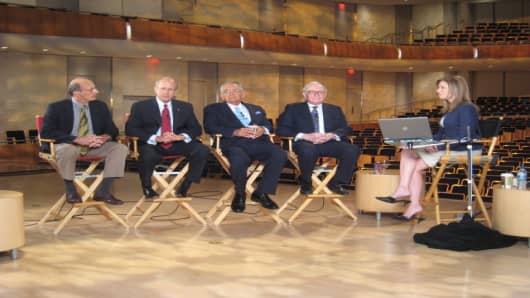
QUICK: OK. Again, that was a clip with Alan Greenspan from the movie last night. It premiered on hundreds of movie screens across the country last night, including right here in Omaha. After the debut, I got the chance to moderate a town hall meeting with the men who were behind the movie, Blackstone's Pete Peterson and the former US Comptroller General David Walker. This is a quick look from that. And Warren, we did have a big discussion last night about what the big problems are and exactly where things are going at this moment. In your--in your view, we just heard from Alan Greenspan, he said that you need to be looking at what's happening down the road. What do you think about that?
WARREN BUFFETT (Berkshire Hathaway Chairman & CEO): Well, I think in any personal activity, business activity or certainly governmental activity, you know, there should be--you should be thinking plenty about what happens down the road. That's one of the jobs of government is to think about what is going to be our energy situation if we don't change 20 or 30 years from now.
QUICK: Mm-hmm.
BUFFETT: What's going to be the fiscal situation. And so unfortunately, you have a many--the most important things in society, the policy cycle is longer than the electoral cycle.
QUICK: Mm-hmm.
BUFFETT: So it's very tough to elect people every two years and ask them to be thinking about something 20 years down the road.
QUICK: OK. We're going to talking more about this film in just a little bit. David Walker will be joining us again, Pete Peterson, to talk about some of these issues. We also, though, have you here for a lot of things that are happening right now in the economy. And at the top of the last hour you talked about where you think the economy is headed. You still think that the trouble in the economy, it could get much deeper from here?
BUFFETT: Well, I think you're seeing the ripples go out from what's started as a crisis in home lending and the fact that we had a--we had a housing boom fueled by a lot of lending by people who didn't know what they were lending on. And that's caused enormous problems in the financial markets as people have started looking at these instruments which they thought were triple-A and they're finding out they're about triple-F and--but those problem--problems have a way of spreading, and that caused the banks to start want--starting to want to start deleveraging in a big way. And when banks start deleveraging, that has--sends ripples out. So there's consequences to every pebble that's dropped in the ocean and we had a pretty big pebble dropped in.
QUICK: Now, you--your view of the economy comes not only from your own holdings, all the companies that you own outright--everything from GEICO to Dairy Queen to Gen Re to Acme Brick Company, all the companies that you hold--but also the holdings that you have in other big companies, correct?
BUFFETT: Right.
QUICK: What sort of insight does that give you?
BUFFETT: Well, it--obviously, I pay a lot of attention to what's happening. And we'll say at American Express--and Ken Chenault talked about that here a month ago--but they are experiencing credit deterioration and they're experiencing it sort of in all segments. So they're seeing the rich customers slow down in payments, slow down in purchases. And American Express can describe that rather than I, but I pay a lot of attention to that sort of thing. And incidentally, it will get cured at some time in the future, but right now the situation is getting worse and I would say I don't see any early end to that.
QUICK: We want to talk to you about...
BUFFETT: But I do see an end.
QUICK: You do see an end, but no early end. I mean, is that six months, is that 12 months, is that 18 months?
BUFFETT: I don't know.
QUICK: Can you put a time?
BUFFETT: Yeah, I don't know the answer to that. All I know is that it's not--I don't think it's going to be really soon. I think that--my candidate is Obama, so I think President Obama is going to have plenty on his plate in January.
QUICK: OK. Let's talk about your most recent disclosures for some of your holdings. When we saw the last numbers, your shares in Anheuser-Busch, a lot of people were surprised to see that you had gotten out of those shares before a deal went through with InBev.
BUFFETT: That's right. I sold about 60 percent of them in the second quarter.
QUICK: Why?
BUFFETT: Well, I wasn't--it was an evaluation of whether I thought the deal would go through and the desire to sell at least some of the shares. I mean, Anheuser-Busch did not want the deal to go through and they hired investment bankers, very expensive. They spent $72 million with two investment banking firms. And believe me, most of that was spent with the idea of trying to keep InBev away. So who knew how it was going to come out? And InBev persevered, they raised their price and on the remaining shares we'll do somewhat better; although there's still a time factor and we've used the money for other things. But in retrospect, I was wrong to decide to partially sell the holdings.
QUICK: What...
BUFFETT: But that--that's not news. I'm often wrong.
QUICK: What price did you sell at? It did not say in the filings.
BUFFETT: Oh, I--we probably averaged around 61 or 2, something like that.
QUICK: OK, 61 or 62, you still had a third. Are you--do you still hold that position?
BUFFETT: Yeah. We--yeah. We hold the shares, yeah. You didn't ask me that last time, so yeah.
QUICK: I know, I didn't. I had to circle back this time a lot. So you still have those shares. One of the other things from that filing that Berkshire filed with the SEC noted that you weren't talking at that point about what's going on with ConocoPhillips.
BUFFETT: That's right.
QUICK: OK. Well, we have you here right now. That means a lot of people are out there assuming that you're either buying or selling shares of Conoco and...
BUFFETT: That's certainly correct.
QUICK: And if I was a betting man, would it be right to think that maybe you were selling and taking profits based on where oil prices have gone?
BUFFETT: Well, if you were a betting man, you'd be betting.
QUICK: Oh, so you're not going to necessarily come out there on that. Let's talk about the price of oil in general.
BUFFETT: Sure.
QUICK: Price of oil has gone rapidly higher in the last few days. Once again, about 120, still down from where it was...
BUFFETT: Mm-hmm.
QUICK: ...just a month ago. But 120, you think that that's a comfortable price for oil?
BUFFETT: It's very hard to tell, but what you do know is that the situation in respect to supply and demand in oil has changed dramatically in the last five or six years from what has existed ever since World War II. I mean, ever since World War II we've always had a significant amount of producible capacity beyond the demand that existed. Now, maybe for one reason or another it wasn't being produced. The Texas Railroad Commission used to--which was kind of--kind of a domestic OPEC--used to shut down the wells in Texas because there was so much producing capacity and they didn't want to knock down the price, which was $3 a barrel then. So we've always had the situation post World War II where it's been a lot more supply could come on than there was demand. In the last 10 years, the first five years oil demand went up around four million barrels a day, and then in the next five years it went up another eight million barrels a day. That's 12 million barrels a day. We did not bring on, in the world, anything like that in terms of productive capacity. So at 86 million barrels a day, which is the present demand, roughly...
QUICK: Mm-hmm.
BUFFETT: ...the world that has no real buffer stock in terms of the--you can't turn the tap on and get 90 or 95. And that means that prices have been and will be quite volatile and probably--well, they have been at a--certainly at a higher level. It is a different world in terms of supply and demand on oil than existed five years ago.
QUICK: What's your thought as to what the nation needs to be doing right now? I know you've spoken with Boone Pickens about his plan.
BUFFETT: Yeah. Well, Boone's on the right track. And then one way or another, you know, we're using 20 million barrels or so a day of oil, we're using a quarter of the oil, roughly, in the world. We and the world cannot certainly keep increasing our demand for oil. If we--if we required another 10 million or 12 million barrels a day in the next 10 years, I'm not sure where it would come from or at what price it would come from. We just don't have that. The tar sands would actually--will increase some, but oil depletes, production of oil depletes.
QUICK: Hm.
BUFFETT: And so one way or another, we're going to have to learn to use a lot less oil. And my guess is we're using less oil right now in the United States because of price factors.
QUICK: Yes.
BUFFETT: But I'm not sure that the world demand is--maybe it's decreased a million barrels a day or something like that, but that isn't going to do it over 10 years. We're going to have to use less oil.
QUICK: OK, Warren, we're going to be checking in with you again after we come back. We'll have more from Omaha, folks. But we're also going to be checking in with Carl. He's got plenty more coming up in Beijing. Carl:
QUINTANILLA: Becky, if Warren breaks any more news we're going to have to just go off the air here, our heads are going to explode for all he information that's coming from him.