Skip navigation

Current DateTime: 04:35:06 22 Nov 2009
LinksList Documentid: 24355697
  • Runway Angels

      The superbowl of fashion shows, models walk down the runway at the 2009 Victoria's Secret Fashion Show.

  • The Richest Members of the US Congress

      Recently, the Center for Responsive Politics found that there are 237 millionaires in the US Congress.

  • 10 Tips to Get Out of Debt

      Renowned financial author Gail Vaz-Oxlade takes a tough-love approach to helping couples in a financial crisis to face reality.

FEATURED QUIZZES


Current DateTime: 04:35:06 22 Nov 2009
LinksList Documentid: 33793611
  • How Much Do You Know About Green?

      Green has become part of our everyday lives. Green is everywhere-- energy, clothing, food, housing, transportation. It's a big business and a global business.

  • The Billionaire BFF's

      Philanthropists. Bridge partners. Hockey players. Which responses are based on facts from Buffett's and Gates' real lives?

  • The Many Myths of Coca-Cola

      Can you tell which statements are true, and which ones are just rumors?


Current DateTime: 04:35:06 22 Nov 2009
LinksList Documentid: 24890560
  • Winterizing Your Portfolio

      If 2009 was the winter of our discontent, will 2010 be a winter wonderland for investors? A lot depends on the recovery—or lack thereof.

  • Investor's Guide to Real Estate

      Some even say the long-awaited recovery is here. Regardless, buyers and sellers alike can profit from our guide.

  • Alternative Investing

      Stocks and bonds? Sure. But it's a big world out there for investors.

powered by digg
Fed Acted Like a Liquidity Drug Dealer: Economist
By: CNBC.com | 23 Sep 2008 | 05:10 AM ET
Text Size

The Federal Reserve, which has encouraged excessive borrowing, is to blame for the credit crunch that has gripped world markets for more than a year, Marc Faber, the author of the Gloom Boom & Doom Report, told CNBC on Tuesday.

"About 15 percent of U.S. households have negative equity. Who supplied the leverage into the system? It's called the Federal Reserve Board," Faber said.

"If I'm the drug dealer I'm not responsible that everybody takes drugs, but I facilitate it, especially if I give it out free of charge, I can enlarge the market share, and that's what the Fed has done."

Liquidity will dry up even more, volatility will stay high and financial assets are going to suffer as the crisis continues to unfold. The bailout plan is unlikely to work and the global economy will take the hit, he predicted.

"People rely on the people in Congress, at the Fed, at the Treasury, people that brought us into this trouble, to take us out of trouble. I don't think they will succeed," Faber said. "We can have recovery rallies but a new high on the S&P is practically out of the question for a very long time. In real terms, equities are still very high and economically, I think the world will go into a slump."

The main provider of global liquidity was the U.S. current account deficit, which increased at a fast pace over the past 10 years, but this will no longer be the case.
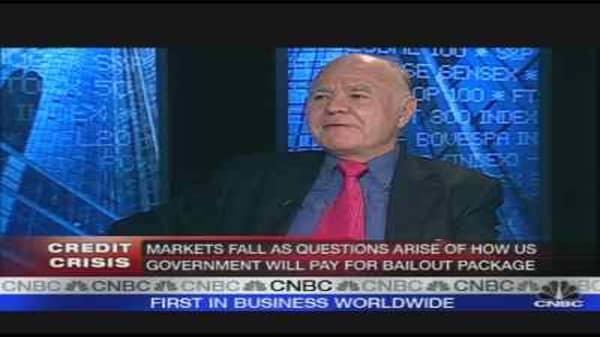
"Next year, if the economy in the U.S. is as weak as I think it would be, the trade and the current account deficit will continue to contract," Faber said. "When global liquidity contracts, it's not a good time for financial assets."

Other sources of funding, such as foreign reserves of resources-rich countries, are also likely to dry up, Faber said. "I think sovereign wealth funds are going to be very busy supporting their own markets, they won't have much money to buy assets around the world."

(Watch Marc Faber's full interview on CNBC above.)

Short-Selling Ban "Stupid"

Volatility comes from the fact that, as the private sector tightens lending conditions to adjust its risk management, central banks are injecting liquidity in the money markets to grease the system, he said, adding that banning short-selling will not contribute to reducing volatility and was a "stupid measure."

"Short sellers are not responsible for current problems. The current problems are caused by the US Fed (Federal Reserve), that was sitting there and letting credit growth go out of bounds," Faber said.

"We have to see very clearly that the cause of the problem was excess leverage. The biggest hedge funds were Fannie Mae [FNM  Loading...      ()   ] and Freddie Mac [FRE  Loading...      ()   ], they had the leverage of one over 150 and under the eyes of Congress, under the eyes of the SEC and everybody… and nobody did anything about it. Then, people go and bitch about the short sellers," he added.

The fact that the rules on short-selling are changing nearly daily, with new names added to the list of securities in which short-selling is banned or with specific rules regarding hedging and confidentiality contributes to adding uncertainty, he said.

The problem is also exacerbated by the fact that nobody knows how long the emergency measure will last or what is next.

"The next emergency measure will be that Americans are not allowed to buy foreign currency and transfer money overseas, and the next measure will be not permitting Americans to buy gold and so on and so forth…. It creates even more uncertainty in the market place when you continually change the rules," Faber said.

© 2009 CNBC.com
Tools:
Print EmailAdd This share icon
  • digg share

CNBC HIGHLIGHTS

  • Technology can make or break a fortune in the world of alternative energy.
  • Many people are facing the holidays with substantially smaller incomes. Here’s how some are adapting.
  • Jim Cramer
  • Jim Cramer is a proponent of stocks that pay healthy dividends, and here are his top five dividend plays.
  • From salt, to lip balm to envelopes, it turns out that bacon flavoring can sell almost anything.
  • real estate signs
  • The homebuyer's tax credit jacked sales for a while, but 2010 is looking weak. Now what?
  • CNBC’s technology reporter Jim Goldman guides you through the best gadgets to buy this holiday season.
ADD COMMENTS
Remaining characters


Current DateTime: 02:29:06 22 Nov 2009
LinksList Documentid: 29778428

Current DateTime: 02:28:44 22 Nov 2009
LinksList Documentid: 29779196

Current DateTime: 02:28:44 22 Nov 2009
LinksList Documentid: 29779199

Current DateTime: 02:28:44 22 Nov 2009
LinksList Documentid: 29779198
  Data is a real-time snapshot  *Data is delayed at least 15 minutes
Global Business and Financial News, Stock Quotes, and Market Data and Analysis

© 2009 CNBC, Inc.  All Rights Reserved.
A Division of NBC Universal
Thomson ReutersThomson Reuters