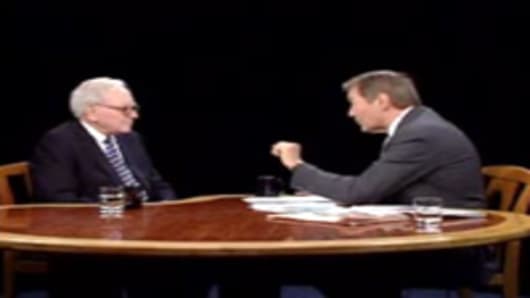
Charlie Rose:
And so when you look at where we are going, there seems to be two issues that are apparent to me at least, risk and leverage. We just lost sight of risk and leverage of what was appropriate?
Warren Buffett:
Yeah. Again, because it pays off for a while. You know, you can lose leverage, and it's the only way a smart guy can go broke. If you owe money, you can't pay them out. You just pay for everything, you do smart things, you eventually get very rich. If you do smart things and use leverage and do one wrong thing along the way, it could wipe you out, because anything times zero is zero. But it's reinforcing when the people around you are doing it successfully, you're doing it successfully, and it's a lot like Cinderella at the ball. I mean you know at midnight everything is going to turn to pumpkins and mice; right? But if the evening goes along, I mean, you know, the guys look better all the time, the music sounds better, it's more and more fun, you think why the hell should I leave at quarter of 12. I'll leave at two minutes to 12. But the trouble is, there are no clocks on the wall. And everybody thinks they're going to leave at two minutes to 12.
Charlie Rose:
And you're having a good time.
Warren Buffett:
Yeah, sure.
Charlie Rose:
So if this plan -- you hope it will do what? It will loosen credit. It will stop the slide and the panic. People will have more confidence --
Warren Buffett:
Confidence is key. Confidence is key. You're not going to leave your money with me unless you're confident I'm going to give it back to you. And at this point, when treasury bills, seven day treasury bills at 1/20th of one percent, it's not because people want to earn 1/20th of one percent, it's because they trust the fact the treasury will give it back to them next week. And I'm sitting with six and a half billion dollars we're going to use to close the Mars-Wrigley deal on October 6. I've got to hand over that six and a half billion on October 6. Now, I have to be very careful about who I leave it in between now and then, because they're expecting that he show up. But I lose confidence in other people, all kinds of institutions. And there are plenty of them that I've lost confidence in. Then they get -- their funds aren't available. They don't have it for the next -- I mean the whole economy just comes to a grinding halt. Competence in markets and in institutions, it's a lot like oxygen. When you have it, you don't even think about it. Indispensable. You can go years without thinking about it. When it's gone for five minutes, it's the only thing you think about. And the oxygen has been sucked out of the credit markets, and confidence, and there has to be -- it'
And that's what this --
Warren Buffett:
That's what I hope gets done.
Charlie Rose:
And if it doesn't work?
Warren Buffett:
You turn the spigot. But you -- I've argued with the senators and congressmen I've talked to. You don't want to be too little too late. They're being somewhat too late, in my view, and -- but that's okay. We're going to argue for a few weeks after Pearl Harbor to decide whether the Japanese attacked or whether we should actually commit a few battle ships. But the too little part, you know, it could be a mistake. I mean this has to be done on a --
Charlie Rose:
Too little meaning in terms of dramatic steps, or the amount of money you're spending --
Warren Buffett:
It's whether people think it's too little, when you get all through with it. I mean in the end, 700 billion is a lot of money. And it will buy a lot of distressed property. And if you buy them at the right price, you may be buying two trillion of face value. The one thing you don't want to do -- [unintelligible] paid for it what you're paying it from or what his carrying value is, you got to buy it at market. And one way to do that is if some institution wants to sell you a billion dollars worth of mortgages, they might have to sell 100 million in the market, and then you'll buy the other 900 million on the same terms. Now, the very fact that this has been authorized or will be authorized, I hope, will firm up the market to some degree. And that's fine. But you don't want to have artificial prices being paid.
Charlie Rose:
What do you believe might never be the same?
Warren Buffett:
Oh, I think confidence will come back. I will tell you this. This country is going -- be living better ten years from now than it is now. It will be living better in 20 years from now than ten years from now. The ingredients that made this country, you know, the miracle of the world -- I mean we had a seven for one improvement in the average American standard of living in the 20th century. Now, we had the great depression, we had two world wars, we had the flu epidemic. You know, we had oil shock. You know, we had all these terrible things happen. But something about the American system unleashed more and of a potential to human beings over that hundred years so that we had a seven for one improvement in -- there's never been any -- I mean, you have centuries where if you've got a 1 percent improvement, then it's something. So we've got a great system. And we've got more productive capacity now than we ever have. The American worker is more productive than he's ever been. We've got more people to do it. We've got all the ingredients for a sensational future. It's just that right now the athlete's on the floor. But we -- this is a super athlete.
Charlie Rose:
And what's the impact of the athlete being on the floor around the globe?
Warren Buffett:
Plenty. Plenty, and we're finding that out. And the same things happen to quite an extent around the globe. I mean, the European banks were doing what the American banks were.
Charlie Rose:
And they're failing now, too.
Warren Buffett:
Yeah. I mean, they were getting the mortgage of some guy in Omaha, you know, securitized a couple of times. I mean he had all these -- they had all these types from Wall Street, you know, and they had advanced degrees, and they look very alert, and they came with these -- they came with these things that said gamma and alpha and sigma and all that. And all I can say is beware of geeks, you know, bearing formulas. They've heard that in Europe.
Charlie Rose:
Have we learned something about decoupling or the American economy in terms of its impact, for example, China, a place where you've had investments, and you know well.
Warren Buffett:
Yeah. We just made a new one a couple days ago.
Charlie Rose:
Where was that?
Warren Buffett:
In a company called BYD, and they develop a really good electric car, I hope.
Charlie Rose:
Is there an operative narrative to the kinds of investments you are making other than you look at and you buy on value, look at advantagement [spelled phonetically] you look at a place that can absorbed the amount of money you want to invest, and you look at its prospects, and you look at price.
Warren Buffett:
Yeah. They have to be pretty good size for us now to have -- to move the needle. But we look for fairly large situations. We look for things I can understand. A lot of businesses I don't understand. So some guy may know how to make money in cocoa beans, but I don't so I just let him have that. But it's got to be something I understand. It's got to be a business with fundamentally good economics. It's got to be a management that I like and trust and admire. And it's got to be a price that makes sense. And lately the price --
Charlie Rose:
Prices make sense.
Warren Buffett:
Prices make a lot more sense now, yeah.
Charlie Rose:
Now, is it --
Warren Buffett:
And I'm not worried they're all about the investments we make. I mean, listen, this country -- we've got $46,000 or $47,000 of GDP per capita. Now, we've done pretty darn well. We'll do better in the future. I am not worried about the country. I'm just worried about anything that gums up the potential of the country. And right now, it's pretty gummed up.
Charlie Rose:
Okay. But we do this emergency, urgent rescue.
Warren Buffett:
Right.
Charlie Rose:
Come January, we have a new president. We have a new treasury secretary.
Warren Buffett:
Right.
Charlie Rose:
We have a new legislature. What's there in parity? What will be the challenge for them because they then can take a little bit of a longer term, look, maybe the patient's getting up off the ground. And but you want to get him or her moving faster.
Warren Buffett:
Yeah. Well, I think it will get moving faster. I mean once you get it off the -- once credit flows -- now the recession is going to get worse. I mean, I don't want to hold out false hopes that the -- by some magic moment, that things will turn around in a couple months because they wouldn't, Charlie. I mean, and it's a big mistake to try and mislead people. They will turn around. I don't know whether it will be six months or whether it'll be two years.
Charlie Rose:
It's more likely two years than six months.
Warren Buffett:
I don't know. It isn't going to be one month or to months, no matter what happens. All I can --
Charlie Rose:
Can you imagine six months from now, it's beginning to turn around? With the condition that you know their --
Warren Buffett:
That's sort of the best case, yeah. That's sort of the best case.
Charlie Rose:
And the worst case?
Warren Buffett:
Worst case is a long time. And I would say that if they --
Charlie Rose:
Worst case is five years or --
Warren Buffett:
If we don't do the things we should do, it could be five years, sure.
Charlie Rose:
Okay. We should do, though, beyond where we are now. What are those things?
Warren Buffett:
Well, I would say this, if it becomes evident that -- I understand the latest bill, they're talking about 350 billion early and then going back.
Charlie Rose:
Right, right.
Warren Buffett:
But we need to throw the resources at this that are necessary. But like I say, we are not spending money. I mean, if we buy these assets intelligently, the United States Treasury will make money. I mean, it's borrowing money. It's just a few percent a year. And these assets are better than that.
Charlie Rose:
Okay. But that's a very big if.
Warren Buffett:
And it makes a difference who the treasury secretary is.
Charlie Rose:
Okay. So that's the important question in terms of whether we buy these assets wisely.
Warren Buffett:
I would say it's more important who the treasury secretary is than who the vice president is. If you want to have a debate here, I'd like a debate between potential treasury secretaries than the vice presidential debate.
Charlie Rose:
Well, might it be a good thing for the presidential candidates to tell it who it is they're going to be listening to and who might be a potential treasury secretary?
Warren Buffett:
Well, presidential candidates which I know listen to you.
Charlie Rose:
That's because they tell you that, aren't they?
Warren Buffett:
Well, no, but I mean it's not their job to know the candidacy of people.
Charlie Rose:
When all these people call you up, what are they asking you? I mean, you’re hearing from your friends and people at the Fed, you’ve been through this before too I mean you were that long term capital , a lot of other times you have had to face difficult crisis.
Warren Buffett:
I’ve seen a lot of things happen.
Charlie Rose:
So they come to you and they say “You’ve fought wars before, Warren, we’d like to talk to you.” But what’s the question they’re asking? What is it they want to know? And I’m talking about smart people who are charged with fixing it.
Warren Buffett:
Yeah. Well, lately they’ve been asking will this work.
Charlie Rose:
Right. Yeah.
Warren Buffett:
And you’re assuring them that if they do it --
Charlie Rose:
I will.
Warren Buffett:
-- if they do it, I -- I [talking simultaneously] Treasury Secretary [unintelligible] I would say this, I would -- they hate this term in Washington, obviously, but I would hand something pretty close to a blank check to a fellow like Hank Paulson to fight --
Charlie Rose:
Would you, really?
Warren Buffett:
Yeah. Well --
[talking simultaneously]
Charlie Rose:
A blank check, $700 billion, go spend it?
Warren Buffett:
Yeah, go invest it. Go invest it. And maybe put up a little of your own money up beside it, I mean, I might ask Hank to go invest with me.
[laughter]
Charlie Rose:
That’s right.
Warren Buffett:
But, no I think that trying to invest through 535 people is a tough job, you know, and so I would give more latitude. That isn’t going to happen and I -- you know, I [inaudible] --
Charlie Rose:
-- go with oversight? I mean, that’s what [inaudible], go with oversight.
Warren Buffett:
[inaudible], I think --
Charlie Rose:
But don’t try to make the decision --
[talking simultaneously]
Warren Buffett:
No, I think the oversight is great, and I think that oversight ought to be devoted almost entirely to the question is this being done at market you know. In other words, you want to make sure that the government isn’t investing foolishly. But you don’t want to care about which congressional districts it goes to or whether banks get favored over --
Charlie Rose:
But how do we determine whether it’s being done wisely?
Warren Buffett:
Well, I think --
Charlie Rose:
That’s a big question.