Skip navigation

Current DateTime: 05:25:09 05 Jul 2009
LinksList Documentid: 24355697
  • Collection of Michael Jackson

      Earlier this year, Jackson sought to auction his personal items. Although it never came through, here's a look at what was almost sold.

  • Recession-Resistant US Cities

      Some cities have been hit much harder than others during the recession. Here are the metro areas faring the best.

  • How Much For A T-Bone Steak?

      From the cost of a T-bone steak to a monthly phone bill, the price for everyday items can vary dramatically across the country.


Current DateTime: 05:25:09 05 Jul 2009
LinksList Documentid: 24890560
  • Boom, Bust and Blame

      The inside story of the economic crisis that has gripped the entire world.

  • E3: Gaming's Cutting Edge

      North America's premier computer and video game trade show draws tens of thousands of professionals to experience the future of interactive entertainment.

  • The Fall of GM

      A look into the fall of General Motors as the automaker heads toward bankruptcy and an effective nationalization.

Stocks Video Gallery
How can you make money this week off currencies? Sean Callow, Senior Currency Strategist Westpac Bank shares his take wi...
There is a degree of stabilization in the professional white collar employment market, notes Gary James, Asia Pacific MD...
If China decides to scrap the annual contract system for iron ore and move towards spot pricing, it may be positive for ...
So you've managed to hang on to your job this long. What do you need to do to hang on to it through the end of the reces...
On this Independence Day, Carmen shows you the way to Financial Freedom with help from credit guru John Ulzheimer, CFP R...
By: Cindy Perman, CNBC.com | 06 Oct 2008 | 05:24 PM ET
Text Size

The Dow pared its massive loss in the final hour of trading Monday after fear that the credit crisis is spreading rippled through world markets.

It was a wild ride for the Dow Jones Industrial Average, which fell straight out of the gate this morning, breaching 10,000, then 9,900 and so on. The blue-chip index ended down just 369.88, or 3.6 percent, at 9955.50, after being down as much as 800 at one point. It was the first time in four years that the Dow has closed below 10,000.

To put the Dow's day in perspective, at its lowest point today, the index was still 300 points from the first circuit-breaker trigger level announced by the NYSE last week. According to the fourth-quarter guidelines, an 1100-point drop in the Dow before 2 p.m. will halt trading for one hour, a 2200-point drop before 1 p.m. will stop trading for two hours, and a 3350-point drop will shut down trading for the rest of the day, regardless of what time it occurs.

Major U.S. Indexes
Loading...
Loading...
Loading...

"We'd actually like to see a little more panic," said Matt Cheslock, a senior specialist at Cohen Specialists. "Then you get stocks that go down and bounce," enticing buyers, he said. "Eighteen percent might seem like a discount but when you don't get a bounce it's not. The stock could go down another 2 percent," he explained.

"I’m a little frustrated and disappointed. I thought we had a great setup here for a selling climax," Art Cashin, director of floor operations at UBS, told CNBC. "We could still see a selling climax tomorrow … then turn like a cattle stampede and roar back. That would be the kind of bottom that could last for months," Cashin said.

All 30 Dow stocks were down for most of the day but American Express [AXP  Loading...      ()   ] and General Electric [GE  Loading...      ()   ] eked out gains by the closing bell.

(Track the Dow winners  and losers.)

The S&P 500 shed 3.9 percent, while the Nasdaq lost 4.3 percent. The CBOE Volatility Index, widely considered the best gauge of fear in the market, soared to a record above 50, ending at 52.05. The last time the VIX closed above 51 was in 1987.

The fear sent a ripple through markets around the world: Latin American markets were at their session lows; trading was halted twice in Brazil after the index dropped 15 percent. European stock markets had their worst day in four years, with most indexes shedding 7 percent or more, amid fear that the credit crisis has spread to European banks. Asian markets also took a hit, with Japan's Nikkei 225 Average dropping more than 4 percent.
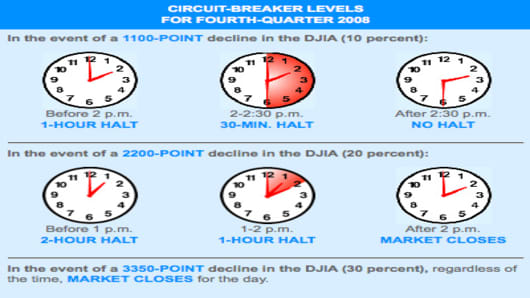
NYSE fourth quarter circuit breaker levels
Source: Nyse.com
NYSE fourth quarter circuit breaker levels

"Some of the concern in the market is ... 'Did everyone wait too long? Have events begun to spiral that can't be reached back for?' You hope not. But there is some feel of that in the markets," Art Cashin, director of floor operations at UBS, told CNBC, while wearing, ironically, a Dow 10,000 hat.

Cashin said ideally we'd see a "capitulation selloff" today, maybe even into tomorrow morning, then get a "massive reversal."

Crude oil [US@CL.1  Loading...      ()   ] tumbled more than $6 a barrel to settle at $87.81 a barrel on fears that a global recession will dampen demand for energy. The last time oil ended below $90 was in February.

Energy stocks decline but, like the rest of the market, ended off earlier lows, with ExxonMobil [XOM  Loading...      ()   ] off less than 1 percent and Chevron [CVX  Loading...      ()   ] off 3.2 percent.

One historical note of optimism, such big drops in commodities typically occurs at the end of a market downturn.

Bank stocks took the hardest hit: Citigroup [C  Loading...      ()   ], Bank of America [BAC  Loading...      ()   ] and JPMorgan [JPM  Loading...      ()   ] all ended off more than 4 percent.

Regional banks got clobbered: National City [NCC  Loading...      ()   ] was down more than 27 percent, while Sovereign Bancorp [SOV  Loading...      ()   ] fell 3.8 percent.

Wachovia [WB  Loading...      ()   ] shares ended down 6.9 percent following news that Citigroup [C  Loading...      ()   ] was filing a complaint, citing breach of contract, after Wachovia snubbed its bid in favor of a deal with Wells Fargo. Citi is apparently seeking $60 billion in damages. A source familiar with the matter said Citigroup and Wells Fargo [WFC  Loading...      ()   ] are close to a resolution.

U.S. lawmakers expressed outrage over the collapse of Lehman Brothers during hearings on the matter, saying the firm's executives, board and regulators all share the blame. Former Lehman CEO Richard Fuld testified that regulators were aware of everything Lehman did — including how it priced its distressed assets — before its collapse.

(Check out a timeline of Lehman's collapse.)

JPMorgan was accused of allegedly precipitating the collapse of Lehman Brothers [LEHMQ  Loading...      ()   ] by freezing Lehman assets days before it filed for bankruptcy protection, UK newspaper the Sunday Times reported.

With hopes that the bailout package voted by Congress would calm the markets dashed, investors are now looking to the Federal Reserve to make the next move. Traders expect the Fed to slash the current 2 percent target Fed funds rate by a half point before its next meeting, Oct. 28.

>> Poll: Should the Fed Announce an Emergency Rate Cut?

Technology stocks also took a pretty good beating amid worries that the global slowdown is going to clamp down on tech spending, both by businesses and individuals.

Research In Motion [RIMM  Loading...      ()   ], Google [GOOG  Loading...      ()   ] and Microsoft [MSFT  Loading...      ()   ] ended lower but Apple [AAPL  Loading...      ()   ] recovered by the end of the day, gaining 1.1 percent.

EBay [EBAY  Loading...      ()   ] lost 5.5 percent after the online auctioneer announced plans to reduce its work force by 10 percent and said it expects to beat its third-quarter earnings forecast. The company also announced $1.3 billion in acquisitions — the Bill Me Later payment service and a Danish online-classifieds firm.

ImClone [IMCL  Loading...      ()   ] was among the few stocks that held onto a gain all day following news that it will be bought by Eli Lilly [LLY  Loading...      ()   ] for $70 a share after rejecting a sweetened offer from Bristol-Myers Squibb [BMY  Loading...      ()   ].

The offer from Eli Lilly values ImClone, which makes the cancer drug Erbitux, at $70 per share, a premium of 51 percent to ImClone's closing share price on July 30, the day before Bristol-Myers made an offer of $60 a share.

Pilgrim's Pride [PPC  Loading...      ()   ] tumbled 26 percent amid a fresh wave of fears that the chicken producer will be able to secure credit amid the global turmoil.

This Week:

MONDAY: House Oversight hearing on Lehman collapse
TUESDAY: Bernanke, Stern speak; Fed minutes; consumer credit; Earnings season kicks off with Alcoa, Yum Brands; Second presidential debate
WEDNESDAY: Weekly mortgage applications; Fed's Plosser speaks; Pending-home sales; Weekly crude inventories; Earnings from Costco, Monsanto and Ruby Tuesday
THURSDAY: Retailers report Sept. sales; Bank of England announcement; Weekly jobless claims; Wholesale trade; Natural-gas inventories; Fed's Stern speaks; Earnings from Chevron
FRIDAY: Import/export prices; Trade gap; Treasury budget; Earnings from GE

© 2009 CNBC.com
Tools:
Print EmailAdd This share icon


Current DateTime: 01:01:24 05 Jul 2009
LinksList Documentid: 29778428

Current DateTime: 01:24:58 05 Jul 2009
LinksList Documentid: 29779196

Current DateTime: 01:24:59 05 Jul 2009
LinksList Documentid: 29779199

Current DateTime: 01:01:20 05 Jul 2009
LinksList Documentid: 29779198
CNBCCNBC
About CNBC  |  Site Map  |  Privacy Policy  |  Terms of Service  |  Video Reprints  |  Advertise  |  Help  |  Contact
Partners: AOL Money  |  BloggingStocks.com
CNBC is a Division of NBC Universal
  Data is a real-time snapshot *Data is delayed at least 15 minutes
Global Business and Financial News, Stock Quotes, and Market Data and Analysis

© 2009 CNBC, Inc.  All Rights Reserved.
Thomson ReutersThomson Reuters