

President Bush said Friday that the government's financial rescue plan was aggressive enough and big enough to work, but would take time to fully kick in. "We can solve this crisis and we will," he said in brief remarks from the White House Rose Garden.
Gerald Herbert
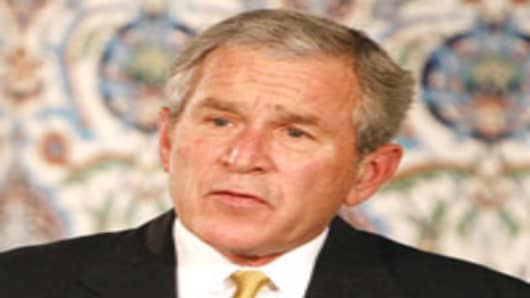
President Bush, right, makes remarks during the re-dedication ceremony of the Islamic Center of Washington in Washington, Wednesday, June 27, 2007. Center Director Dr. Abdullah Khouj is at left. (AP Photo/Gerald Herbert)
Bush spoke as leaders of the world's top economies gathered in Washington amid frozen credit markets, panic selling in stock markets and a looming global recession.
The president noted that major Western countries were working together in an attempt to stabilize markets and end the spreading panic, including coordinated cuts in interest rates.
"Through these efforts, the world is sending an unmistakable signal. We're in this together and we'll come through this together," Bush said.
Finance ministers and central bankers from the Group of Seven -- the United States, Japan, Britain, Germany, France Italy and Canada -- were here for a weekend meeting. Bush plans to meet with the leaders on Saturday.
Bush said he understood how Americans could be concerned about their economic future. "That anxiety can feed anxiety and that can make it hard to see all that's being done to solve the problem," he said.
But despite a relentless sell-off that has seen the Dow Jones industrials plunge 20 percent in the past seven trading days, Bush said, "We are a prosperous nation with immense resources and a wide range of tools at our disposal."
(To listen to Bush's comment, watch the attached video.)
The president said the new $700 billion rescue plan that he signed into law a week ago authorizes the Treasury Department to use a variety of measures to rebuild their balance sheets including "purchasing equity of financial institutions."
It was the first time the president has mentioned suggestions that the government buy shares of banks, although it has been mentioned by other administration officials.
Since the bailout package was signed into law, the conversation about how it will be used has shifted from taxpayers buying troubled mortgages to taxpayers buying troubled banks. Or at least pieces of them.
Such a move would amount to a partial nationalization of the U.S. banking industry, a move once considered unthinkable.
The government is authorized under the law to buy "troubled assets."
Those assets include mortgages, but according to the law, they may also include "any other financial instrument" that is "necessary to promote financial market stability ... ."
It is the government's position that this authority extends to bank stocks.
"The plan we are executing is aggressive. It is the right plan. It will take time to have its full impact. It is flexible enough to adapt as the situation changes. And it is big enough to work," Bush said.
He also noted that the Federal Reserve has injected hundreds of billions into the system and with other central banks has made interest-rate cuts that should help thaw frozen credit markets and enable loans to flow again.
Government insurance on bank and credit union deposit accounts has been raised to $250,000 and the Treasury is offering insurance for the first time for money-market funds, he added.
"The federal government has a comprehensive strategy and the tools necessary to address the challenges in our economy," Bush said.
While he sought to reassure Americans that the government is doing all it can, Bush also acknowledged mounting worry among people about their retirement and investment accounts.
Bush said his administration had launched initiatives that "have helped more than 2 million Americans stay in their homes."
He also noted "rigorous enforcement" steps taken by the Securities and Exchange Commission to make sure that some investors don't "take advantage of the crisis to illegally manipulate the stock market."
Stock market volatility continued, with the Dow Jones industrials falling nearly 700 points soon after trading began, regaining all of that deficit to show an advance and then turning lower again.
"Over the past few days," Bush said, "we have witnessed a startling drop in the stock market, much of it driven by uncertainty and fear. This has been a deeply unsettling period for the American people."
More From CNBC.com