![]()
- FDIC's Bair Cautions on Risks in Bank Break-Up Plan
- Wednesday's Economic News Crunch Could Tilt Markets
- Call Me Crazy: Confessions of a Black Friday Shopper
- US Firms Hit by Payroll Taxes at Exactly the Wrong Time
- Citi Mortgage Reveals Something the US Treasury Won't
- Fed Sanguine About US Recovery, Worried on Jobs
- MGM Pitches Sale to 20 Suitors, Including News Corp
- Holiday Guide to This Season's Smartphones
- Amended Berkshire Filing Reveals No 'Secret' Holdings
- Citi Mortgage Reveals What Treasury Won't
- S&P to Hit 1,200 by Year-End: Chief Investor
- Amended Berkshire Hathaway Filing Indicates No Secret Stock Stakes at End of Q3
- Facebook's Biggest-Ever Holiday Shopping Season
- Facebook's New Dual Class Structure - Slow Steps to an IPO
- 5 Big Bank Stocks Investors Should Consider: Strategists
- Gambling Drunk, Texting to Live And America's On Sale - Your Emails
- Nov. 24: Unusual Volume Leaders
- NBA D-League On The Rise
MOST SHARED
- The 'Real' Jobless Rate: 17.5% Of Workers Are Unemployed
- Wednesday's Economic News Crunch Could Tilt Markets
- NBA D-League On The Rise
- Obama Reiterates Commitment to Boost US-India Ties
- Australia Wheat Exporters Face Challenges: GrainCorp
- Trading Block
- Stifling Anger at Work Can Kill, Survey Finds
- Japan Export Rebound Eases Fear of New Recession
- Oil Slips Below $76 On Revised US GDP Data
- Gold Hits Record on Dollar, India Buying Talk
![]() |
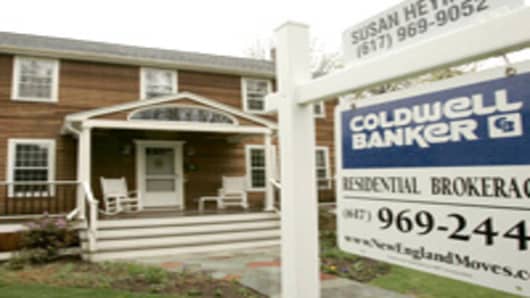
AP Home for sale - Coldwell |
Home prices across much of the country are likely to fall through late 2009, economists say, and in some markets the trend could last even longer depending on the severity of the anticipated recession.
In hard-hit areas like California, Florida and Arizona, the grim calculus is the same: More and more homes are going up for sale, but fewer and fewer people are willing or able to buy them.
Adding to the worries nationwide are rising unemployment, falling wages and escalating mortgage rates — all of which will reduce the already diminished pool of would-be buyers.
“The No. 1 thing that drives housing values is incomes,” said Todd Sinai, an associate professor of real estate at the Wharton School at the University of Pennsylvania. “When incomes fall, demand for housing falls.”
Despite the government’s move to bolster the banking industry, home loan rates rose again on Tuesday, reflecting concern that the Treasury will borrow heavily to finance the rescue.
On Wednesday, the average rate for 30-year fixed rate mortgages was 6.75 percent, up from 6.06 percent last week. While banks are moving aggressively to sell foreclosed properties, the number of empty homes is hovering near its highest level in more than half a century.
As of June, 2.8 percent of homes previously occupied by an owner were vacant. Nearly 1 in 10 rentals was without a tenant. Both numbers are near their highest levels since 1956, the earliest year for which the Census Bureau has such data.
- Dow Plunges Over 700 Points on Recession Fears
- Bernanke: Credit Crisis Major Threat to Economy
- Retailers Brace for Blue, Blue Christmas
- Poll: Tell Us Your Holiday Spending Plans
At the same time, the number of people who are losing jobs or seeing their incomes decline is rising. The unemployment rate has climbed to 6.1 percent, from 4.4 percent at the end of 2007, and wages for those who still have a job have barely kept up with inflation.
In New York and other cities that rely heavily on the financial sector, economists expect that job losses will increase and that pay heavily tied to year-end bonuses will decline significantly.
One reliable proxy of housing values — the ratio of home prices to rents — indicates that in many cities prices are still too high relative to historical norms.
In Miami, for instance, home prices are about 22 times annual rents, according to analysis by Moody’s Economy.com. The average figure for the last 20 years is just 15 times annual rents. The difference between those two numbers suggests that a home valued at $500,000 today might be worth only $341,000 based on the long-term relationship between prices and rents.
The price-to-rent ratio, which provides one measure of how much of a premium home buyers place on owning rather than renting, spiked across the country earlier this decade.
It increased the most on the coasts and somewhat less in the middle of the country. Economy.com’s calculations show that while it remains elevated in many places, the ratio has fallen sharply to more normal levels in places like Sacramento, Dallas and Riverside, Calif.
The current housing downturn is much more national in scope and severe than any other in the postwar period, partly because of the proliferation of risky lending practices. Today, foreclosures are running ahead of the downturn in the economy, a reversal of previous housing slumps.
“We are in uncharted waters,” said Brian A. Bethune, an economist at Global Insight, a research firm.
![]() |
Colleen Pestana, a real estate agent in Orange County in California, said many people losing their homes in Southern California used to work at mortgage and real estate companies. Many of them bet heavily on real estate by upgrading to bigger houses every few years. Now, many are losing their homes.
At the same time, Ms. Pestana said, her clients who are looking to buy are having a harder time lining up financing. One of her clients recently had to give up on a home after the lender that had offered a pre-approved loan changed its mind — a frequent occurrence, according to real estate agents and mortgage brokers.
“I am working harder than I have ever had to work to get a deal together and keep it together,” said Ms. Pestana, who has been a real estate agent for seven years.
To cushion themselves from potential losses if homes lose value, Fannie Mae and Freddie Mac, the mortgage finance companies that the government took over in September, have increased fees on loans made to borrowers who have good but not excellent credit records, even those who are making down payments as big as 30 percent.
Those higher fees are generally invisible to borrowers because banks factor them into mortgage interest rates. While the national average rate for a 30-year fixed-rate mortgage is now 6.75 percent, according to HSH Associates, mortgage brokers say the rates for many borrowers in the Southwest or Florida can be as high as 8 percent, especially for so-called jumbo loans that are too big to be sold to Fannie Mae [FNM
Loading...
()
] and Freddie Mac [FRE
Loading...
()
]. (Those loan limits vary by area from $417,000 to roughly $650,000.)
- Remember when auto shows were major events where new models could generate buzz?
- CNBC’s Mike Huckman visits a cutting-edge plant to see how the flu vaccine of the future is being made.
- People who bottle up their anger at work are up to five times more likely to suffer a heart attack, a study found.
- Playboy will outsource its publishing operations in a bid to become profitable again.
- A new McDonald's in Manhattan is the nation's first to sport a sleek, chic interior imported from stores in London and Paris.
- For nearly three decades, these on-call experts have been dishing advice on how to – and not to – cook turkey.


