

The hot-button issues of CEO pay and the Wall Street bailout may soon collide with the real world of Wall Street bonuses, taxpayer and shareholder anger over the financial crisis, and a Treasury secretary with deep roots on Wall Street. And that collision could be loud and ugly.
AP
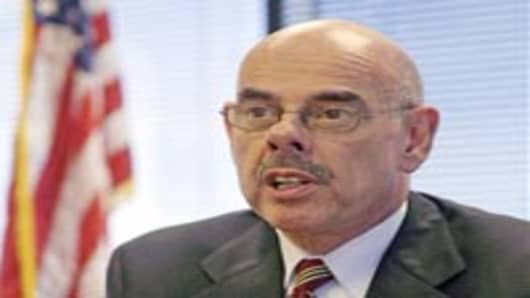
The first salvos were fired late Tuesday when Rep. Henry Waxman, who chairs the House Committee on Oversight and Government Reform, disclosed that he sent letters to the first nine major banks set to receive a capital injection from the government, seeking information on their compensation and bonus plans for 2008 and other years.
New York Attorney General Andrew Cuomo said that he would also be looking into the issues , though he isn't opening a formal investigation at this time.
Though what's commonly known as the Wall Street bailout package includes modest restrictions on CEO pay, it hardly prevents participating financial firms from paying bonuses to top executives and others.
And in an environment of beaten-down stock prices, rising layoffs, recession and huge government bailouts, experts and legislators say big end-of-year bonuses will cause a firestorm of public outrage and likely provoke a Congressional backlash.
"The corporate community doesn't seem to get it," says a seething Nell Minow, founder of the Corporate Library, which focuses on corporate governance issues. "If the corporate leaders don't come to the American people with some accountability, they are going to find themselves in a world of pain. Congress will set CEO pay."
And then some.
"People are going to be demanding that someone go to jail," say Rep. Peter DeFazio (D.-Ore), who says his constituents have applauded him for voting against the legislation. "It will require Democrats to revisit restrictions [on CEO pay]. "
DeFazio says he would also recommend Congress "empower a division in the FBI and Justice Department to investigate the fraud and misdeeds that went on."
Bailout Bonanza
Big compensation packages for CEOs, especially those on Wall Street, have been a matter of controversy for years, but what's different this time around is that the financial crisis has bludgeoned investors and taxpayers alike just as the economy tips into a nasty recession.
"You’re really dealing with an environment where outrage is the benchmark," Eric Dezenhall, founder of Dezenhall Resources, a damage control expert who's represented CEOs facing criminal prosecution and corporate crises. "In a climate like this, the question is: Do you want to make your millions or to be loved? Take your pick. Its not all spinnable."
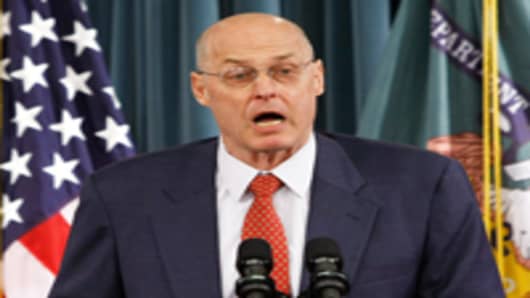
The equation is also complicated because as little as two years ago, the architect of the bailout program, Treasury Secretary Henry Paulson, ran Goldman Sachs, one of the big firms receiving a capital injection from the government and one famous for staggeringly high bonuses to executives —Paulson included.
AP
Henry Waxman
In a statement about his inquiry, Rep. Waxman's cites reports about billions in bonuses and quotes an unnamed analyst as saying: "Had it not been for the government’s help in refinancing their debt, they [the companies] may not have had the cash to pay bonuses."
Wall Street firms may already be aware of that public relations nightmare and readying gestures to quiet the storm. It's also too soon to tell how much bonus money is at stake. Few firms have commented on the issue publicly. One of the better-off firms, JPMorgan Chase ,which is also participating in the bailout plan, recently said it was cutting bonuses, but did not say it was eliminating them altogether.
Some critics of Secretary Paulson have accused him of being too too close to Wall Street, even as he has been thrust into the dual roles of fireman and policeman during a one-of-a-kind financial crisis. (Treasury has not responded to a request for comment around the time of publication)
What's more, the limited restrictions on CEO compensation in the bailout legislation, known as the Emergency Economic Stabilization Act, or EESA, were included at the urging of Congress. Like much else in the law, the restrictions give broad discretionary power to the Treasury Secretary.
More from CNBC:
- Treasury May Expand Rescue Plan to Include Private Banks
The EESA's restrictions on executive pay vary from program to program, but they universally limit tax deductions on pay up to $500,000. For the capital purchase program, which is now being used to recapitalize banks, the measures also eliminated the existing exception for performance-based compensation, such as bonuses.
The recap program also directs the Treasury secretary to prevent "incentives" that encourage executives "to take unnecessary and excessive risks that threaten the value of the financial institution," and bans so-called "golden parachutes" to the top five senior executives, whose compensation must be reported under existing SEC regulations.
Compensation experts say the restrictions won't make much of a difference.
AP
Henry Paulson
"You can get paid $30 million under this program," says Michael Kesner, who heads Deloitte Consulting's exceutive compensation practice. "There's no limit on what you can get paid. You think tax deductions are the concerns of these banks right now. They've got more tax deductions than than they can use. It does hurt shareholders, though."
Kesner says the measures may force companies to review risk policies and their relationship to compensation policies such that they "won't pay excessive severance" in the future, but adds "if it was really going to be a huge burden, companies wouldn't be lining up to participate." He says the the government's 5 percent payoff on capital invested is a "good deal" for the firms.
Critics of the legislation, both in and out of Congress, however, call the pay restrictions superficial, if not totally toothless.
"They just gave people cover to vote for the legislation," says Rep. DeFazio, who voted against the EESA.
"When the bill passed, everybody knew two things," says Rep. Brad Sherman (D. Calif.), who also voted against the bailout plan. "Hundreds of billions of dollars would be going to big firms, and the executives of those institutions would continue to get gigantic financial packages." Executives with existing golden parachutes will get them, says Sherman.
Wall Street firms may already be aware of that public relations nightmare and readying gestures to quiet the storm. It's also too soon to tell how much bonus money is at stake. Few firms have commented on the issue publicly. One of the better-off firms, JPMorgan Chase ,which is also participating in the bailout plan, recently said it was cutting bonuses, but did not say it was eliminating them altogether.
Some critics of Secretary Paulson have accused him of being too too close to Wall Street, even as he has been thrust into the dual roles of fireman and policeman during a one-of-a-kind financial crisis. (Treasury has not responded to a request for comment around the time of publication)
What's more, the limited restrictions on CEO compensation in the bailout legislation, known as the Emergency Economic Stabilization Act, or EESA, were included at the urging of Congress. Like much else in the law, the restrictions give broad discretionary power to the Treasury Secretary.
More from CNBC:
- Treasury May Expand Rescue Plan to Include Private Banks
The EESA's restrictions on executive pay vary from program to program, but they universally limit tax deductions on pay up to $500,000. For the capital purchase program, which is now being used to recapitalize banks, the measures also eliminated the existing exception for performance-based compensation, such as bonuses.
The recap program also directs the Treasury secretary to prevent "incentives" that encourage executives "to take unnecessary and excessive risks that threaten the value of the financial institution," and bans so-called "golden parachutes" to the top five senior executives, whose compensation must be reported under existing SEC regulations.
Compensation experts say the restrictions won't make much of a difference.

WALL STREET IN CRISIS - A CNBC SPECIAL REPORT
Even supporters of the bailout plan and the pay measures admit they could have been stronger.
"We tried to get more restrictive language in the bill," says Steve Adamske, a spokesman for House Financial Services Committee Chairman Barney Frank (D. Mass.) "We were not able to go as far as we would have perhaps wanted," he says, noting that the House earlier this year passed an advisory vote on a non-binding resolution giving shareholders a greater say on pay.
Corporate Culture Clash
What happens from here may partly depend on what happens behind closed doors. Experts say it is possible executives could be persuaded or pressured into taking smaller bonuses or forgoing them altogether — by the government or their boards.
There was a hint of that from the federal government recently when the SEC's Division of Corporation Finance Director John White addressed stock plan professionals at the 3rd Annual Proxy Disclosure Conference in New Orleans.
He spoke at length about the changes mandated by the EESA and, as one observer put it, "told boards to do what they thought Congress wanted them to do."
Some observers say none other than Henry Paulson might be doing some of the persuading.
Wall Street firms may already be aware of that public relations nightmare and readying gestures to quiet the storm. It's also too soon to tell how much bonus money is at stake. Few firms have commented on the issue publicly. One of the better-off firms, JPMorgan Chase ,which is also participating in the bailout plan, recently said it was cutting bonuses, but did not say it was eliminating them altogether.
Some critics of Secretary Paulson have accused him of being too too close to Wall Street, even as he has been thrust into the dual roles of fireman and policeman during a one-of-a-kind financial crisis. (Treasury has not responded to a request for comment around the time of publication)
What's more, the limited restrictions on CEO compensation in the bailout legislation, known as the Emergency Economic Stabilization Act, or EESA, were included at the urging of Congress. Like much else in the law, the restrictions give broad discretionary power to the Treasury Secretary.
More from CNBC:
- Treasury May Expand Rescue Plan to Include Private Banks
The EESA's restrictions on executive pay vary from program to program, but they universally limit tax deductions on pay up to $500,000. For the capital purchase program, which is now being used to recapitalize banks, the measures also eliminated the existing exception for performance-based compensation, such as bonuses.
The recap program also directs the Treasury secretary to prevent "incentives" that encourage executives "to take unnecessary and excessive risks that threaten the value of the financial institution," and bans so-called "golden parachutes" to the top five senior executives, whose compensation must be reported under existing SEC regulations.
Compensation experts say the restrictions won't make much of a difference.
Jaap Steinvoorte
Wall Street
"I hope so," says Keith Johnson, who heads the institutional investor services practice group at Reinhart Boerner Van Deuren. "Giving back their unearned compensation, any jesture would be a recognition of the roles they have played in helping create the situation we're suffering in. It would also help inevstors regain faith in the system."
Though many observes say the Treasury secretary should be doing that, skeptics find it hard to believe.
"How in the hell is he going to tell others that they should take less when he took half a billion dollars [in his career]?" says Rep. Sherman. "The most likely outcome is that the executives will get to keep the money."
Wall Street firms may already be aware of that public relations nightmare and readying gestures to quiet the storm. It's also too soon to tell how much bonus money is at stake. Few firms have commented on the issue publicly. One of the better-off firms, JPMorgan Chase ,which is also participating in the bailout plan, recently said it was cutting bonuses, but did not say it was eliminating them altogether.
Some critics of Secretary Paulson have accused him of being too too close to Wall Street, even as he has been thrust into the dual roles of fireman and policeman during a one-of-a-kind financial crisis. (Treasury has not responded to a request for comment around the time of publication)
What's more, the limited restrictions on CEO compensation in the bailout legislation, known as the Emergency Economic Stabilization Act, or EESA, were included at the urging of Congress. Like much else in the law, the restrictions give broad discretionary power to the Treasury Secretary.
More from CNBC:
- Treasury May Expand Rescue Plan to Include Private Banks
The EESA's restrictions on executive pay vary from program to program, but they universally limit tax deductions on pay up to $500,000. For the capital purchase program, which is now being used to recapitalize banks, the measures also eliminated the existing exception for performance-based compensation, such as bonuses.
The recap program also directs the Treasury secretary to prevent "incentives" that encourage executives "to take unnecessary and excessive risks that threaten the value of the financial institution," and bans so-called "golden parachutes" to the top five senior executives, whose compensation must be reported under existing SEC regulations.
Compensation experts say the restrictions won't make much of a difference.
"I think it would be reckless not to assume that there probably is somone working for him [Paulson] making a damage control calculation," says Dezenhall, the damage control expert. "You're dealing with a virtually guaranteed backlash."
Kesner of Deloitte says corporate America has read the writing on the wall, adding that he has a number of corporate clients whose stock is down sharply, are laying off employees, and feeling a lot of pressure to make a gesture, whether it's a salary freeze or giving up part of their bonuses.
"My client base doesn't really want to be seen as the bad guy," he says. "I think senior management is going to take steps to avoid it seeming they're making money off the back of their shareholders and taxpayers."
DeFazio is skeptical and prepared to legislate.
"If not, they'll be making my day. I've been trying to close these loopholes for years," he says of the compensation rules. "They'll become juicy targets."
The absence of any such gestures, however, is also likely to generate enough public outrage and thus draw more scrutiny, increasing the chance of civil and/or criminal investigations, sources say.
Sherman, for one, doesn't think they'll be much of that given what he sees as a general lack of wrongdoing in the crisis, but he did warn those who crossed the line.
"If any executive did anything wrong, he better have done it in 1997 and not 2007," he says. "If it was at a financial institution, there is going to more scrutiny. If there is anything illegal it's going to to be dealt with far more harshly."
(Editor's note: This story has been updated and republished since its original publish date of Oct. 28.)
