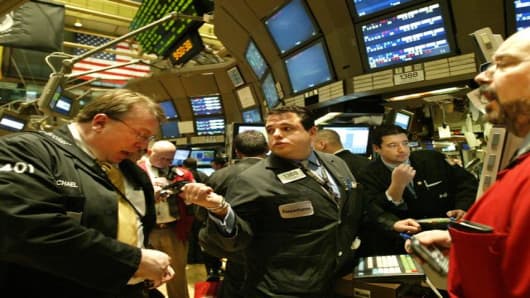
"It's actually not extraordinary," says Jordan Kimmel, a hedge fund and mutual fund manager at Magnet Investment Group in Randolph, N.J. "This is exactly how bear markets end, so it's not that uncommon at the very end of a bear market that has been this severe to see this kind of emotional trading."
Stocks had another volatile day on Thursday, when the Dow shot up roughly 150 points in the final 15 minutes to close up nearly 200.
The late-day market swing on Wednesday was attributed largely to an out-of-context statementfrom General Electric chairman Jeff Immelt that some took as an earnings warning from the company, a Dow component and parent of CNBC.
But to market veterans, such a wicked swing in sentiment is merely the symptom of the type of volatility that plagues bear markets. That's because when volume is light—as it typically is in bear markets—the actions of a relatively small number of investors can have a profound impact on stock prices.
So what should investors do in this kind of market? Investment pros have identified three broad factors behind this kind of whipsaw trading—and how you can profit from it.
Speed of Information
Though there are common elements in this bear market with previous downturns, market analysts do see differences.
For one thing, no other bear market has ever had such swift dissemination of information through electronic media, nor the ease of trading that sometimes bedevils this one. That has compounded the volatility.
"It has been exacerbated compared with other bear markets," says Quincy Krosby, chief investment strategist at The Hartford. "With programmed trading everything is very quick, instantaneous. It's been exacerbated by technology, the movement of global information and rumors."
For Investors
That came into play sharply following the Immelt rumor.
"What that rumor did—whether it was true or false—the fact that this is a trader's market you're going to extrapolate from that rumor," Krosby says. "That's what happens. They act very quickly, and what happens is you've got to take all this information, all these various headlines, all these disparate headlines, disparate rumors, and you have to distill them in a second and extrapolate from them, and that's what I think happened yesterday."
That rapid pace of information only serves to feed the anxiety that has been prevalent through the market since the credit crisis hit.
"I don't think it's normal, but nothing that has happened over the last several months has really been normal," says Richard Sparks, senior analyst at Schaeffer's Investment Research in Cincinnati. "We're in a market that we've never experienced before. It seems to me to point to how much fear there is in this market."
Traders Play the Swings
The types of market movements that have led to the Dow swinging as much as 1,000 points in a single day essentially involve taking the old strategy of "buy the dips, sell the rallies" and putting it on steroids.
Asked whether bear market rallies can be even this violent, Krosby says, "not even, especially this violent."
"That has been the hallmark of these rallies—sell into strength," she says. "I have to say the volatility we're seeing, the swings are emblematic of a bear market."
As the trend gains steam and the market gets closer to finding a bottom, such swings tend to be larger in terms of points and percentages, and can happen later in the day, especially if the market is at an extremely high or extremely low level.
That's been evidenced throughout the month, as the chart below illustrates.