"Slush fund" ... "banana republic" ... "Keystone Kops."
That's how some observers are describing the government's effort to stabilize the financial system, including its centerpiece rescue mechanism, known as the TARP.


"Slush fund" ... "banana republic" ... "Keystone Kops."
That's how some observers are describing the government's effort to stabilize the financial system, including its centerpiece rescue mechanism, known as the TARP.
Hatched hastily about two months ago, the TARP (Troubled Asset Relief Program) was
conceived to stabilize financial markets and restore investor confidence. But now it is looking so amorphous and vulnerable to political trade winds, that it is has become almost a constant of uncertainty.
"Things are changing so quickly, to a certain extent, it undermines the effectiveness of the actions undertaken" " Michelle Girard, senior economist at RBS Capital Markets, told CNBC Tuesday. "It makes people feel they don’t really have a handle on things."
"It's a little like the Keystone Kops," Girard added. "They're very reactive and it's very ad hoc and I think that undermines confidence at a time when what we need most is confidence that the officials in Washington know what's going on and know how to address the problem." (See her full comments in the video)
The latest turn came from Treasury Secretary Henry Paulson, who disclosed Monday that he did not plan on seeking authorization to release the second $350 billion in funds authorized under the TARP plan. He said he wanted to "preserve the firepower, the flexibility we have now and those that come after us will have."
What Paulson calls flexible, others consider amorphous. They say it is one of the plan's failings, along with its basic structure and generally poor coordination and execution. Together, critics argue, the problems are creating unnecessary uncertainty and undercutting its impact.
Just a week ago, Paulson made what many consider a major reversal by essentially dropping the TARP's original concept—to buy troubled assets in an auction—which many considered a bad idea in the first place. Instead, he said he would focus on its companiion program—exchanging capital injections for equity stakes in financial institutions—which Congress foisted on the Treasury Secretary in agreeing to approve rescue legislation.
Watch Paulson, others testify before House Financial Services panel—9:30 a.m. ET on CNBC.com
"If you start changing your mind about what the $700 billion is for, it detracts from your credibility," says Bob Bixby, executive director of the Concord Coalition, a non-profit group advocating fiscal discipline. "Right now it's questionable as to what the strategy is."
On the very same day Paulson changed course, Rep. Barney Frank (D.-Mass.), chairman of the powerful House Financial Services committee, was extolling the virtues of the auction process.
"It gives an appearance of they're-making-it-up-as-they-go along-element to this," says Steve Adamske, a spokesman for Rep. Frank, adding that the committee wished "there were a greater emphasis on foreclosures."
"By not having a clear focus and vision, people read him [Paulson] to believe that there was billions of dollars available for other things," says Brian Bethune, chief US economist at Global Insight. "The unintended consequence was that the fund could be raided."
And that's exactly how it seemed to many when some in Congress started talking about using TARP funds to help the ailing auto industry.
"Money in Washington is fungible," says Tom Schatz, president of Citizens Against Government Waste, adding the TARP has "become a kind of a slush fund in some ways in terms of who the Congress wants to bail out. Lobbyists are lining up to figure what they can get out it."
Others say that and a sizable election victory has emboldened Democrats in Congress.
"It's hard to escape the feeling that the majority in the Congress are paying off a strong constituency that helped them enormously in the last election," says former ten-term Republican congressman Bill Frenzel, now with the Brookings Institution. "You are seeing the Congress in a role people hate to see it in—responding to powerful constituencies rather than going after solving the problem."
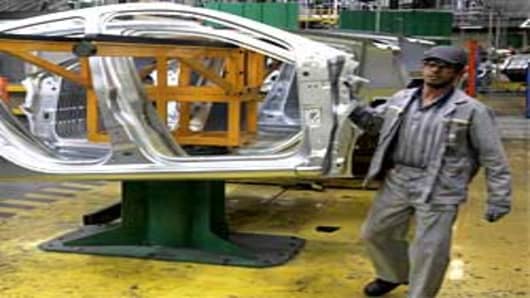
Frenzel, Schatz and others say there's no shortage of struggling manufacturing industries ready to join the auto companies in seeking a handout.
"This is just the beginning of corporate welfare in a big, big way," Richard Shelby (R.-Ala.), the ranking Republican on the Senate Banking Committee, told NBC's "Meet The Press" Sunday.
Meanwhile, some House Democrats want TARP funds used to help the foreclosure problem, an idea Frank strenuously argued for during a committe hearing with Paulson and Fed Chairman Ben Bernanke Tuesday. (That issue was indirectly addressed through the original auction process, which would have bought distressed mortgage-backed securities.)
Whether it is corporate welfare or simply a good deal, there may still be more to come.
Paulson's other surprise disclosure last week was that he was now leaning toward the requirement that companies receiving capital injections also needed to raise money from the private sector.
That's also met with some skepticism in Congress. Some legislators are critical over Paulson's decision to seek only a 5 percent dividens for its capital infusion, compared to what Berkshire Hathaway Chairman Warren Buffett extracted from Goldman Sachs.

"The key issue there will be whether his overwhelming sense of generosity to Wall Street will force him to inject capital on terms that are much worse for the tax payer than the terms private investor insist upon," says Rep. Brad Sherman (D. Calif.), who voted against the TARP legislation. "And by having those two groups come in at the same time, the differential in how those two groups of investors are treated will be all too apparent. "
Sherman suspects Paulson will try have the government continue to take preferred stock, while forcing private investors to buy something else, probably common stock, "to make it harder to compare apples and oranges."
Critics both in and out of government trace many of the problems to the TARP's origins. It was hatched in a crisis environment and is too vague in statute.
"The law has to be loose so the manipulators can attack different problems they see," says Frenzel, with the irony of a Capitol Hill veteran.
It addition to giving the Treasury Secretary too much authority, the TARP lacks adequate oversight, critics say. At the same time, though the exigencies of the crisis have forced the government to act quickly in spending funding, operational progress has been slow. Rules for the now uncertain auction have yet to be disclosed and the oversight board unfilled.
The oversight board may be constituted before the last dollar is spent," says Rep. Sherman. "And keep in mind the word 'oversight' is a misnomer. This is a critique board, not a control board. This board can issue press releases and write op-eds. It can't delay, halt or reverse any action taken by Paulson."
Dan Mitchell, a scholar at the Cato Institute, says the US is acting like a "banana republic."
"The legislation from the very beginning was an absolute blank check," explains Mitchell, who served as an economic aide to then-Sen. Bob Packwood. "I don't think there's any way a program like this can be successful. Politics is going to be the dominant factor."
