

If Congress turns its back on the Big Three auto makers—as many expect—investors probably won't drive the stock market off a cliff.
AP
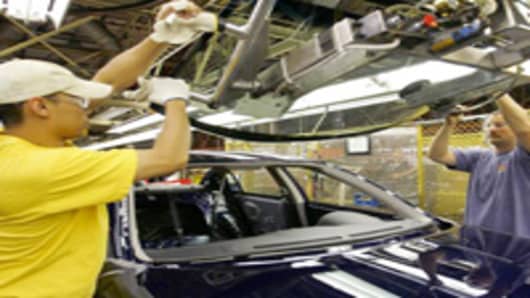
Car Factory Employees
Instead, some market experts see at most a brief selloff once news hits that Ford , General Motors and Chrysler won't be getting a bailout.
- Click here to watch House auto hearing live
Market reaction otherwise could be muted, despite the big scare headlines such a development would generate—and worries among average investors (see poll below).
"The market believes the importance of General Motors and the Big Three to the country at this stage is significantly smaller than what the auto makers are trying to make out," says Jordan Kimmel, a fund manager at Magnet Investing in Randolph, N.J.
"This (bailout) would be throwing good money after bad," Kimmel adds. "And you're looking at a couple of organizations that for years have missed every kind of business clue, and I think that the country is OK with letting somebody fail at this point."
Kimmel says the auto industry would recover as foreign producers like Toyota and Honda open new plants in the US and consumers buy their cars instead. That, in turn, would prop up ancillary businesses, such as suppliers and maintenance shops, that count on the automakers for their survival.
Moreover, sending the companies into Chapter 11 bankruptcy might be their only hope, giving them the opportunity to reconfigure their business models while staving off creditors.
After that, the companies can move forward with at least some protection both for consumers as well as employees and pensioners.
"I do not see much risk because of the fact that it's not going to be in Chapter 7," says Michael Cohn, founder of Atlantis Asset Management, referencing the term for a liquidation bankruptcy. "Whatever happens will be either a bailout or will be one of those pre-packaged bankruptcies, in which case they continue operating."
The market's initial reaction likely will be to sell on the auto maker news, but a closer look at the situation on Wall Street probably will stem a full-scale panic.
"The issue is that the business can't continue in its current state," Cohn adds. "The question is, how do we pull it out of its current state? I see absolutely no risk in the industry failing as a whole in that it's too big to fail. The repercussions are too big."
And a bailout itself may not necessarily lead to a rally, he argues.
With confidence so low in the government's ability to fix problems by aggressive intervention—read, the financial sector collapse—investors may shrug off such a move anyway.
More for Investors:
"Unless something really creative and really good is proposed to pull these guys out of the abyss, which no one believes is going to happen, the initial reaction is the 'sell' button," Cohn says. "It's a loss of faith, even in the (Treasury) printing presses. If they could dump money out of an airplane it wouldn't do anything."
More to Worry About
Besides, investors have plenty of things on their mind besides the crisis facing the Big Three.
Unemployment, housing troubles and continued pressure on the financial sector are every bit as much to blame for the current state of stocks as the problems with the auto industry, experts argue. In fact, there's debate about whether Detroit's ills are even the biggest issue among the market's various burdens.
"Certainly what's going on with the auto industry is grabbing a lot of headlines, but I also think there's a host of other factors out there," says Todd Salamone, vice president of research at Schaeffer's Investment Research in Cincinnati.
The auto stocks were down Wednesday, largely on belief that the hopes for a bailout were fading.
At the same time, the market sold off about in line with some of its recent declines. Analysts saw the drop related to the bad economic news of the day as well as the automaker troubles.
That's about what could be expected if the news is finalized that the bailout isn't happening.
"I wouldn't be surprised to see a quick reaction to any negative news," Kimmel says. "But the real question is, are you trying to create a healthy environment or are you trying to look at the next tick of the market? And that's what the decision has to be based upon."
Kimmel compares the auto makers situation to the Long Term Capital Management hedge fund bailout in 1998. That nearly $4 billion buyout is attributed by some to have contributed to the highly leveraged bank moves this decade that led to the credit crisis.
Formulating a similar government-funded rescue, he asserts, would send the wrong message to companies that take unwise risks with the belief that the government will be there to help should they fail.
"I think there was a day when what's good for General Motors was good for the United States. I think that day has probably passed," Kimmel says. "There are many more important companies than General Motors right now, and so there comes a time when you have to let somebody fail, and that sends a message."