

Wall Street isn't feeling much love from Washington these days.
With the lame-duck Congress and the Bush administration unable to agree on any action to boost the economy or ease the financial crisis, the markets have nosedived. The Dow Jones Industrial Average alone has plunged 2,000 points since Election Day.
"It can't get much worse,” says Christopher Rupkey, chief financial economist at Bank of Tokyo-Mitsubishi. “We're discounting they're going to rise to the rescue.”
Analysts say the problem goes well beyond the normal lame-duck government issues.
“They are working against confidence building,’ says David Resler, chief economist at Nomura International. “We're in a world where we need to deliver.”
The examples of paralysis are everywhere—from Treasury Secretary Henry Paulson’s frequent policy surprises to Congress’ inability to forge an auto bailout or second stimulus package.
President-elect Barack Obama’s delay in naming a Treasury Secretary had been a factor, as well, until the announcement late Friday that he had nominated Tim Geithner, president of the Federal Reserve Bank of New York and a key player in the government's rescue efforts, who was widely seen as a solid pick.
For Investors
- S&P 500 Falling to 660 'Within Days'
- A Few Investors 'Sniff' Capitulation
- Four Stocks That Are 'Relatively Safe'
- Peter Schiff: Dollar Will 'Fall Like a Stone'
- Credit Spreads and Libor
“Right now, it's almost too big for people to comprehend,” says Donald W. Riegle Jr., who chaired the Senate Banking Committee during the savings and loan crisis nearly 20 years ago. “You have divided government and a form of paralysis. And the main leadership force—the President—is sort of missing in action.”
Paulson In Focus
The stock of the administration’s man of action—Paulson—seems to have fallen as sharply as the market lately. Critics cite his stunning reversal on how the Wall Street bailout fund should be used, as well as signs this week that he's becoming disengaged from the whole crisis.
“I'm really at a loss to understand what he is doing,” says Dean Baker, co-director of the Center for Economic and Policy Research. “He's made a lot of big mistakes.”
Video: Watch a discussion of the markets and the gridlock in Washington
Paulson’s announcement a week ago to abandon using the TARP fund to buy troubled mortgage assets in favor of injecting capital directly into banks is still reverberating in financial circles—as well as Washington.
“The abrupt change caught us by shock because that was not part of the debate,” Sen. Charles Grassley (R.-Iowa), told CNBC.
“Secretary Paulson is not getting the phone calls we're getting,” adds Sen. Claire McCaskill (D.-Missouri), who—along with Grassley—is cosponsoring legislation to strengthen the oversight board of the TARP. “It is uncomfortable to rationalize that what we voted for is not what they're going to do. He has to understand in this climate, it’s very frustrating for the average American to understand what we're doing.”
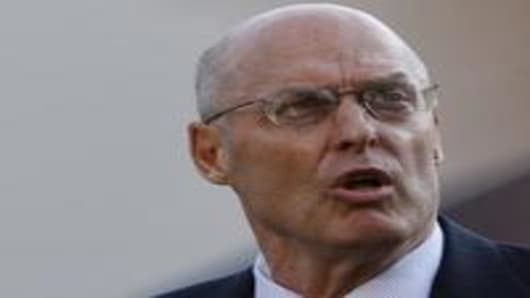
Days after that policy move, Paulson surprised many again in saying he would not seek authorization for the second $350 billion of the TRAP program, leaving that to the Obama administration.
That raised questions about how Paulson viewed the urgency of the current situation, given that he had rushed to Capital Hill in late September and urged swift passage of the $700 billion package. It also emboldened Congressional Democrats to consider using the rescue fund for non-depository institutions.
"It’s not big enough and it’s not going in the right direction," Christian Thwaites, CEO of Sentinel Asset Management, told CNBC, echoing a common criticism. "It’s a disaster from a PR point of view and a confidence point of view. He keeps making these opaque speeches. He's completely lost the thread of his communication."
Thwaites thinks the market can fall another 5-10 percent before the Jan. 20 inauguration, in what appears to be a new stage of the financial crisis, which has been particularly brutal on bank stocks, such as Citigroup .

WALL STREET IN CRISIS - A CNBC SPECIAL REPORT
Even more surprising, Paulson made public comments twice this week that the government’s efforts had succeeded in stabilizing the financial system.
On Thursday, he made that point in a major speech at the very moment Congressional leaders were holding a news conference to say there was no compromise agreement to bail out the nation’s automakers.
“It’s not clear to me that we’ve stabilized the financial system—the markets don’t think that,” says Lawrence White, a former white house economist and regulator, now with NYU’s Stern School of Business. “I'm really surprised that Paulson has thrown in the towel.”
The Impact of Paulson's Lame-Duck Status
TARP Politics
Supporters and critics say Paulson’s lame-duck status may be more worrisome and unsettling than President Bush’s, because the bailout legislation gives vast and unprecedented authority to the Treasury Secretary.
At one point Paulson seemed “almost presidential,” says Bon Bixby, executive director of the Concord Coalition, which preaches fiscal responsibility. “If you start changing your mind about what the $700 billion is for, it detracts from your credibility.”

“There was an atmosphere here in Congress, ‘Oh my god, we need somebody smarter than ourselves, give him the money,” says Rep Brad Sherman (D. Calif.), who voted against the legislation.
Paulson’s missteps and step-back have both emboldened members of Congress, some of whom clearly regret voting for the TARP, say observers, and is now rethinking its use.
“Congress wants influence over it,” says the Cato Institute’s Dan Mitchell, who served as an economist to Sen. Bob Packwood.
“They don't have much incentive to compromise with Paulson at this point,” says Baker.
Congress Adrift
That, too, has had negative repercussions for the markets.
“The kind of spread-it-around mentality shows a lack of understanding of the issue that's out there,” says Brian Bethune, chief US economist at Global Insight.
That was aptly illustrated by the desire of some Democrats to use the TARP to bail out the auto industry. Former ten-term Republican congressman Bill Frenzel, now with the Brookings Institution, calls it “a new-use mandate.”
What’s worse, ideological differences and partisan politics boiled over during the auto bailout debate.
“It’s very hard for the Congress to do itself,” says Riegle, who represented Michigan and spearheaded the Chrysler bailout three decades ago. “You have a vacuum. “If the president had a plan to direct some of that money, then you could get the votes in the Congress.”
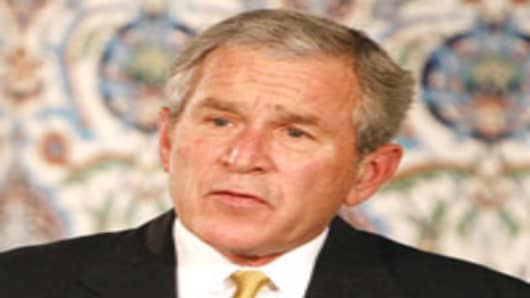
Gerald Herbert
President Bush, right, makes remarks during the re-dedication ceremony of the Islamic Center of Washington in Washington, Wednesday, June 27, 2007. Center Director Dr. Abdullah Khouj is at left. (AP Photo/Gerald Herbert)
Instead, the Congress spent about as much time on a $25 billion package as it did on the $700 billion TARP, failing to produce any legislation but creating more uncertainty.
“Congress is going back to a business-as-usual approach,” says Frenzel.
In doing so, the lame-duck Congress probably gave up any chance of creating a second stimulus package, whose broad support includes Fed Chairman Ben Bernanke, business leaders, supply-side economic maestros such as Martin Feldstein of Stanford University and, of course, President-elect Obama.
Obama's Role
Obama, who quickly convened a group of economic advisors for a one-day summit the same week he was elected, certainly did what he could in naming his Treasury nominee, who by virtue of already being in government should be able to achieve a faster transition than others.
AP
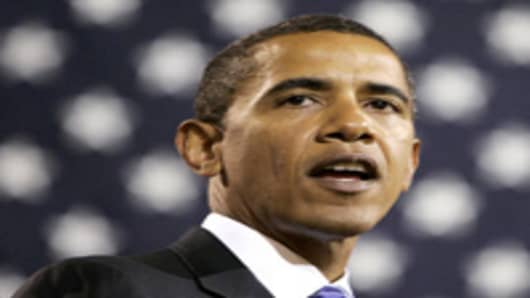
Barack Obama
Until that decision Friday, observers like Resler worried the President-elect would soon "squander his honeymoon period.”
For former senator Riegle, who was among those applauding the choice of Geithner, much of the responsibility still rests on the sitting president, George W. Bush.
“The President should assemble a task force and working group, meeting seven days a week to come up with a plan to get us thru November, December and January,” says Riegle.
