

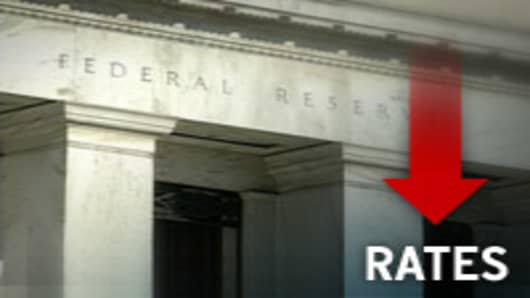
The Federal Reserve slashed its target for overnight interest rates to a record low of zero to 0.25 percent, and said it would employ "all available tools" to battle a year-long recession.
The surprise move to lower its target for the benchmark federal funds rate from one percent puts the Fed in uncharted territory. Financial markets had expected the Fed to lower rates by no more than three-quarters of a point, to 0.25 percent.
AP
In its statement, the Fed underscored its committment to use extraordinary measures, including using its balance sheet to support the credit markets.
"The Federal Reserve will employ all available tools to promote the resumption of sustainable economic growth and to preserve price stability," the Fed said.
The cut in the federal funds rate pushes it to its lowest level on records dating to July 1954, and the central bank said it would likely keep it at "exceptionally low levels for some time."
"There is no more room to cut rates, as the target cannot go negative," said economist Chris Rupkey of Bank of Tokyo-Mitsubishi. "Quantitative easing will be the new way for the Fed to stimulate the economy going forward."
In addition to the rate cut, the Fed said it was prepared to expand already announced large purchases of debt issued by government-sponsored mortgage agencies to support the battered US housing market.
The program to buy $600 billion in debt and mortgage-backed securities from mortgage giants Fannie Mae and Freddie Mac already has helped pushed mortgage rates down.
The Fed, however, remained cautious about another unusual measure, which Fed Chairman Ben Bernanke first floated two weeks ago. The statement said the central bank was still "considering" buying long-term Treasury securities, which is also thought to be aimed at lowering borrowing costs by going around commercial banks.
By boosting the quantity of money in the financial system, the Fed has engaged in so-called "quantitative easing" to provide economic relief. The Fed's balance sheet has ballooned to $2.2 trillion, from close to $900 billion in September, reflecting efforts to mend the financial system.
Video: Reaction to the Fed decision.
"With this statement the Fed embarks on a no-holds barred posture to help the economy." said Robert Brusca, chief economist at Fact & Opinion Economics. "The rate cut is the least of what the Fed is doing."
Mickey Levy, chief economist at Bank of America, said the Fed emphasized its intention to focus on "open market purchases of agency mortgages and debt, which will involve allowing the federal funds rate go toward 0%."
Prices for US stocks and government debt shot higher, while the dollar slipped, on the Fed's announcement.
"It's a highly unorthodox and creative step," said Michael Woolfolk, senior currency strategist, at the Bank of New York-Mellon in New York. "We think it's the best possible move for the U.S. consumer and for the financial market."
The Fed's unusual decision to establish a target range for the federal funds rate rather than a set level is a clear response to recent market conditions, where the rate has actually traded well below the one percent target.
The Fed is "acknowledging that", Bob Doll of BlackRock told CNBC. In recent days, the rate has been solidly below 0.25 percent.
In its statement, the Fed signaled its intentions by saying circumstances "warrant" keeping interest rates low for "some time." The Fed empoyed a similar telegraphing approach during the 2003 period when there were worries about deflation. That successfully managed the market's expectations.
"He [Bernanke] took the conventional funds rate out of play," says David Jones, of DMJ Advisors. "He's saying I'm going to use everything in my power."
Doll says the Fed is trying to get investors to buy a broader range of debt products than Treasuries, which have benefitted from an enormous flight to safety in recent months.
If successful, investors will move to government agency securities and then corporate bonds, which market strategists say is a necessary precondition to any sustainable improvement in stock prices.
Though economists and money managers welcomed the Fed's latest innovation, it did raise some concen about the state of the economy.
"The economy must be in pretty bad shape if the Fed needs to jump market expectations and push rates just a hair above the zero line," said Rupkey.
One veteran economist—among those who thought the Fed had already eased more than enough—said the central bank may have created an interesting predictament for itself and the markets going forward.
"What will the statement at the end of January say other than offer a litany of all the risky assets they are buying," asked Ram Bhagavatula of Combinatorics Capital. "How does that indicate whether monetary policy is more or less easy?"
—AP and Reuters contributed to this story.
