Go Symbol Lookup
Loading...

Outlook 09: Bad Or Worse For The Economy

 Text Size  
Published: Wednesday, 24 Dec 2008 | 1:45 PM ET
Albert Bozzo By: | Senior Features Editor

Forget about the good. It’s about the bad and the ugly when it comes to the US economy next year. The big questions are how ugly things will get and how they’ll compare to recessions of the past.

Ever since the collapse of Lehman Brothers in mid-September, economists have been scrambling to revise their forecasts, and its all been for the worse.

AP
Crowd of people on the street.

“The economy is in a bit of a free fall,” says Nariman Behravesh, chief economist at Global Insight.

Behravesh is among those who now expect the economy to contract as much as 5 percent on an annualized basis in the first quarter, followed by a small contraction in the second quarter.

Bank of America’s chief economist Mickey Levy is forecasting a decline in every quarter of 2009 and doesn’t see a return to trend, or normal, growth until early to mid 2010.

"The enormous correction in housing will continue through next summer," accompanied by a "rapid rise in unemployment and declining corporate profits," Levy says.

History In The Making?

Current conditions, as well as the outlook, are bad enough that there’s significant debate over how deep the recession will be.

Global Insight’s outlook assumes President-elect Barack Obama and Co. “do something big, bold and swift,” explains Behravesh. “If they don’t, then for sure this is the worst recession in the Cold War period.”

That would top those of the 1973-1975 and 1980-1982 periods. In the former, the jobless rate was above 10-percent for 10 consecutive months; in the latter, the economy didn’t grow for two consecutive years.

The rebounds from those two recessions, however, were powerful, marked by strong growth for a couple of years thereafter with housing leading the way.

Residential investment, a.k.a. housing, averaged some 22 percent growth in the 1976-1977 period and 23 percent in the 1983-1984 period.

“With another eight months of declines in home prices, you start to get some modest pickup in sales, followed by a stabilization in construction, not a bounceback,” warns Levy.

Predictions 09 -- A CNBC Special Report

Another key yardstick of any recession is unemployment. The jobless rate is widely expected to rise steadily from its current rate of 6.7 percent to 9-percent in 2009 or early 2010. If so, that would be double the expansionary low of 4.4 percent set in December 2006—something that didn’t happen in either of the past two recessions.

While the doom-and-gloom camp is looking crowded these days, it's difficult to find someone with a rosy scenario. At best, there’s guarded optimism.

“The recession will end sometime in the first quarter, followed by a not great-shakes recovery,” says Ram Bhagavatula, managing director at Combinatorics Capital. “There’s room for optimism. Both the Fed and Treasury have done a lot more than they usually do at this point in the cycle."

That might help explain the Fed’s latest quarterly forecast, released at the end of October.

What it calls its central view, what might be considered a median, puts real 2009 GDP in a range of –0.2 to 1.1 percent. The full spectrum of members’ views runs from -1.0 to 1.8 percent.

At best, the Fed’s survey is approximate, reflecting “higher than normal” uncertainty about economic activity (the margin of error is plus/minus 1.3 percent).

At worst, the Fed’s forecast is hopelessly dated, like those of the Congressional Budget Office and the International Monetary Fund, both of which will be updating their numbers in early January. The IMF wouldn’t comment for this story.

"Aggressive action is going to be necessary," says John J. Castellani, chief economist at the Business Roundtable, whose members see the economy contracting through the second quarter.

The CEO group would like to see tax cuts, heath care modernization and housing relief in the nation's recovery agenda.

Housing Holds the Key

Housing Divided

AP

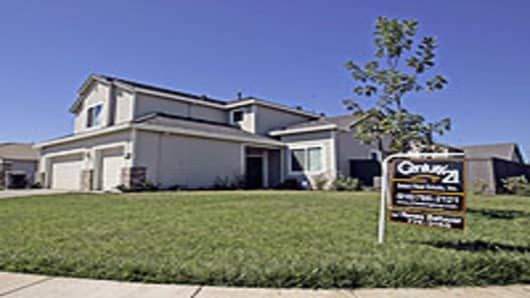
If, as Treasury Secretary Henry Paulson has often said, the problem began with housing, there’s a chorus saying housing is the key to any sustained economic recovery. Agreement, however, ends there, as there's considerable debate about when that will happen.

David Rosenberg, chief North American economist at Merrill Lynch, sees another 15 percent decline in house prices. “We don't have a lot of pent up demand,” he told CNBC. “The supply needs to go down.”

On the other hand, optimists point to relatively stable sales over the past year, declines in new and planned construction and the recent sharp drop in mortgage rates.

“We are starting to find the critical elements to a housing bottom,” says David Resler, chief economist at Nomura International, adding a late spring rebound in sales and prices is “not out of the question.”

Trade groups like the Mortgage Bankers Association and National Association of Realtors are more guarded.

The MBA expects rates on 30-year fixed mortgages to plateau at about 5 ¼ percent in the first half of the year, but tighter credit borrowing standards will continue to keep would-be buyers out of the market. Meanwhile, prices will continue to decline, but more moderately.

“Were it not for the recession increasing joblessness, stabilization is not inconceivable,” says Jay Brinkman, the group's chief economist.

“Rates need to go lower to offset speed of rising joblessness," adds Lawrence Yun, chief economist at the NAR, which expects single-family home sales rising in the first half and prices in the second half.

The NAR is among those that say housing-focused programs are needed in the massive fiscal stimulus plan expected from the Obama administration.

White House, Your House

 Print
The big questions for the coming year are how long and deep will the recession be  and how it will  compare to those  of the past.

   
Comments


More Comments


Add Comments


Your Comments (Up to 1100 characters):

Remaining characters

Your comments have not been posted yet.

Please review your submission to make sure you are comfortable with your entry.

Your Comments:


Featured