Skip navigation
MOST POPULAR RELATED TAGS
  • TOPICS
  • SECTORS
  • COMPANIES
Tech Check Video Gallery
Dell's Q3 earnings still weigh on the tech sector today, with CNBC's Jim Goldman.
Insight on Dell's numbers, with CNBC's Jim Goldman and Mark Stahlman, Signal Lake Ventures.
TECH CHECK STOCK INDEX
Loading...
Loading...
Loading...
Loading...
Loading...
Loading...
Loading...
Loading...
Loading...
Loading...
Loading...
Loading...
Loading...
Loading...
Loading...

TECH CHECK VIDEO

» More

Current DateTime: 03:57:43 21 Nov 2009
LinksList Documentid: 31047929
Expiration DateTime: 11/21/2009 3:58:29 PM

RSS FEED

» Help

Current DateTime: 03:57:43 21 Nov 2009
LinksList Documentid: 31047922
powered by digg

Tech Check

Text Size
Jan.14
8:23 PM ET
Wednesday, 14 Jan 2009
For Apple's Jobs, What a Difference a Week Makes

By now you know the news, that Apple CEO Steve Jobs is admitting that his health issues have not only become a serious distraction for him, his family and the Apple community, but they've also become more "complex" than Mr. Jobs had originally thought.

He'll take himself out of the day-to-day limelight of the company for the next six months, but not relinquish his role as CEO. Day-to-day management will now go to Chief Operating Officer Tim Cook, who assumed the same responsibilities when Jobs underwent surgery for pancreatic cancer back in 2004.

There will be myriad questions as to how Apple [AAPL  Loading...      ()   ] has handled this issue from the start; beginning with Jobs' gaunt appearance in public and the shroud of secrecy over all things health-related when it came to Jobs; there will be questions about how Jobs has teased the media, investors and the Apple community with passing references to his blood pressure, and citing the famous exaggerated death quote from Mark Twain after a news organization mistakenly ran his obituary. But the biggest question I have centers very much on the present.

Over these last several months, I have reported extensively on the Steve Jobs health issues: not how sick he was, because how could I possibly know without having access to his medical charts; but instead about Apple's fiduciary responsibility in releasing material news about its CEO and his ability to run the company. The threshold is quite simple: either he can run the company or he can't. If he's dying, but still running the show, technically, Apple didn't have to share any private details about his health. Legally, the company was solid. Ethically, morally, maybe not so much. But such was the tack Apple took.
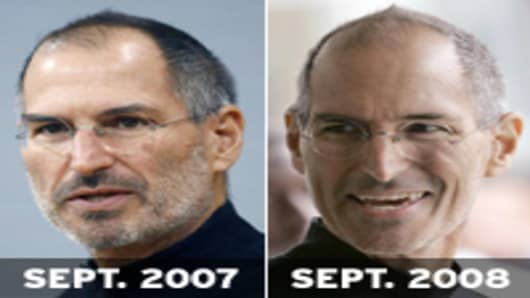
AP
Pictures of Steve Jobs just a few years apart.

Last week, Jobs released a statement acknowledging a "hormonal imbalance" as the reason why his body remained so thin. It was only after "sophisticated" blood tests that doctors finally pinned down what was plaguing him. He said in the note then that as soon as he determined he was unable to perform his duties as CEO, he'd be the first to step forward and admit it. All along, sources (and yes, there are several) inside Apple have reassured me that Jobs was firmly in charge, executing his responsibilities, and performing his role as CEO. One source, who I have known for years, told me recently that Jobs was "fine," and that everything was under control. All of it was fine. And I stand by every word of that reporting. Even today.

What troubles me is what has transpired over the past week. Sophisticated tests showed Jobs he was suffering a hormone imbalance. And only a week later, he admits that something happened in these intervening days that showed him his health-related issues are more complex than he originally thought. Come on. Forgive my skepticism. That seems disingenuous to me at best; dishonest at worst. It's tantamount to fiduciary, ethical and financial whiplash.

The fact is, late last week I spoke to two well-known tech industry executives, both of whom are very close to Jobs, and one of whom had been speaking to Jobs regularly up until a couple of months ago. Neither has an axe to grind, and neither needs to manipulate Apple stock to make more money. Trust me when I tell you that both have plenty. What struck me was that both felt compelled to come to me to tell me that they had "serious misgivings" about the state of Jobs' health. One said, based on his contact with Jobs personally, that he was in "serious denial" about just how bad the circumstances had become. The other explained to me that he was "deeply concerned" about Jobs, and the sudden lack of communication, the non-return of emails, ignoring chat requests, unreturned phone calls was a strong indication to him that Jobs was in "dire" shape.

Both of these executives admitted that they had no direct knowledge of Jobs medical treatment. But both also said they were making their judgments based on their past relationships with Jobs, what he had told them, and how he was acting today.


Tools:
PrintEmailAdd This share icon
Next Post
  • digg share
ADD COMMENTS
Remaining characters


Current DateTime: 06:39:37 21 Nov 2009
LinksList Documentid: 29778428

Current DateTime: 01:03:48 21 Nov 2009
LinksList Documentid: 29779196

Current DateTime: 01:05:48 21 Nov 2009
LinksList Documentid: 29779199

Current DateTime: 01:05:48 21 Nov 2009
LinksList Documentid: 29779198
  Data is a real-time snapshot  *Data is delayed at least 15 minutes
Global Business and Financial News, Stock Quotes, and Market Data and Analysis

© 2009 CNBC, Inc.  All Rights Reserved.
A Division of NBC Universal
Thomson ReutersThomson Reuters