

The Obama Administration's bank-bailout plan is now expected to include a new form of "bad bank" that would essentially combine public and private resources to take bad assets from banks' books, sources told CNBC.

In addition, funding for the bank-rescue plan is unlikely to exceed the $350 billion currently available under the TARP, another source said.
"We don't know yet whether we're going to need additional money or how much additional money we'll need until we see how successful we are at restoring a level of confidence in the marketplace," President Obama said in a news conference Monday night.
A Treasury Department source said the plan was essentially complete with only minor “tweaks” being applied. The plan is being presented to members of Congress this evening, according to sources.
Based on details coming out that presentation, the plan calls for:
- Some $100 billion will be committed to new capital injections
- Another $100 billion will go to the Federal Reserve's TALF program
- And $50-100 billion on housing measures, as expected, according to the source
The package will be unveiled Tuesday by Treasury Secretary Timothy Geithner at 11 am EST. CNBC.com will carry the speech live.
CNBC will also interview Geithner after the speech at 12 Noon EST. It will be his first television interview since becoming Treasury Secretary
There’s been great speculation in recent days about both the measures and terms involved in the bank-rescue plan. In particular, there’s been great uncertainty about the inclusion of the "bad bank" concept, where the government would set up an aggregate bank and buy up billions of dollars of bad debt from banks.
For Investors
- Plan Ahead: Buy Small-Cap Consumer Stocks
- Gold Seen Jumping to $1,200 as Bailouts Mount
- Time to Sell or Go Bargain-Hunting?
At the moment, the idea of involving private capital in the purchase of bad assets “is gaining speed,” said the source, who is familiar with the discussions. In that way, the government might simply encourage firms to buy the assets or provide some sort government subsidy covering some of the costs.
“You don’t need as many dollars," the source explained, and “the market sets the price.” Such a model would also reduce the likelihood of bank nationalization by demonstrating that the “company is strong enough to attract private capital."
The latest version of the plan no longer addresses any immediate aid to insurance companies with thrift units that have applied for capital injections under the existing TARP. That idea appeared to be gaining support on Saturday.
The core of the plan for aid to the financial sector remains largely the same at this point.
In addition to asset purchases, the government will continue capital injections into needy firms as well as the "ring fence" concept recently applied to Citigroup and Bank of America , which provides guarantees and insurance to cover bad assets remaining on firms’ books.
Of the $350 billion in TARP money, some $50 billion to $100 billion will go to stemming foreclosures, according to the source. The Obama administration has previously pledged to commit that much in a letter to Congress, but it has been unclear where that money would come from.
Aid to homeowners is a key priority to Democrats in the House of Representatives, who faulted former Treasury Secretary Henry Paulson for his administration of the TARP because they felt it was too lenient on and generous to Wall Street.
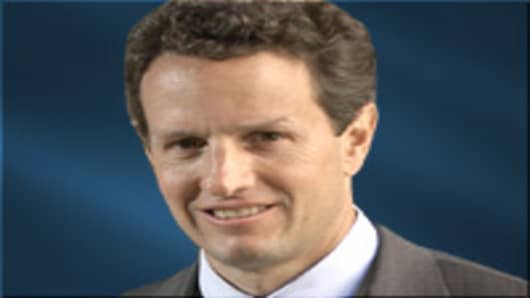
CNBC.com
Treasury Secretary Timothy Geithner
They expected firms receiving government aid to lend more to consumers. Many of them now want such firms to be required to participate in foreclosure mitigation efforts.
That Congressional support is seen as key to both the Obama administration’s forthcoming initiatives as well as those that may be needed in the future, which would include the authorization of new funding.
“There has to be some sort of sales job to the people before we go out on the limb and appropriate new money,” said a senior Congressional staffer “Any new money will be largely leveraged on how they do with this money.”
Geithner is also expected to announce plans to widen the scope of a Federal Reserve program worth up to $200 billion that seeks to encourage private investors to buy consumer-credit backed debt. The program is known as TALF, or term auction lending facility.
In a statement Monday, the Treasury said that senior officials from Treasury, the Federal Reserve Board and the Federal Deposit Insurance Corporation would hold a media briefing on the plan at 11:45 a.m. ET.
CNBC Slideshows:
- Rogues: A Gallery of Financial Crime
- Where They Go: Top 10 Relocation Cities
- The 10 Worst Jobs in America
Treasury Secretary Geither met with the Democrats at their caucus retreat in Williamsburg, Virginia Saturday and discussed foreclosure and mortgage loan issues but the details remain unknown at this time.
Geithner will testify before the Senate Banking Committee Tuesday afternoon after his speech and CNBC interview. CNBC.com will carry the event live.
Revisiting Private Capital
Word that the government’s discussions included the private capital concept first surfaced Saturday, but the idea of some kind of private sector involvement dates back to right after Paulson first proposed a government auction of assets last fall.
Rep. Jeb Hensarling (R.-Texas), who was among those in Congress pushing for it in the original TARP legislation, called the current private capital idea "feasible" because there's a lot of it "sitting on the sidelines."
Hensarling, added, however, that he still favors his insurance-based model, wherein firms participating in the asset transactions pay fees.
"In a pure vacuum, I would tend to lean toward an insurance-based model," said Hensarling, who voted against the original legislation and is a member of TARP’s Congressional Oversight Panel.
The funding issue is critical yet potentially complicated, say analysts as well as some in government.
One question is whether the administration might use a multiplier method in backing troubled assets through the ring fence guarantees, rather than a virtual dollar-for-dollar approach.
“And the question is will the Fed participate," as Rep. Brad Sherman D.-Calif.) recently put it in an interview. If so, he says, "it would clearly give the government more money to work with.”
Hensarling shares Sherman’s concerns, saying there "appears to be little check" over the Fed using its balance sheet. “Congress would have to explore statutory authority to limit that.
A senior member of the House Financial Services panel, Sherman like Hensarling, voted against the original TARP and thinks the capital injection is the best approach in using taxpayer money.
