

Wall Street's message to the Obama administration was clear Tuesday, even if the plan to save the banking industry wasn't.
Unhappy with a lack of clarity in Treasury Secretary Timothy Geithner's new financial rescue plan, investors launched a massive stock selloff, raising further questions about when confidence would be restored to the market.
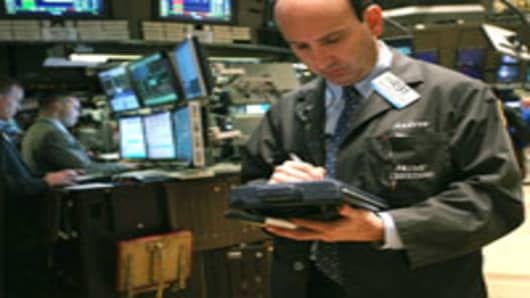
Photo: Oliver P. Quilla for CNBC.com
NYSE trader
From the squishy rhetoric about how complex the problem is to the lack of a clear time-frame for when specific weaknesses in the financial sector would be addressed, Geithner's speech did nothing to assuage the market's concerns about the nation's future.
Broadly speaking, reaction to the speech broke down into five areas:
1. There Really is No 'Change'
"I'm really underwhelmed by the plan," says David Twibell, president of wealth management for Colorado Capital Bank in Denver. "Maybe there's not much that can be done right now other than let this work itself out."
For someone who ran last year as an agent of change, President Obama's plan for banks seemed to represent more of the same. While investors were looking for some concrete moves on how distressed assets would be taken off banks' books, they instead walked away from Geithner's speech with no indication of how the assets would be priced or who would be buying them.
And as one of Wall Street's oldest maxims goes, the market hates uncertainty.
"I think we need to see exactly how this program is going to work," Twibell says. "Maybe that will give the markets a little more comfort level."
But for many, the plan offered little real guidance for how to invest going forward, save for a promise to help buoy small business.
"Zero has changed," said Michael Cohn, chief market strategist at Atlantis Asset Management in New York. "Everyone knew everything except the issue with doing something positive for small business. There's no clarity on whether they can repeal the mark-to-market (accounting rules). I don't know how they're going to do it."
2. A Far Cry From Finished
If the administration was purposely setting out a general plan with the specifics to be crafted by Wall Street, then it may have accomplished something.
CNBC.com
Treasury Secretary Timothy Geithner
With so many details left unsolved, much more work will have to be done, again creating uncertainty for investors.
"It's going to be fine-tuned many times over," predicts Quincy Krosby, chief market strategist at The Hartford. "Given the enormity of the problem it's clear that certain parts will work and certain parts won't work, but it's a start."
The market is clamoring to know how the government will be able to help banks with their toxic assets while also protecting investors and taxpayers from getting blindsided if the fixes don't work.
"The devil's going to be in the details with this stuff," Twibell says. "We're still back to the old problem of how you price that, how you structure that."
3. Treasury Bubble Still Popping
While Treasurys rallied Tuesday on a further flight to safety, government debt prices are likely to fall as more and more supply comes on line while the government finances the bank rescue.
For Investors
- Analyst: One Regional Bank Will Survive
- Stimulus May Be 'Beginning of the End': Pros
- Value Stocks: Get 'Em While They're Not Hot
The predicted trend reflects the difficulty the government will face getting a premium on bills it will be in a hurry to unload.
"The idea that you can just borrow and spend, borrow and spend, run ever-larger deficits and essentially print money with no consequences is economically naive," says Mike Larson, analyst for Weiss Research's Money & Markets newsletter. "Yet no one seems to be talking about the unintended consequences until now."'
Larson called the popping of the bond bubble months ago and sees the trend continuing as the government accumulates more and more debt.
Moreover, he said the pressure on Treasurys will cause interest rates to rise and thwart hopes of mortgage rates falling to 4.5 percent or even lower, a prediction made Mondayby Bill Gross, co-CEO of Pimco, the world's largest bond fund.
"The longer-term trend is clearly for lower prices and higher rates as a result of this supply issue," Larson says.
Money to Stay Put, But Hope Remains
4. Money Will Stay on the Sidelines
With the government unable to stem the tide of uncertainty bedeviling stocks, convincing people to buy will prove all the more difficult.
"The poor reception afforded to Mr. Geithner's speech in which little was revealed reminded investors that more turbulent times may be ahead without some sense of resolution to the health of the banks' balance sheets," Andrew Wilkinson, senior strategist at Interactive Brokers, wrote in a research note to clients.
The result is likely a stock market that will continue to be range-bound, and perhaps even retest its November lows.
"Is there a reason to deploy a lot of capital in this market? My view is we still don't know when we can get some stability in this economy, and until we do it's awfully tough to put a lot of money to work," Twibell says. "To actually go in from an investment standpoint at this juncture is tough."
Video: Geithner interview on CNBC
"You must have a functioning, normal financial system, including the securitization market," Krosby adds. "In the market economy, the financial infrastructure is the lifeline."
5. One Hope: 'Buying Begets Buying'
CNBC.com
The one bit of solace from the post-Geithner selloff Tuesday was that you could have set your watch by it.
As news spread last week that a rescue plan was in the making, the markets jumped. When the actual plan was unveiled, the market jumped back. Buy-the-rumor and sell-the-news has been one of the few constants in a stunningly volatile market, and the continuing of the trend raised hopes that the selloff Tuesday would be a one-off event.
"This is a trader's selloff, 100 percent pure and simple," Cohn says. "When (the Dow) gets back to 7,900, 7,850, buyers come back. It's nothing."
Slideshows on CNBC.com
So when selling begets selling, the one hope is that the corollary can be true and will be one catalyst helping the market get past its banks-induced doldrums. That trend is likelier to come once Wall Street has a better picture of what the White House is going to do to help.
"Buying begets buying, and that's a takeaway that has served me in good stead," Krosby says. "What gives you, the retail investors, hope is when you start to see the hedge funds go back into equities, institutional buying into equities, that pushes the market up for two or three days."
A change in the news cycle away from the negativity of the White House's fumbling of the bank rescue announcement would help make that happen.
"Professional investors would much rather see an organic move in the market, meaning it's not induced by any move from Washington but rather by a company saying revenue looks better than expected, that orders have picked up," Krosby says. "Or they begin to see the news, the macroeconomic data are stabilizing, that's what moves the market ultimately."
"Slowly but surely this thing is going to get better," Cohn adds. "It's just really slow. Until the bad news stops, you're not going to change the world's perception."


