

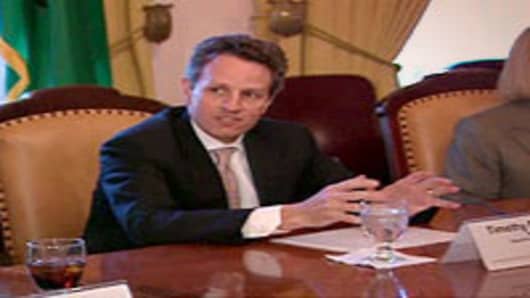
The day after President Obama’s big news conference, and on the day Treasury-man Tim Geithner unveiled his Bank Bailout Nation TARP III Plan, stock markets plunged in a vote of no-confidence, with the Dow dropping nearly 400 points.
Obama got the ball rolling by painting a dismal picture of the U.S. economy, saying recovery won’t arrive until 2010 at the earliest. He then said only big-government spending can jolt our economy back to life. He also bitterly attacked supply-siders and the Bush tax cuts, especially “tax cuts that are targeted to the wealthiest few Americans.” He added that these strategies have “only helped lead us to the crisis we face right now.”
You can say a lot of things about President George W. Bush’s big-government mistakes. But blaming the Bush tax cuts for the credit-crunched downturn is utter nonsense. It’s ideological politics at its worst. (It’s worth noting that while Obama was trashing supply-siders on Monday night, Scott Rasmussen’s latest poll showed 62 percent of U.S. voters wanting the stimulus plan to include more tax cuts and less government spending.)
Later in the news conference, Obama acknowledged how businesses that suddenly couldn’t get credit pulled back on their investment and laid off workers -- workers who then cut back on their spending. That -- along with the Fed’s stop-and-go monetary policy and a huge oil shock -- is much closer to the true cause of this recession.
This is all most strange. Obama’s attack on supply-side economics would rule out the successful Kennedy-Johnson tax cuts that spurred growth in the 1960s and the Reagan tax cuts that ignited growth in the 1980s. Even Bill Clinton cut the capital-gains tax. And George W. Bush’s tax cuts helped generate a six-year economic expansion before the oil shock and credit crunch took hold.
On Tuesday morning, stocks opened down about 75 points in the wake of Obama’s pessimism. But stocks really started to tumble when Tim Geithner stepped to the microphone. He totally bombed in his debut.
Geithner had no real plan to deal with the problem of unmarketable toxic assets on bank balance sheets. He offered no new architectural structure, no good way to remove the toxic assets, no clear pricing or funding proposals, and no meat on the bones.
According to Merriam-Webster, a “plan” is “a detailed formulation of a program of action; a method for achieving an end.” But Mr. Geithner had none of this. As a result, stocks plunged about 250 points. Prominent investment strategist Ed Yardeni described Geithner as an empty suit with an empty plan.
A week earlier, ace CNBC reporter Charlie Gasparino scooped the speech by chronicling how Wall Streeters advising the Obama administration talked Geithner out of a government-backed “bad bank” that would somehow buy toxic assets to be either worked out profitably or resold to private investors. These were the same “greedy” executives that Obama and Geithner had been trashing. So now Geithner talks vaguely about some sort of public/private investment fund that will use government capital and provide financing for private investors, who are then supposed to buy toxic assets.
Nobody on Wall Street is buying it right now. Geithner said the fund might cost $1 trillion, but there’s no “there” there. No wonder bank stocks dropped 12 percent on Tuesday.
By the way, Geithner did not offer any regulatory accounting relief, such as putting an end to the disastrous mark-to-market rule that has wrecked bank capital and is one of the root causes of the whole financial problem.
Geithner did talk about an expansion of the Fed’s Term Asset-Backed Lending Facility, or TALF, to help finance consumer-loan securitization packages that provide upwards of 40 percent of all consumer and small-business lending. This might work, but again there were no details. And the Fed has yet to start its TALF operation.
Finally, Geithner talked about a comprehensive $50 billion housing-and-mortgage modification plan. But once again, no details -- especially on the controversial issue of having bankruptcy judges determine home-loan interest rates and lending totals without bank recourse to contractual obligations.
One positive comes from a New York Times story claiming that Geithner beat back Obama’s political advisers who want to nationalize big banks, fire senior bank executives, and establish heavy government controls over bank operations. But at the end of the day the absence of any clarity or pragmatic details from Mr. Geithner left stock markets sadder and poorer for the effort.
Geithner would have been better off not giving a speech until he could put real meat on the bones. What he pulled Tuesday was a classic rookie move that will further erode the public’s trust in his capabilities. Following the controversy over his late payment of taxes, this bank-plan blunder could be another nail in his coffin.
Apparently, Tim Geithner is not yet ready for prime time.