Go Symbol Lookup
Loading...

After-Hours Buzz: Adobe, La-Z-Boy, Teva Pharmaceuticals & More

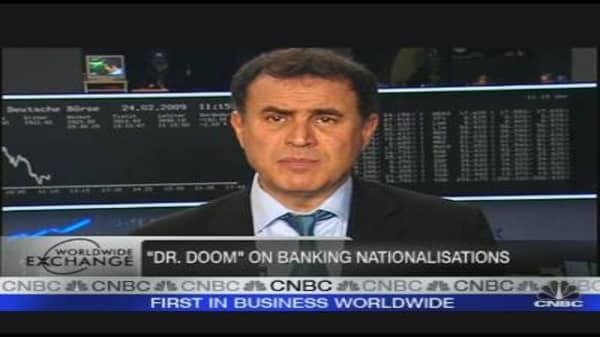
Dr. Doom: Nationalizing Banks is 'Market Friendly'

 Text Size  
Published: Tuesday, 24 Feb 2009 | 6:31 AM ET
By: CNBC.com

Nationalizing insolvent US banks is the best solution to avoid a Japan-like scenario in which 'zombie' financial institutions would eat up public resources while the US economy would teeter on the brink of depression, Nouriel Roubini, economics professor NYU and chairman at RGE Monitor told CNBC Tuesday.

Bank shares have fallen on news of abysmal losses and on fears that governments across the world would step in and wipe shareholders out, dragging global stock markets down, but temporary takeover by the state of the sick institutions will insure the survival of the system, Roubini said.

"The market friendly solution is temporary nationalization," Roubini told "Worldwide Exchange".

"Doing something surgical and radical actually may improve the market sentiment," he said. "If we don't do it, we risk ending up like Japan, that had zombie banks for a decade," he added.

CNBC.com
Credit Crisis

Furious banking consolidation that took place in the years preceding the crisis has made matters worse, as it had created banks that were too big to fail but also too big to save, according to Roubini.

The US government has already provided between $7 trillion and $9 trillion in explicit or implicit support for banks, and taxpayers would actually benefit from nationalization, as they wouldn't have to bail out shareholders as well, he said.

"If you don't nationalize them on a temporary basis the fiscal commitments will be bigger," Roubini said. "The alternative is actually a dangerous debt spiral. We risk ending up in a near depression for the US and the global economy if we don't take this radical action as necessary."

Taxpayers could even make a small profit when the nationalized banks will be privatized again, he said.

AIG, which is seeking more government cash after getting ready to report a $60 billion loss, the highest in US corporate history, is bankrupt despite the tens of billions in taxpayer funds already pumped into it, he said.

Banks Need Temporary Nationalization: Roubini
"In the long run, we don't want government ownership of the banking system. In the short run, temporary nationalization â?? cleaning up the banks and selling them back to the private sector â?? might be the right policy," Nouriel Roubini, chairman of RGE Monitor & NYU professor, said Tuesday.

"AIG is effectively insolvent. Rather than saving AIG, we've been saving the counterparties of AIG - firms like Goldman Sachs and other broker-dealers would have been gone bankrupt without that," Roubini said.

Nationalization of insolvent banks should be done in Europe as well, all major central banks' rates should be slashed to zero and quantitative easing should take place, and the housing sector crisis should be solved for a depression to be avoided, he warned.

"You need to do massive fiscal stimulus, Europe is not doing enough, Japan is not doing enough," Roubini said.

"That's the risk right now, of an L-shaped recession. This is what we are facing right now, the risk of a near depression, and unfortunately policymakers are really behind the curve. It's time to act, right now."

 Print
Nationalizing insolvent US banks is the best solution to avoid a Japan-like scenario in which 'zombie' financial institutions would eat up public resources while the US economy would teeter on the brink of depression, Nouriel Roubini, economics professor at NYU and chairman at RGE Monitor told CNBC Tuesday.
  Price   Change %Change
AFF ---
GS ---

   
Comments


More Comments


Add Comments


Your Comments (Up to 1100 characters):

Remaining characters

Your comments have not been posted yet.

Please review your submission to make sure you are comfortable with your entry.

Your Comments:


Featured

Europe Video

  • Max Knudsen, chief market strategist at ADS Securities, highlights the strong improvement in the euro over the past four weeks and the growing confidence in the currency.

  • Alberto Gallo, head of European macro credit research at RBS, prefers European high-yield bonds to U.S. bonds, over the medium-term.

  • European shares closed mixed on Tuesday, after better-than-expected economic data from Germany, and stock market gains in the U.S.