Skip navigation
GM Video Gallery
CNBC's Rick Santelli breaks down Greece's austerity package and last week's jobless claims.
CNBC's Rick Santelli criticizes today's mortgage suit settlement with some of the nation's biggest banks.
More and more Americans are going solo. The so-called singletons spend about $1.9 trillion annually. What's behind the r...
CNBC's Phil LeBeau and Robert Lutz, former General Motors vice chairman discuss the data that may show a comeback for De...
Robert Reich, fmr. Labor Secretary, and Steve Moore, Wall Street Journal sr. economic writer, debate whether the auto ba...
Watchlist Sponsored By :


Current DateTime: 06:20:45 10 Feb 2012
LinksList Documentid: 35767090

Current DateTime: 06:20:46 10 Feb 2012
LinksList Documentid: 23452764
Expiration DateTime: 2/10/2012 6:21:24 AM

MOST SHARED


Current DateTime: 06:20:48 10 Feb 2012
LinksList Documentid: 31330905
Expiration DateTime: 2/10/2012 6:21:45 AM

MOST POPULAR


Current DateTime: 06:20:49 10 Feb 2012
LinksList Documentid: 35819650
    • Road Warriors

        All the gadgets and gear a savvy frequent traveler needs to navigate the global economy.

HOT ON FACEBOOK

GM Auditors Raise the Specter of Chapter 11

By: Associated Press | 05 Mar 2009 | 12:09 PM ET
Text Size

General Motors' auditors have raised "substantial doubt" about the troubled automaker's ability to continue operations, and the company said it may have to seek bankruptcy protection if it can't execute a huge restructuring plan.

The automaker revealed the concerns Thursday in an annual report filed with the U.S. Securities and Exchange Commission.

"The corporation's recurring losses from operations, stockholders' deficit, and inability to generate sufficient cash flow to meet its obligations and sustain its operations raise substantial doubt about its ability to continue as a going concern," auditors for the accounting firm Deloitte & Touche wrote in the report.

GM [GM  Loading...      ()   ] has received $13.4 billion in federal loans as it tries to survive the worst auto sales climate in 27 years. It is seeking a total of $30 billion from the government. During the past three years it has piled up $82 billion in losses, including $30.9 billion in 2008.

Meanwhile, a White House spokeswoman said Thursday that President Barack Obama's administration is working "around the clock" to form an approach for the challenges facing General Motors and the auto industry.

"The administration is very mindful of the challenges in the auto sector," the spokeswoman said. "Our team is working around the clock to develop the most thoughtful approach possible to the situation."

The company faces a March 31 deadline to have signed agreements of concessions from debtholders and the United Auto Workers union to show the government it can become viable again. On Feb. 17 it submitted the restructuring plan to the Treasury Department that includes laying off 47,000 workers worldwide by the end of the year and closing five more U.S. factories.

GM said in its filing that its future depends on successfully executing the plan.
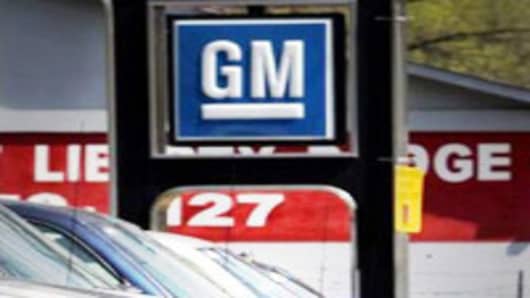
GM auto dealership with sign.

"If we fail to do so for any reason, we would not be able to continue as a going concern and could potentially be forced to seek relief through a filing under the U.S. Bankruptcy Code," the Detroit-based automaker said in the annual report.

GM, the report said, is highly dependent on auto sales volume, which dropped rapidly last year. "There is no assurance that the global automobile market will recover or that it will not suffer a significant further downturn," the company wrote.

But Harlan Platt, a professor at Northeastern University in Boston who teaches about corporate turnarounds, said the auditors' concerns don't mean GM is headed for a bankruptcy filing. The auditors, he said, are merely stating what the world has known for months.

"A company which has borrowed $13.4 billion and has asked for billions more around the world is obviously in trouble. So this is anticipated," he said.

Platt said the union concessions and debt restructuring laid out in the government loan terms, plus GM's own restructuring steps that include shedding unprofitable brands, will make the company healthy again once auto sales recover from current low levels.

"I think the government has forced the hands of everybody," Platt said. "In 18 months to 24 months, I anticipate they will be profitable, in the black. A mean and lean competitor that will be world-class."

U.S. auto sales in February dropped to the lowest level since December 1981. Last year, automakers sold 13.2 million vehicles in the U.S., about 3 million less than the 16.1 million sold in 2007. Analysts and auto company executives are predicting sales of just over 10 million this year.

GM has said it wants to avoid bankruptcy protection because it would scare off customers. Car buyers, the company has said, would be reluctant to buy from an automaker in Chapter 11 due to fears that it wouldn't be around long enough to honor warranties or make replacement parts.

GM, in its viability plan submitted to the Treasury last month, said it explored three bankruptcy scenarios, all of which would cost the government more than $40 billion.

Chief Operating Officer Fritz Henderson said at the time that the government would be the only place the company could get financing for a Chapter 11 reorganization, because the credit markets are frozen. The worst-case bankruptcy scenario would cost the government $100 billion, Henderson said, because revenue would severely drop due to a lack of sales.

He said there is not a lot of research about whether people would buy cars from an automaker in bankruptcy protection, but "that which is there suggests that sales fall off a cliff."

GM warned last month that its auditors may raise the "going concern" doubts, and industry analysts said auditors' statements may trigger clauses in some of GM's loans, placing them in default.

But the company said in its filing that it has received waivers of the clauses for its $4.5 billion secured revolving credit facility, a $1.5 billion term loan and a $125 million secured credit facility.

"Consequently, we are not in default of our covenants," the report said. "If we conclude that there is substantial doubt about our ability to continue as a going concern for the year ending Dec. 31, 2009, we will have to seek similar amendments or waivers at that time."

GM spokeswoman Julie Gibson said there is no clause in the terms of the government loans that places them in default if the auditors raise doubts about GM's ability to keep operating.

"That was not a condition of the loan. It's not in the agreement," she said.

© 2011 The Associated Press. All rights reserved. This material may not be published, broadcast, rewritten or redistributed.
Tools:
Add This share icon

CNBC HIGHLIGHTS

  • How much did the Facebook founder pay for other shareholders' voting rights? Not a heck of a lot, says the NY Times.
  • Here’s a look at Westminster Kennel Club’s most successful breeds and how much they cost.
  • The oft-mentioned jobs "miracle" in European economic powerhouse Germany has a dark side that's largely escaped comment.
  • Job Interview
  • When looking for that next career move,  workers need to look at the differences between a start-up and a public firm.
  • After enduring the recession, many Baby Boomers say money isn’t the most important thing they hope to leave to their kids.
  • The ‘Fast Money’ traders weigh in on fashion related stocks from apparel to footwear to accessories and fragrances.


Current DateTime: 05:18:53 10 Feb 2012
LinksList Documentid: 29778428

Current DateTime: 11:56:47 09 Feb 2012
LinksList Documentid: 29779196

Current DateTime: 04:07:58 10 Feb 2012
LinksList Documentid: 29779197

Current DateTime: 10:56:22 09 Feb 2012
LinksList Documentid: 29779199
CNBCCNBC
About CNBC  |  Site Map  |  Video Reprints   |  Advertise  |  Help  |  Contact
Privacy Policy  |     |  Terms of Service  |  Independent Programming Report
  Data is a real-time snapshot  *Data is delayed at least 15 minutes
Global Business and Financial News, Stock Quotes, and Market Data and Analysis

© 2012 CNBC LLC.  All Rights Reserved.
A Division of NBCUniversal
Thomson ReutersThomson Reuters