

President Barack Obama's top economic adviser told CNBC that the Obama administration will be "as creative as we can" to get back at least some of the $165 million in bonuses that AIG paid to executives after the insurance giant got billions in federal bailout money.
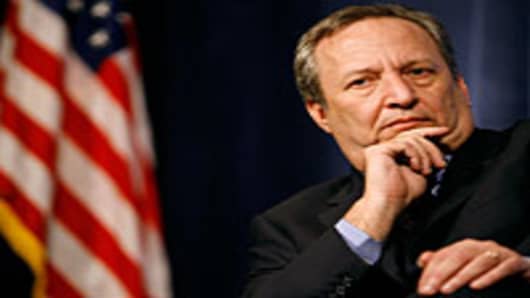
Getty Images
Lawrence Summers, Director of President Barack Obama's National Economic Council
"What happened at AIG was outrageous," National Economic Council Director Lawrence Summers said in a live interview. "The way the company was operated, the way it was regulated, the contracts that were let, the payments of these bonuses, acceptance of these bonuses without shame, it was outrageous.
"What the President's made clear, what our Administration's doing," he added, "is being as creative as we can with a group of lawyers working on this problem, using recoupment authority, employing other means to do everything we can within the law to address this situation. We're not going to just abrogate the law, we're not going to abrogate contracts, we're not going to do things that would put the whole economy at risk."
Summers also confirmed earlier reports that the administration planned to create a "systemic risk regulator" to oversee banking and market problems that could threaten the economy.
"We are going to be pushing very hard for a so-called 'resolution regime,'" he said. "A system that will enable the government to intervene when a big financial company gets in trouble in the future, like the FDIC does with banks, and take the necessary steps to make the thing work, to make the people who should bear the responsibility actually bear the responsibility. That's the approach we're going to take."
The U.S. Treasury is expected to propose a "systemic risk regulator," probably the Federal Reserve, within the coming days. The Treasury also is expected to propose tougher capital standards for banks and better derivative market clearing and settlement mechanisms.
Proposals for better consumer protection and more aggressive oversight of hedge funds and credit rating agencies are also anticipated, as are new ways to unwind big companies whose outright failure could do wide-scale economic damage.
The Treasury was unlikely to make proposals on all these topics in one legislative package, congressional aides said.
In the interview, Summers also defended the administration's economic policies even though the stock market has plunged 9% since President Obama was inaugurated.
"They're policies not set with the objective of moving the market for a period of weeks," he said. "They're set with the objective of strengthening the fundamentals of the economy...That approach, taken successfully, will ultimately be the best approach for the markets as well.
"We've learned, in the few months since President Obama took office, that the damage to the economy, globally, the seriousness of the situation we've inherited is much greater than almost anybody had imagined," he added.
Summers also dismissed criticism that Obama's planned tax increases on the wealthiest Americans would hurt the economic recovery.
"Let's be very clear," he said. "There are no—no—tax increases this year. There are no—no— tax increases next year. In fact, there are substantial tax cuts to the people who are most likely to spend and push the economy forward this year."
On the mounting debt facing the US government, Summers said: "There's no alternative. If we don't fix this economy, if we don't get a jolt to this economy that permits recovery, and we get into a situation of continuing, grating deflation, like the Japanese did, like has happened at other times."