

The Fed's surprise decision to buy billions of dollars of government debt rippled across financial markets on Thursday—with gold, oil and other commodities getting a big boost from a weaker dollar while stocks drifted lower amid uncertainty about the long-term impact.
AP
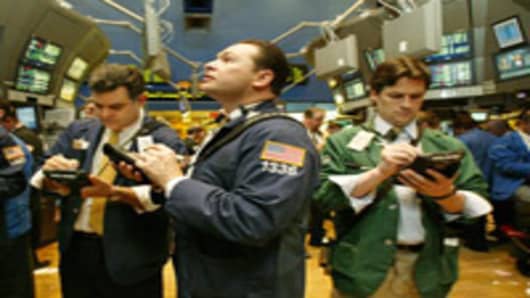
NYSE Traders
Treasurys also benefited, as did mortgage rates, though there were questions over how long that phenomenon would continue.
The overall view of the the Fed's plan to buy up to $300 billion of long-term government bondsand $750 billion in additional mortgage-backed securities: While it may help ease the credit crisis for now, the longer-term impact is giving some investors pause.
"It's short-term positive," said Peter Tanous, president and director of Lynx Investment Advisory in Washington, D.C. "If you look a little bit down the road it potentially exacerbates the inflationary pressures we're going to be having somewhere in the future, because essentially the Fed is printing money and putting a lot of money out there to buy the paper that it's going to buy."
Here's a rundown of how the Fed move is affecting different markets.
Stocks
Major indexes got a modest boost Wednesday but then meandered Thursday before ceding some of their recent gains.
Bank of America and others in the sector retraced, while home builders, particularly Hovnanian , were mostly positive.
The upshot seemed to be a reluctance from portfolio managers to make big changes at least in terms of their equity allocations.
"One can be a little more optimistic about stocks," Tanous said. "At least they stopped freefalling—that's a good sign. It does appear that we're getting a handle on some of these problems."
Yet Tanous said that perhaps the best investment anyone can make now is to go out and buy a house. The reason: mortgage rates may take a quick drop, but rates overall could head higher in the coming months.
"If (the Fed move) doesn't point to higher interest rates (eventually), I don't know what does," he said. "We are going to be out borrowing a lot of money in the world markets and I don't think anybody—when they see that historic volume—believes that can be done at lower interest rates."
Interest Rates
Indeed, one of the most pronounced moves in the financial markets came from mortgage rates, which fell to a jaw-dropping 4.79 percent for a 30-year fixed,according to the Zillow Mortgage Rate Monitor.
In addition to its move to buy $300 billion in long-term Treasurys, the Fed said it would purchase an additional $750 billion of agency mortgage-backed securities, bringing total purchases to up to $1.25 trillion this year, as well as double its potential purchases of agency debt securities to up to $200 billion.
Aside from the question of what the long-term prognosis is for mortgage rates—most expect the near-term trend to be lower—there were questions about whether another drop would do anything to spur lending and home purchases.
"The financial system has been badly mauled and one wonders what desire banks have to return to the outright amount and type of lending practices that they did just a few years ago," Andrew Wilkinson, senior market analyst for Interactive Brokers, said in a research note. "Without a shadow of a doubt housing values have further to fall and that will weigh on spending and construction activity going forward."
Gold
Among the most dramatic move off the Fed's decision came from gold, which picked up close to $60 an ounce at one point before easing.
Gold generally moves in the opposite direction from the dollar, which saw its biggest one-day tumble since 1985 immediately after the Fed's decision and added to its losses Thursday. Gold's higher was unexpected to some analysts who saw the metal's price falling before the Fed move.
"We had argued that gold should retract towards the $850 area on physical dishoarding, but now the goalposts have been moved courtesy of the Fed. It is considerably less clear whether such a pullback is likely," JPMorgan said in a research note. "It is very clear that investors are jumping back into gold and this flow, which has until recently been overwhelmed by dishoarding, may now get the upper hand."
The most popular exchange-traded fund for gold, the SPDR Gold Trust , was gaining Thursday as well.
But gold was hardly alone in a surge for metals.
Copper jumped more than 6 percent, while nickel, lead and zinc also posted sharp moves to the upside.
Dollar Down, But Oil Gushes
Dollar
The dollar slid precipitously, sparked by more concerns over a flood of US borrowing around the world.
The move was most responsible for the higher trend in commodities, which benefit because they are sold in dollars.
In addition to the core issue of the Fed expanding its balance sheet even further, currency investors were spooked on a general feeling that policymakers were going to seek to bolster the economy even if it came at the dollar's expense.
"The dollar liquidation was broad-sided." Wilkinson wrote. "It appears that as much as the case for zero interest rates appealed to investors through an outward signal of proactivity from a central bank, quantitative easing has an unwanted stigma attached that sours the palatability of holding onto associated currencies. As investors realize this they are quick to dash for the exits."
The dollar index, a gauge of its performance against a basket of six major currencies, slipped 1.4 percent to 82.994 after a 3 percent slide on Wednesday—its biggest one-day drop in about of a century, according to Reuters data. It earlier slipped to 82.880, the lowest since early January.
"Investors were already selling the dollar before the Fed, but the announcement seemed to have given a green light for more euro buying (and dollar selling)," said Marc Chandler, global head of forex strategy at Brown Brothers Harriman in New York. "This correction in euro-dollar seem to be moving towards the $1.40 level. I wouldn't be surprised if we hit that marksoon."
Oil
Like the others in the commodities field oil also fed off the dollar's weakness, breaking out of a two-month trading range.
Crude prices eclipsed $50, sending a feeling through the trading pits that there was still more room to the upside as the dollar was likely to continue to slide.
"We have for the time being a return to risk appetite in the oil market and it's based on the Fed's announcement yesterday," said analyst Mike Wittner of Societe Generale. "That's having a positive impact on sentiment."
Investor Advice on CNBC.com
- Video: Bull vs. Bear
- Will Rally Bravado Last?
- Global Pros Worry US is 'Bankrupt'
The $50-mark has been the top of oil's trading range so far in 2009. A close above that level is needed to increase the prospect of a further rally, said analysts who use past price moves to predict future direction.
Treasurys
Bond prices rose sharply after the Fed announcement, though the after-effects were somewhat muted in Thursday trading as yields continued to tumble.
The 30-year bond saw little benefit as the Fed said it would focus most of its buying on two-year and 10-year notes.
Still, the benchmark yield promptly shed nearly 50 basis points Wednesday, providing plenty of upside effect for investors.
"We are still feeling the after-effects of that," said Kim Rupert, managing director of global fixed income analysis at Action Economics LLC in San Francisco, adding "Treasurys still have a solid bid at these new, higher (price) levels."
--Reuters contributed to this report
