

The bear may finally be beaten.
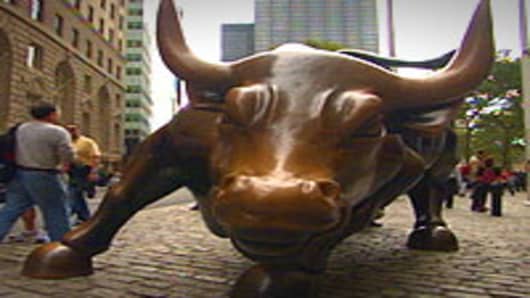
As investors digested this week's flurry of good news—or at least better-than-bad news—talk grew that the long slog through the debilitating bear market could be over.
"The world is not going to zero," Nadav Baum, managing director of investments at BPU Investment Management in Pittsburgh, says of investor sentiment these days. "Things seem to be getting better. Deals are getting done and people have more swagger in their step. So maybe we are coming out of something."
The markets kicked off the second quarter in the face of a series of positive developments that sent stocks soaring in Thursday trade.
Consider:
- Mark-to-market accounting rules, the long-despised bogeyman keeping banks' toxic assets from being sold, were altered substantially, kickstarting the Wall Street rally.
- The Group of 20 world economic summityielded a $20 billion pledge to resuscitate the global economy.
- Auto sales numbers, while still dauntingly low, beat expectations and analysts foresee more lending to get the sales pace accelerated.
Add some stabilizing in housing numbers and improvement in investor sentiment to the mix and you had both technicians and analysts of fundamentals cheering on the surge that has welcomed in the second quarter.
Market pros consider this a strong buying opportunity, with banks, materials and technology the main sectors to pull the market out of its malaise.
"This is a really big moment," says Uri Landesman, head of global growth strategies at ING Investment Management in New York. "The real question in my mind is if we are dragging the floor up."
The Standard & Poor's 500 put in an intraday floor of 666 on March 6, and Landesman now sees the market gradually setting higher lows, which he says is a building process towards a bull market.
On the other end, traders were watching 840 as a possible new resistance level that the market hit but did not exceed Thursday. Breaking through that and then past 845 would be seen also as strongly bullish trends.
"If they go through that I think they'll catch a lot of shorts flat-footed and it will overtrade on itself," Art Cashin, director of floor operations at UBS, told CNBC (see video). "But I think the bottoming process looks very healthy here and we'll see if they do pull back to retest anything."
Whether the latest effort at recovery takes a perfect "V" shape is up for debate.
Unemployment appears to be posing the strongest headwind to the market now, and first-quarter earnings also will pose a significant challenge to investor sentiment.
The changes to mark-to-market accounting left some uncertainty as to what impact they will have on the earnings reports that will kick off next week, with most expecting the greatest impact to come in the second quarter numbers released over the summer.
"We're going to go through a very rough earnings period now," Landesman says. "I don't know one month from now if we're going to be higher than we are today. But I think once you get first-quarter earnings out of the way we could be poised for a pretty good move."
The accounting rules changes received most of the credit for Thursday's rally.
Banks have been hampered from lending because the distressed assets were impairing capital ratios, but the new rules are directed at that problem and were widely expected to goose lending across the financial industry.
"This is kind of like the gum that's been holding up the dam," says Gary Hager, president of Integrated Wealth Management in Edison, N.J. "When they peel this rule back and say that the toxic or Level 3 assets can be moved back to either off the balance sheet or quoted at a reasonable valuation to their timeline ... all hell is going to break loose on the upside."
Using the Fibonacci numbers sequence to predict stock movements, Hager says 8,330 and 9,313 will be critical resistance levels for the Dow, with 10,220 seen as a breakthrough that will firmly establish the potential to challenge the historic high of 14,164 on Oct. 9, 2007.
In the meantime, though, he says policy makers are on the right track to getting the market back to health. Thwarting short-sellers by reinstituting a rule that prevents shorting stocks unless it is after an up move would complete the picture, Hager says.
"If they could add one thing more to this cake they're baking, it would be the uptick rule," he says. "If they come off that uptick rule it's off to the races."
If there is any other wariness over the rally it stems from inflationary concerns--that in priming the pump with trillions of printed money the government may overshoot and create more problems down the line.
"I dislike tremendously the long-term foundation upon which it will have been built, but you have to be the most committed dogmatic ideologue to believe that the end of the American empire is near," Hanlon says.
As for leadership areas, some suspect banks will have to lead the way out, yet others look to materials and infrastructure to pave the way.
"You have governments around the world focused on infrastructure plans," Hanlon says. "It just stands to reason that real assets would be the beneficiary."
Science and related technology stocks might be leadership areas as well, says Hager, who particularly likes Genentech , Amgen and Gilead in the group.
Slideshows on CNBC.com
On the banking side, which Hager says definitely will be a leadership group, he prefers Bank of America and Wells Fargo.
"The deck's being cleared. All the companies have taken all this on the balance sheet in valuation," he says. "This is an incredibly potent cocktail being built."
The sentiment that banks will benefit most from the mark-to-market changes and will lead the market back to bull status is gaining traction.
"This changes everything. It not only gives them immediate balance sheet relief, it gives them immediate incentive to lend," Hanlon says. "If you look at how much liquidity has been built into the system you might have to conclude that the market will be drinking from a fire hydrant for a while."
