

Big oil companies are betting that algae—that's right, pond scum—is a viable source of renewable energy, and they're joining academics, start-ups and the U.S. government in committing resources to studying its potential.

Photo by Fred LaSenna
"Oil companies got started in algae research and development and investment in 2007, as they realized that first generation biofuels—grain ethanol and palm or soy biodiesel—would not reach large production quantities cost-effectively," says Brian Fan, senior director of research at the Cleantech Group, a market research firm.
Unlike first generation biofuels, algae has the potential to produce thousands of gallons of oil per acre and does not compete with agriculture for cropland. And because algae are photosynthetic organisms, they feed on carbon dioxide, thus removing some C02 from the air.
Put together, it's an attractive combination.
Here's a snapshot at where the major companies stand.
Chevron
"We’re looking at developing advanced biofuels that don’t materially impact the food or feed supplies, and algae is one that we think holds a tremendous amount of promise," says Jeffrey Jacobs, vice president of Chevron Technology Ventures' biofuels and hydrogen business unit.
In October 2007, Chevron announced a collaborative research and development agreement with the U.S. Department of Energy's National Renewable Laboratory (NREL) to study and advance technology to produce liquid transportation fuels using algae. Chevron and NREL scientists are trying to identify and develop algae strains that can be economically harvested and processed into finished transportation fuels.
“We’re reasonably confident, given the technology that exists today, that we can convert (algae) oils and lipids into transportation products that are compatible not only with existing infrastructure, but with existing vehicles on the road today,” added Jacobs.
In addition to its work with NREL, Chevron is also a direct investor in Solazyme, a well-funded start-up that uses algae to create biodiesel. In January 2008, Solazyme and Chevron announced a biodiesel feedstock development and testing agreement.
Shell
Shell announced a joint venture with biofuel company HR BioPetroleum in 2007 called Cellana. Cellana investigates different strains of algae, cultivates them in ponds and seeks to process the algae into oil that can be used as a raw material for fuel.
“In our view, algae holds much promise for the future because they grow very rapidly, are rich in oil and can be cultivated in seawater, minimizing the use of fertile land and fresh water,” says Luis Scoffone, vice president of biofuels at Shell.
Scoffone says the Cellana venture is going well but noted it is still in its infancy.
“We’ve done more algae strain screening than planned, cultivation has started and lab buildings are in place,” he says. “However, it is still early days and we have yet to produce oil from the facility.”
ConocoPhillips
In July 2008, ConocoPhillips signed a $5 million, multi-year research agreement with the Colorado Center for Biorefining and Biofuels (C2B2), a joint venture of the University of Colorado at Boulder, Colorado State, Colorado School of Mines and NREL, to develop new ways to convert biomass into low-carbon transportation fuels. The first project involves converting algae into renewable fuel.
"Algae is one of a group of potential feedstocks that ConocoPhillips is investigating as a part of a larger biofuels program,” says Nancy Turner, a spokeswoman for ConocoPhillips. “Algae biomass is an attractive feedstock because it does not compete with the food supply and has the potential of being produced efficiently, compared to conventional feedstocks.”
BP
In February 2007, BP joined forces with University of California, Berkeley, the Lawrence Berkeley National Laboratory (LBNL) and the University of Illinois at Urbana-Champaign to research and develop technology to produce biofuels, including those made from algae. The collaboration formed the Energy Biosciences Institute (EBI), and BP will support the Institute with a ten-year, $500-million grant.
ExxonMobil
In a speech at Stanford University in February, ExxonMobil CEO Rex Tillerson said his company was bypassing first-generation biofuels—such as corn-based ethanol —and researching advanced biofuels.
“Our initial analysis suggests that with much further R&D, it may be possible that new algae and biomass conversion technologies could play a role in transportation fuel supplies, while reducing greenhouse-gas and land-use impacts as compared to first-generation biofuels,” explained Tillerson.
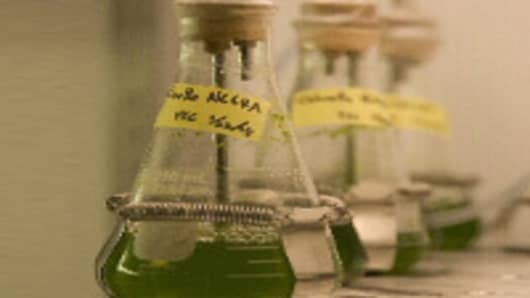
Photo: Chevron
For algae biofuel to become commercialized, multiple partners will have to be involved, says those familiar with biofuel production, with major energy companies leading the effort.
"In 2007 the U.S. consumed 140 billion gallons of gasoline, so when you talk about scale, getting algae oil to matter means producing billions of gallons,” says Cleantech's Fan. “The only people on the planet who have the infrastructure, the experience and the balance sheets to break the market with billions of gallons of liquid biofuels are the major oil companies and the national oil companies.”
Despite the promise of algal oil, experts agree that it is still a way off from hitting the market; estimates vary from five to 20 years.
“We still need several fundamental scientific breakthroughs to get algae to mass-produce large amounts of oil cost-effectively,” says Fan. “This will take many years of research and testing."