

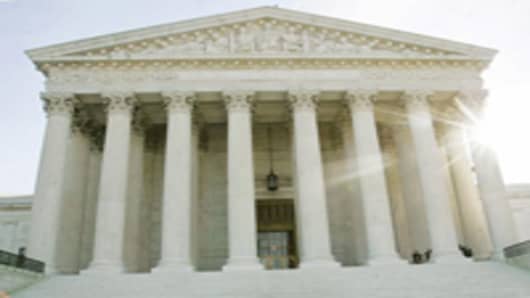
The Supreme Court said Monday it would decide a constitutional challenge to the 2002 law that created a national board to oversee U.S. public company auditors.
AP
The justices agreed to review a ruling by a U.S. appeals court that upheld the Sarbanes-Oxley Act of 2002, which set up the private sector Public Company Accounting Oversight Board.
A conservative activist group called the Free Enterprise Fund and a small Nevada accounting firm appealed to the Supreme Court in arguing that the law violated constitutional requirements on separation of powers because it failed to allow adequate control of the board by the U.S. president.
The board polices the U.S. audit industry, including the Big Four firms that review the books of major corporations: Ernst & Young LLP, KPMG, PricewaterhouseCoopers and Deloitte & Touche LLP.
A board spokeswoman said: "We remain confident that the PCAOB's structure is constitutional and look forward to our opportunity to demonstrate that in the Supreme Court." The Sarbanes-Oxley corporate reform law created the board in response to auditing scandals early in the decade that involved Enron Corp and other companies.
The board's members are appointed by the Securities and Exchange Commission, with consultation from the Federal Reserve Board and the Treasury Department. The SEC's five commissioners are appointed by the White House with Senate consent.
Competitive Enterprise Institute, a public interest group representing Free Enterprise, said the PCAOB imposes massive regulatory burdens on public companies.
"Yet the regulators are unaccountable to the people, the president or the senate," said Sam Kazman, general counsel at CEI, a nonprofit free enterprise group.
The lawsuit, filed in 2006, argued that the law unconstitutionally stripped the president of all power to appoint or remove board members, or to supervise or control their activities.
A federal judge and then the appeals court rejected the challenge. The appeals court ruled that past Supreme Court decisions on the president's relationship with administrative agencies meant the board's set-up must be upheld.
Lawyers for the Justice Department, the SEC and the board all urged the Supreme Court to reject the appeal.
But the Supreme Court said it would hear arguments in the case and issue a ruling during its upcoming term that begins in October.
An SEC spokesman said the agency agreed with the Court of Appeals ruling.
"We believe that Congress acted properly and within its constitutional authority when it established the accounting oversight board to protect investors," SEC spokesman John Nester said. "We look forward to presenting our arguments to the Supreme Court."